Spray foam fundamentals
What Is Spray Foam Insulation? Types, Uses, and Limits
Spray polyurethane foam is a family of reacting products that expand and cure in place. The useful question is not simply whether foam insulates, but which product system is being used, where its control layer belongs, and whether the installation conditions can support it.
On this page
The short answer
Spray foam can combine insulation and air control, but the phrase covers small one-component sealants, low-pressure two-component kits, and professional high-pressure systems. Their approved uses, exposure controls, yield, vapor behavior, and installation limits are not interchangeable.
This answer changes when…
- The product is one-component, low-pressure two-component, or high-pressure professional SPF
- The work is a visible gap, an open cavity, a roofline, or a concealed space
- The substrate is dry, clean, and within the exact product temperature limits
- The assembly needs to dry inward, outward, or in both directions
- The cured foam will be exposed, covered, or part of a tested fire-protection assembly
Dotted terms have plain-language definitions. Browse the glossary ↗
Start with the product family
“Spray foam” is used for several products that behave differently in the field:
| Product family | Typical role | What not to assume |
|---|---|---|
| One-component sealant | Beads around penetrations and small gaps | That it is whole-cavity insulation |
| One-component surface foam | Open, accessible surface coverage where specifically approved | That it performs like professional closed-cell SPF |
| Low-pressure two-component kit | Small-to-medium open applications with chemical mixing at the gun | That advertised yield equals usable field yield |
| High-pressure two-component SPF | Professional building-envelope work | That a consumer can reproduce the system safely |
The table separates useful shopping formats. EPA’s product classification uses three broader groups: one-component, low-pressure two-component, and high-pressure two-component products. One-component surface foam remains part of the first group and requires its own documented intended use.
Open-cell and closed-cell describe foam structure, but those labels do not replace the exact technical data sheet, safety data sheet, evaluation report, installed thickness, or local requirements.
What spray foam can do
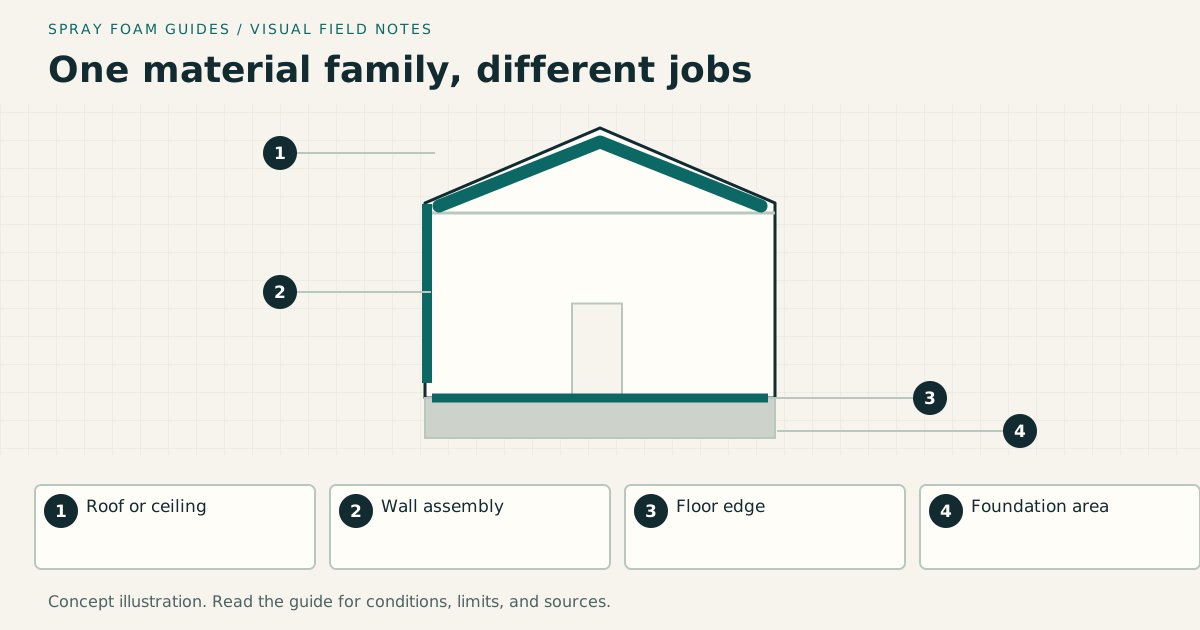
Installed as a continuous layer, an appropriate spray foam system may resist heat flow and limit air leakage. Depending on the exact product and thickness, it may also affect vapor movement. Those functions must be placed deliberately in the building assembly.
Foam does not manage bulk rain, repair a plumbing leak, remediate mold, design ventilation, or prove code compliance by itself. Tightening an enclosure can also change pressure relationships and indoor-air needs. The DOE Building America air-sealing checklist calls for water, structural, pest, ventilation, radon, and combustion-safety considerations around air-sealing work.
Why installation conditions matter
Two identical packages can produce different outcomes when tank or can temperature, substrate temperature, moisture, mixing, lift thickness, nozzle condition, or spray technique changes. That is why a listing claim is not the same thing as installed performance.
Before buying, record:
- The exact assembly and surface area.
- The job’s water and moisture history.
- The required thermal and air-control location.
- The exact product family and approved substrates.
- Manufacturer limits for conditioning, application, cure, ventilation, and re-entry.
- Fire covering and local inspection requirements.
Where foam fits in a home improvement project
Consider three homeowners with a cold room. One has an accessible gap at a plumbing penetration. Another has a wall with intact insulation but a leaky window connection. The third has a room over a garage with several disconnected air-control details. All three might search for spray foam insulation, but they need different repairs. Covering the largest visible surface could leave the actual problem untouched.
Describe the complaint before specifying a material: a draft in windy weather, a cold floor, an overheated upstairs room, or a recurring moisture stain. Record when it happens and what has changed. An energy assessment or enclosure inspection can then connect the symptom to an assembly. Insulation, air sealing, duct repair, shading, or water-management work may each have a role.
For an existing vented attic, compare work at the ceiling plane with a roofline conversion. The first keeps the established boundary and may combine selected sealants with fibrous insulation. The second changes the volume inside the enclosure and needs a coordinated roof, moisture, and mechanical plan. Those are different scopes even if both proposals say “insulate the attic.”
Read a proposal as a finished assembly
A useful proposal names the surfaces that will receive foam and the details that connect them. “Insulate basement” leaves too much uncertain. Does it mean the foundation walls, the rim, the ceiling above, or all three? How will the wall connect to the slab and floor framing? What remains accessible for maintenance?
Ask for a marked drawing and a description of the completed layers. The contract should identify the exact material, the required installed thickness, how that thickness will be checked, and what finish or protective covering follows. Keep the explanation understandable enough that another trade can recognize the boundary later.
The document guide separates hazard information from performance and approval. It is particularly useful when a proposal supplies only a product brochure. A polished brochure cannot resolve an omitted coating, an uncertain substrate, or an unplanned return to an occupied home.
What an owner can reasonably verify
Before work, save photographs of exposed framing, penetrations, stains, and service routes. Ask the contractor which areas need inspection before they become inaccessible. After the restricted-entry period has ended under the written job plan, compare the completed work with the drawing and the contractor’s thickness record. Keep questions about suspect texture or odor separate from ordinary punch-list items.
Do not judge an installation by smoothness alone. A neatly trimmed face can conceal a thin area, while a less even surface may still satisfy a documented specification. The relevant evidence is location, depth, continuity, substrate acceptance, and the completed covering. A site inspection and measurements answer questions that photographs cannot.
Keep these records with the home’s maintenance documents. Future roofers, plumbers, electricians, and buyers may need to know where adhered foam is present. A later leak or service change is easier to investigate when the original condition and product identity are available.
Questions people ask first
Does spray foam replace ventilation?
No. Air leakage through random cracks and planned outdoor-air ventilation serve different purposes. After extensive air sealing, have the ventilation and combustion implications reviewed. The objective is a controlled enclosure with an appropriate ventilation strategy, rather than dependence on accidental leaks.
Does foam make a roof or wall waterproof?
An insulation claim does not establish a roofing or waterproofing system. Keep the roof covering, flashing, drainage plane, and foundation water management in the design. If the proposed benefit is “it will stop the leak from inside,” investigate and repair the water source before approving insulation.
Choose the next useful step
If you are still identifying the job, use the Project Advisor. If you are reviewing a contractor’s proposal, start with comparing the written scope. If foam is already installed and something seems wrong, use Troubleshoot before planning additional material.
For a narrow opening around a frame, use the window and door sealing guide to separate air leakage from drainage and operation problems. For a larger contracted job, agree on the inspection and handover records before work starts, while concealed details can still be checked.
Research & references
Sources used for this guide
- Spray Polyurethane Foam Insulation: How to Use It More Safely (archived)U.S. Environmental Protection Agency · government guidance · United States · accessed 2026-09-05
- Ventilation Guidance for Spray Polyurethane Foam Application (archived)U.S. Environmental Protection Agency · government guidance · United States · accessed 2026-09-05
- Isocyanates: OverviewOccupational Safety and Health Administration · government guidance · United States workplaces · accessed 2026-09-05
- Home Air Sealing ChecklistDOE Building America Solution Center · government guidance · United States · accessed 2026-09-05
- Spray Polyurethane Foam Product Types (archived)U.S. Environmental Protection Agency · government guidance · United States; archived product-family and exposure overview · accessed 2026-09-06
A citation supports a specific statement, not every possible assembly or local code interpretation.