Choose the product system
One-Component vs Two-Component Spray Foam
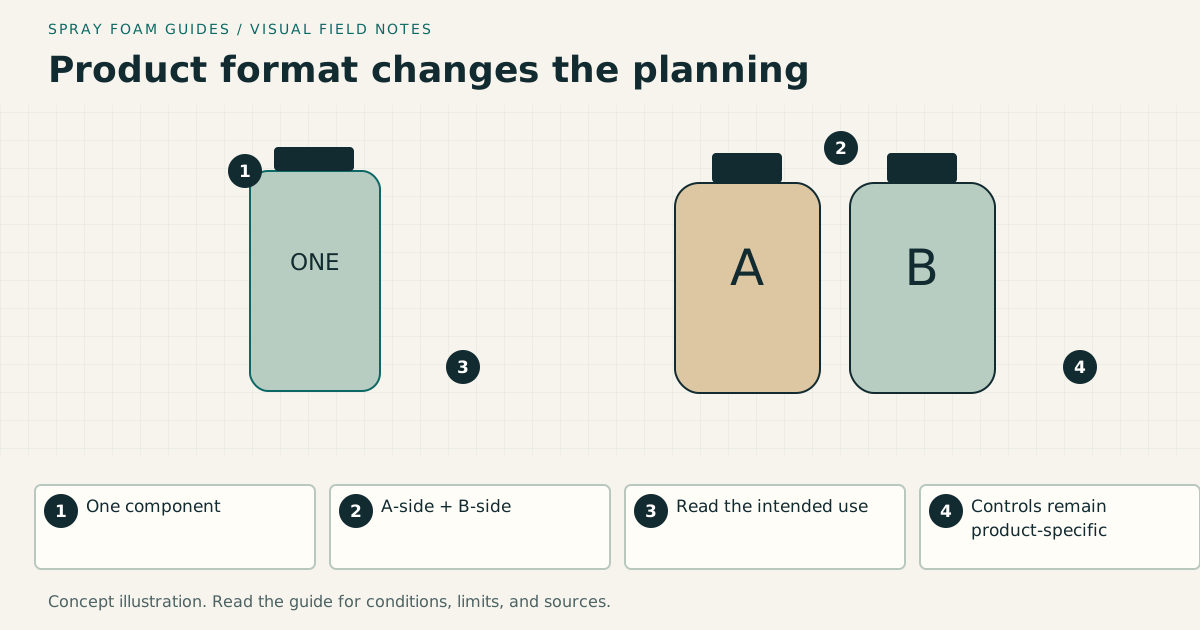
One-component foam cures with available moisture and is commonly used for joints, penetrations, or specifically approved open-surface applications. Two-component systems mix reactive chemicals during application and carry different process, ventilation, and quality-control demands.
On this page
The short answer
Choose by job scale, geometry, visibility, required performance, and exposure controls. A one-component can is not a miniature professional SPF rig, and a portable two-component kit is not automatically appropriate because the area is technically within its claimed yield.
This answer changes when…
- The opening is a narrow joint, a broad open surface, or a concealed cavity
- The job requires a bead, a continuous layer, or a controlled installed thickness
- The work area can be isolated, ventilated, and kept clear of occupants and pets
- The installer can control temperature, mixing, lift thickness, and quality checks
Dotted terms have plain-language definitions. Browse the glossary ↗
Four systems often share one name
The market commonly groups together products with very different roles:
- One-component foam gap sealant: usually dispensed through a straw or gun as a bead.
- One-component surface foam: dispensed over an open surface where the exact product permits it.
- Low-pressure two-component foam kit: two containers feed a mixing gun and disposable nozzle.
- High-pressure two-component SPF: proportioned, heated professional equipment supplies a trained crew.
The chemistry and application process affect exposure, quality control, yield, and the type of failure an installer can create.
EPA’s product-type overview distinguishes one-component products from low- and high-pressure two-component systems. It also explains that a one-component product continues reacting with available moisture after dispensing. Cell structure and package size do not change that distinction. Here, “surface foam” identifies an application format within one-component products, not an additional chemistry category.
Match the geometry
A window or door perimeter needs a product that limits pressure on the frame. A plumbing penetration may need backing plus a compatible sealant. An open rim joist bay may permit visible inspection during application. A closed wall cavity can hide expansion, wiring, obstructions, and moisture; injecting a generic expanding foam into it is not a reasonable default.
The fact that a package dispenses foam does not make the formats substitutable.
More expansion does not settle the insulation question
Gap filler is a use category, not a synonym for poor foam. A suitable sealant can do valuable work at a permitted joint. The mistake is treating its visible expansion as evidence that it can replace a specified insulation layer across a wall or roof.
PNNL’s window and door guidance addresses sealant selection and the geometry of rough-opening air sealing. Its installation-quality guidance considers gaps, voids and contact in the thermal layer. These are different checks, even when foam is involved in both jobs.
| What a demonstration shows | What remains to be established |
|---|---|
| A bead grows after dispensing | Whether that product is intended for the proposed joint or surface |
| Foam looks thick at its highest points | Whether the specified layer is continuous at the required thickness |
| A finished area looks tidy | Product identity, relevant performance evidence and installation acceptance |
| The owner is happy on day one | What, if anything, was observed after a meaningful follow-up period |
A fan nozzle does not by itself establish surface-insulation suitability. Nor does a can format rule that suitability out. Read the exact instructions instead of deciding from the spray pattern, the foam’s color or the size of its expansion.
There is no sound basis here for saying an unfamiliar product will fail after two or three years. Long-term statements need relevant follow-up records. A first-day video establishes neither durability nor inevitable failure. For an existing concern, record what is visible without probing or disturbing suspect material and use the problem library to identify the appropriate next step.
Two-component work adds process controls
The mixed result depends on both components reaching the nozzle in the intended proportion and condition. Temperature, flow, nozzle condition, spray pattern, lift thickness, substrate, and work pace can affect cure and adhesion. Unexpected softness, persistent tackiness, unusual brittleness, scorching, or persistent odor needs investigation before covering. Normal flexibility varies by formulation.
EPA ventilation guidance emphasizes isolating the work zone, directing airflow across the spray area toward safe outdoor exhaust, protecting HVAC openings, and continuing ventilation according to product and site conditions. Re-entry is not a universal clock.
Check the installation requirements
For the proposed system, confirm:
- Exact approved application and substrate.
- Conditioning and temperature range.
- Personal protective equipment and ventilation.
- Working time, nozzle-change cadence, and shutdown procedure.
- Cure and re-entry instructions.
- Required covering and local inspection.
Large or concealed work, occupied buildings, poor ventilation, nearby heat or electrical hazards, and enclosure conversions call for qualified assessment.
Do not mistake surface set for full cure
A foam surface that can be trimmed may still be subject to separate cure, ventilation, and occupancy instructions. EPA’s discussion of curing and exposure explains that a tack-free surface can still contain reacting chemicals. Record each milestone from the exact documentation; do not substitute one for another.
Use the SDS, TDS, and evaluation-report guide to find the right evidence before moving from a product family to an exact product.
Component count and cell structure answer different questions
“One component” describes the dispensing and curing system. “Open cell” describes the resulting foam structure. Neither label tells you the complete approved use. A can that produces a rigid foam is not thereby equivalent to a professional closed-cell insulation specified in a roof design.
Similarly, two-component products include different formulations, delivery pressures, and intended applications. Do not transfer one system’s temperature limits, thickness allowances, or protection requirements to another. If a proposal switches from one product to another, ask the contractor to review the assembly and work plan again instead of treating the change as a brand substitution.
Use the cell-type comparison only after identifying the system and the role it must perform. This order prevents a shopping label from becoming the design specification.
Compare three practical scopes
An accessible pipe gap: first identify the surfaces, opening size, movement, and any fire-resistance or heat-clearance requirements. An appropriate sealant detail might be sufficient. That decision does not authorize filling an electrical box or sealing around a flue with generic foam. A penetration through rated construction needs its own approved system.
A small open wall area: the whole cavity is visible, but the job still needs a defined thermal target, air-control connection, substrate acceptance, and protective finish. Package coverage alone cannot establish those requirements. If using foam would require a chemical-exposure setup that the location cannot support, evaluate a different insulation and air-sealing approach.
An entire roof deck: the relevant scope includes the roof assembly, attic boundary, moisture management, equipment, and all transitions. Even if enough portable kits could theoretically supply the volume, that arithmetic does not make the project suitable for DIY work. A qualified designer and installer should coordinate the enclosure conversion.
These examples are planning comparisons. They deliberately leave application settings to the exact manufacturer instructions and trained installer.
Yield claims can use different geometry
A bead product may state linear feet at a specified bead size. A surface product may state square feet at a specified thickness. An insulation kit may report board feet. Those figures cannot be compared until their geometry is known.
For example, 100 linear feet of sealant says nothing useful about covering a 100-square-foot wall. A square-foot claim also becomes incomplete when the advertised layer is thinner than the layer your assembly needs. Write the unit and thickness beside every quantity in the estimate, and use board-foot calculations only where a volume calculation fits the stated product use.
Storage and partially used material create another practical distinction. Check the exact shelf life, storage instructions, allowed reuse, and waste requirements before scheduling. Do not assume an opened two-component system can be saved and restarted like a reusable sealant gun. Ask the manufacturer what its instructions actually permit.
What to settle before material reaches the site
For occupied properties, include residents and neighboring spaces in the logistics review. Shared corridors, air intakes, and return-air paths can make a small project complicated. Use the ventilation and return-planning guide to establish responsibilities before setting a date.
If the plan relies on improvising unfamiliar chemical mixing, guessing a cure period, or hiding an inaccessible fill, change the scope. The professional-help guide explains which questions require an applicator, enclosure specialist, or exposure professional.
Research & references
Sources used for this guide
- Spray Polyurethane Foam Insulation: How to Use It More Safely (archived)U.S. Environmental Protection Agency · government guidance · United States · accessed 2026-09-05
- Ventilation Guidance for Spray Polyurethane Foam Application (archived)U.S. Environmental Protection Agency · government guidance · United States · accessed 2026-09-05
- Isocyanates: OverviewOccupational Safety and Health Administration · government guidance · United States workplaces · accessed 2026-09-05
- Quick Safety Tips for Spray Polyurethane Foam Users (archived)U.S. Environmental Protection Agency · government guidance · United States; archived guidance · accessed 2026-09-05
- Spray Polyurethane Foam Product Types (archived)U.S. Environmental Protection Agency · government guidance · United States; archived product-family and exposure overview · accessed 2026-09-06
- Potential Chemical Exposures From Spray Polyurethane Foam (archived)U.S. Environmental Protection Agency · government guidance · United States; archived guidance · accessed 2026-09-05
- Air Sealing Window and Door Rough OpeningsDOE Building America Solution Center · government guidance · United States; window and door rough-opening details · accessed 2026-09-06
- Insulation Installation Achieves RESNET Grade 1DOE Building America Solution Center · government guidance · United States; program-specific installation-quality guidance · accessed 2026-09-06
A citation supports a specific statement, not every possible assembly or local code interpretation.