Know what the document proves
How to Read Spray Foam Labels, SDSs, TDSs, and Evaluation Reports
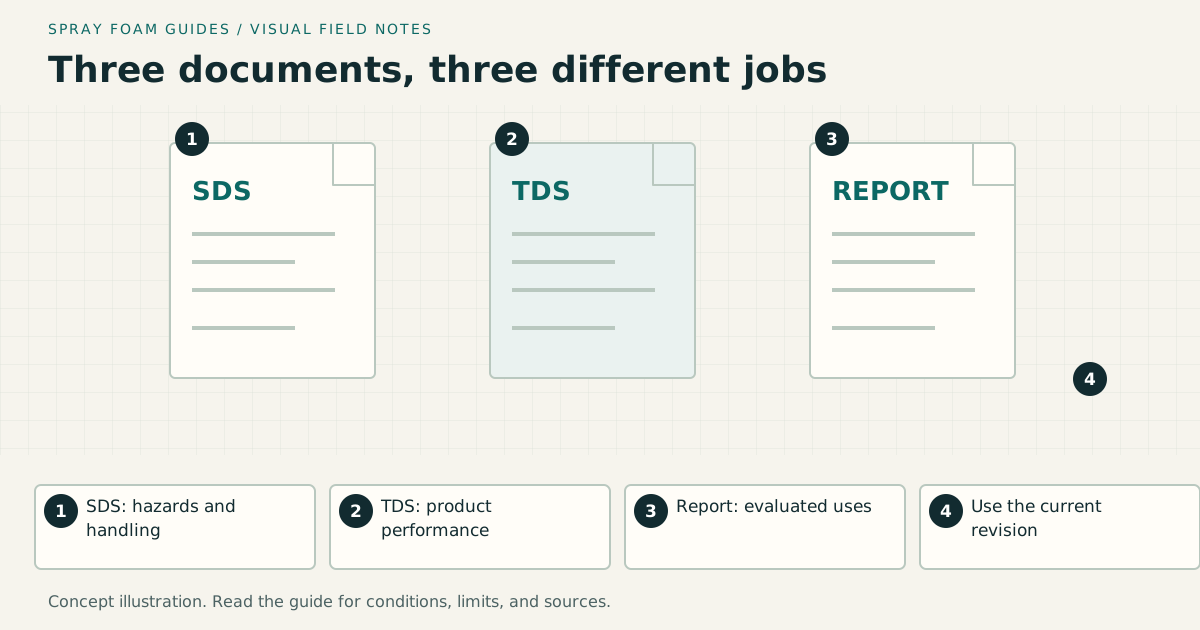
A safety data sheet describes hazards; a technical data sheet describes product properties and application conditions; an installation manual gives procedures; an evaluation report addresses defined uses and conditions. None of them replaces all the others.
On this page
The short answer
Match every document to the exact product and formulation, record its revision date, and separate the claim from the conditions that support it. Missing, mismatched, or conflicting documentation is a reason to pause selection and ask the manufacturer for written clarification.
This answer changes when…
- The product name, formulation, component, and document revision match
- The proposed substrate, location, and thickness fall within the documented use
- Hazards, ventilation, worker protection, and occupant restrictions have separate answers
- A listing or evaluation report is being offered as evidence of code compliance
Dotted terms have plain-language definitions. Browse the glossary ↗
Start with product identity
Before reading a claim, compare the name on the container with the document title. Record the formulation or model, component designation, manufacturer, revision date, and source URL. For a two-component system, obtain the applicable documents for both components and the combined installation system.
A similar brand name or package illustration is not enough. If the container and document disagree, ask the manufacturer which revision governs that material. Keep the answer with the job record rather than silently choosing the more favorable claim.
Use the right document for the question
| Document | Start here for | What it does not establish by itself |
|---|---|---|
| Container label | Identity, warnings, directions, storage and use restrictions | Complete assembly design |
| Safety data sheet, or SDS | Chemical hazards, first aid, handling, exposure controls | Installed R-value or permission to leave foam exposed |
| Technical data sheet, or TDS | Reported properties and specified application conditions | Suitability for every substrate or climate |
| Installation manual | Preparation, equipment, application sequence, limitations | Permission to change required exposure controls |
| Evaluation report or listing | Defined tested uses, conditions and applicable code references | Universal approval for a different product or assembly |
This table is a reading workflow, not a hierarchy that lets one document override another. Resolve conflicts with the manufacturer and, for local assembly approval, the authority having jurisdiction.
Find the critical SDS sections
OSHA’s SDS guide explains the standardized section format. A useful first pass is:
- Sections 1 and 2: identity, supplier contact, and hazard identification.
- Section 4: first-aid information.
- Sections 5 and 6: fire and accidental-release information.
- Sections 7 and 8: handling, storage, exposure controls, and personal protection.
- Section 10: stability, reactivity, and conditions to avoid.
- Section 16: preparation or revision information.
Read the full applicable document before work. This map helps you find information; it does not select a respirator, create a spill response, or authorize entry into an affected area. Workplace respiratory protection has additional requirements under OSHA’s respiratory-protection standard.
Turn a technical claim into a question
For each performance claim, write three things: the property, its stated conditions, and the proposed use.
For example, “R-value at a stated thickness” requires an actual thickness and reporting basis. It does not establish the whole-wall result. The FTC’s 2018 rule explanation discusses why per-inch claims require supporting evidence; simply dividing a listing number can mislead.
For yield, record whether the figure is a manufacturer claim and what geometry or conditions accompany it. Keep raw board feet separate from exact-package planning. For application temperatures, distinguish material, air, and substrate limits wherever the manufacturer does.
For a usable job record, follow the application conditions and substrate readiness guide. It connects each documented limit to a particular material, location, time, measurement method, and responsible decision.
Read the conditions of an evaluation report
Locate the product identity, scope, installation conditions, and limitations. Check whether the proposed location, substrate, thickness, density, covering, and assembly match. A test named on a sales page may support only one characteristic.
The 2021 IRC’s foam-plastic provisions treat surface-burning characteristics, thermal protection, specific uses, and specific approval separately. That model-code example explains why one test result cannot answer every fire question; it does not determine the code adopted locally.
Work through a claim before accepting it
Imagine a proposal describing a product as “Class A, air sealing, and suitable for attics.” That sentence contains at least three separate claims. Find the test supporting the surface-burning description, the thickness and conditions supporting air control, and the specific attic assembly covered by the report. Then check the permitted covering, use of the space, and local acceptance.
If the report describes a coating and the quote does not include one, ask whether the proposed work falls under a documented alternative or simply omits part of the assembly. A sales email saying that the coating is optional should identify the written evidence for that conclusion. Keep the answer with the report, including its revision.
The same method works for “vapor barrier.” Ask for the exact permeance information at the planned thickness and test conditions. Then have the assembly designer confirm that the resulting vapor control belongs in that location. A valid material measurement can still be misapplied to a building.
Watch for documents that look complete but do not match
Common mismatches include a safety sheet for only one of two components, a report for another formulation in the same brand, and a technical sheet copied from a reseller without a revision date. A package-size difference may be harmless; a chemistry or application difference may be material. Ask the manufacturer to establish equivalence rather than deciding from similar wording.
Check whether a linked report is current on the issuing organization’s site, what code editions it addresses, and whether supplements or conditions accompany it. Download the relevant version for the project record. A saved PDF is useful evidence of what was reviewed, but does not establish that it remains current years later.
Keep installation directions as well as the TDS. A short table of physical properties often lacks the full procedure, substrate exclusions, safety conditions, and repair instructions. If the contractor’s method depends on an exception, ask for the written exception and its scope.
Try a document-to-job matching exercise
The following is a constructed reading exercise, not a real test report or a finding against a manufacturer. Imagine a quote names Product Q, while the supplied report identifies a manufacturing code rather than that retail name.
| Record | What the exercise provides | What to request or decide |
|---|---|---|
| Quote | Product Q in a selected pack | Exact can or container label and product identifiers |
| TDS | A model code and a dated revision | Manufacturer confirmation that this revision covers the proposed product |
| Fire report | An identified specimen and test configuration | Traceable connection between that specimen and the sold material |
| Installation scope | A room, thickness and proposed finish | Evidence that the accepted configuration covers that scope |
The missing retail name does not automatically invalidate the report. A documented manufacturing-to-retail identity link may resolve the question. Conversely, a matching logo or foam color is not enough to create that link. Keep the unresolved field visible until the relevant source supplies the answer.
Separate the outcomes: a source was located; product identity was established; a particular claim was supported; the proposed installation was accepted. Those are four different milestones. An SDS can be the correct safety document without supporting a yield figure. A valid fire result can still leave the proposed covering or room use unresolved.
This is a worksheet the reader can copy into a project file. It is not permission to substitute their own judgment for an applicable professional or building-official decision.
A practical document register
Use one row per document with the exact product, document type, title, revision, issuing organization, source link, and unresolved issue. Add the date reviewed and the person or organization responsible for the answer. This register can be a simple spreadsheet; the value is traceability, not elaborate software.
For an existing installation, include label photographs, lot identifiers, and any substitution records. If the material cannot be identified, say so clearly. Do not borrow the closest available TDS and treat its properties as measured facts about unknown foam.
At handoff, save the final thickness record, covering information, inspection documentation, and manufacturer correspondence beside the preinstallation evidence. The owner should be able to learn both what was proposed and what was actually installed. The contractor checklist helps connect those documents to responsibilities on the job.
Research & references
Sources used for this guide
- Hazard Communication Standard: Safety Data SheetsOccupational Safety and Health Administration · government guidance · United States workplaces · accessed 2026-09-05
- 29 CFR 1910.134: Respiratory ProtectionOccupational Safety and Health Administration · official standard portal · United States workplaces; applicable industry and state-plan rules matter · accessed 2026-09-05
- Safer Workplace Practices for Spray Polyurethane Foam Installation (archived)U.S. Environmental Protection Agency · government guidance · United States; archived guidance · accessed 2026-09-05
- 2021 IRC Chapter 3: Building Planning (R302 and R316)International Code Council · official standard portal · 2021 model code example; not a local adoption determination · accessed 2026-09-05
- Labeling and Advertising of Home Insulation: 2018 Final Rule NoticeFederal Trade Commission · official standard portal · United States; 2018 rule explanation, not a current legal review · accessed 2026-09-05
A citation supports a specific statement, not every possible assembly or local code interpretation.