Renovation and construction field guide
Which Spray Foam Do You Need for Each Job?
General gap foam, window and door foam, and pest-block foam share a basic job: filling and air-sealing eligible gaps. Their formulations and documented special uses are different, while straw, controlled-dispenser, and pro-gun packages are separate delivery choices. This guide shows where those dimensions overlap and where they do not.
On this page
The short answer
Start with gap sealing as the base function, then add the specialty the detail requires. Choose low-pressure window and door foam at a permitted rough-opening joint, pest-block foam when closing a pest entry path, fireblock only for an accepted fireblocking use, and an insulation system for broad walls or rooflines. Straw and pro-gun versions can exist in several families; the applicator does not define the formulation.
This answer changes when…
- The job is a narrow fixed joint, a larger opening, an open surface, or a concealed cavity
- The opening is ordinary construction, required fireblocking, or part of a rated assembly
- The location includes a window frame, wiring, plumbing, pests, weather, heat, or water
- The exact product documents support the substrate, opening size, exposure, and installed performance
- The dispenser can reach the work without hiding an uninspected condition
- The work area can meet the product's exposure-control and access requirements
Dotted terms have plain-language definitions. Browse the glossary ↗
Start with three separate choices
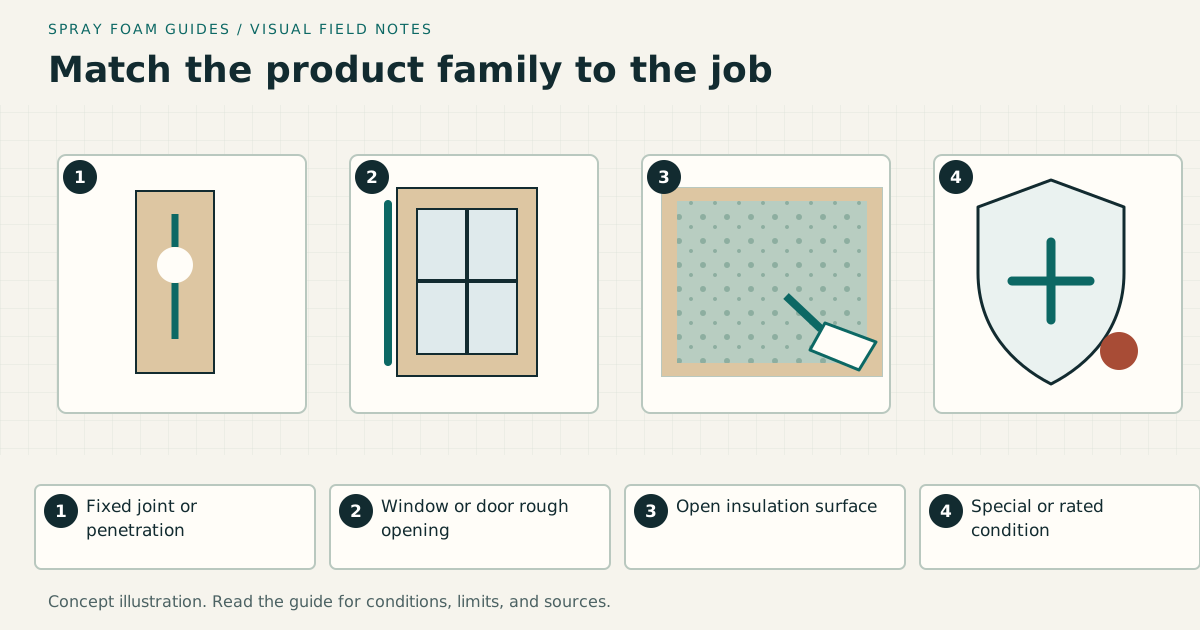
People often ask which spray foam to buy as if the answer were one can. A real renovation can include several unrelated jobs: sealing wire holes through top plates, insulating an open exterior wall, filling an irregular pipe opening, and sealing the gap behind window trim. One product should not be expected to do all four.
Make these choices in order:
- The building detail: What moves, drains, heats up, remains accessible, or carries a fire-resistance requirement?
- The product family: Does the work need a narrow-bead sealant, a special-purpose sealant, or a documented surface-insulation system?
- The delivery tool: Will the product use a disposable straw, a controlled dispenser, a reusable pro gun, a long-barrel gun, a fan-pattern nozzle, or a two-component mixing gun?
The delivery tool comes last. A longer gun can make a permitted joint easier to reach, but it cannot make blind cavity filling safe or turn a gap sealant into whole-wall insulation.
The categories overlap on purpose
General gaps-and-cracks foam, window and door foam, and pest-block foam can all be one-component polyurethane foam sealants. Each can fill and air-seal a compatible gap within the exact product’s stated limits. The useful taxonomy has three layers:
- Base function: Fill and seal a stationary joint, crack, hole, or penetration.
- Specialized formulation or claim: Lower pressure and flexibility for a window frame, pest-entry closure, an accepted fireblocking use, or a dark finish for a named landscape application.
- Delivery system: Disposable straw, controlled can dispenser, threaded pro gun, long barrel, or another compatible tip.
Those layers should not be collapsed into one product name. A pest-block foam is a specialized gap filler, but that does not make every general gap filler a pest product. Window and door foam also fills gaps, but its reason for selection at a rough opening is documented low pressure or minimal expansion and, for some products, cured flexibility. A pro-gun can dispense general gaps-and-cracks, window and door, or pest-block formulations. The word “PRO” identifies the package and compatible dispenser, not one universal window-and-door chemistry.
Quick selector for a house project
| Job in the house | Product family to investigate | What rules it out |
|---|---|---|
| Gap between a window or exterior-door frame and its rough opening | Minimal-expansion, low-pressure window and door foam, or the backer-rod and sealant detail allowed by the unit manufacturer | A general high-expansion filler, blocked drainage, contact with operating hardware, or conflict with window instructions |
| Small fixed crack or ordinary service opening | General gaps-and-cracks sealant within the exact label’s size and substrate limits | A moving joint, heat clearance, rated assembly, drainage path, or opening larger than the product permits |
| Larger irregular opening | A big-gap product only within its documented limit, often with suitable backing or rigid blocking as the assembly requires | Treating an unlimited void as a foam-only repair or covering an uninspected cavity |
| Wire, cable, pipe, or duct opening at a prescribed fireblocking location | An approved fireblocking detail and a product accepted for that exact use | Assuming orange color, ASTM E84, or the word “fire” creates a rated firestop system |
| Penetration through a fire-resistance-rated wall or floor | The listed firestop system for the exact assembly and penetrant | Substituting a residential fireblock can or an unrated generic sealant |
| Pest entry gap | A compatible pest-block gap sealant, with durable physical exclusion where the opening needs it | Assuming every pest-block product repels animals, relying on foam alone where rodents can chew it, or leaving the entry cause unresolved |
| Small open surface or touch-up | A product whose documents permit that surface application; a wide pattern may improve coverage control | Inferring R-value or whole-wall suitability from spray width alone |
| Open wall, roofline, rim area, or other insulation surface | A documented insulation system selected for the full assembly, installed thickness, exposure controls, and protective covering | Using narrow-bead cans as a substitute for a continuous, verifiable insulation layer |
| Visible pond, waterfall, or rockwork gap | A black landscape or pond foam whose exact label supports the exposure and intended water-feature use | Treating color as an insulation, UV, structural, or universal pond-safety rating |
This table identifies a research path. The exact product label, technical data, safety data, evaluation report, building detail, and local acceptance still control the choice.
Open walls and rooflines need an insulation system
When framing is open during new construction or a substantial renovation, begin with the complete assembly. An exterior wall has water, air, vapor, thermal, structural, and interior-protection functions. A roofline also has sheathing temperature, drainage, ventilation or unvented-roof design, mechanical-equipment, and fire-protection questions.
For broad open surfaces, investigate a product that documents surface insulation as an intended use. That may be a one-component surface-applied product, a portable low-pressure two-component kit, or a professional high-pressure two-component system. These formats differ in mixing, output, quality control, worker protection, and practical project scale. The one-component and two-component guide explains those differences without treating retail availability as proof that a project is suitable for DIY work.
Do not estimate a wall from the number of aerosol cans that seem capable of producing foam. Require the R-value basis, permitted thickness, substrate conditions, expected yield unit, installation limits, protective-covering requirements, and evidence for the proposed assembly. Open-cell and closed-cell descriptions do not replace exact-product documents.
A wide spray pattern can be useful on a limited open area, at an edge, or during a documented touch-up. Spray width is a delivery characteristic. It does not by itself establish installed R-value, air-barrier thickness, cell type, adhesion, or suitability for a whole wall.
Window and door foam belongs at the rough opening
The foam joint associated with a window or door usually sits between the installed frame and the framed rough opening. It is not applied to the hinge, latch, sash track, weatherstripping, weep hole, or another operating or drainage component.
DOE Building America guidance calls for low-expansion foam designated for windows and doors when foam is selected for that rough-opening joint. Ordinary expanding foam can build enough pressure to distort a jamb and interfere with operation. The exact window or door instructions must also allow the proposed material and location.
Window and door foam is still a gap-filling foam sealant. Its special value is the documented pressure build, expansion behavior, adhesion, and flexibility needed around a frame. It may be eligible for another stationary joint only when its own label names or permits that use. Conversely, a general gap filler should not move into a window or door rough opening unless the product and unit instructions establish the required low-pressure performance.
Keep three connections distinct:
- The rough-opening joint may need an interior air seal.
- The operating joint needs its intended weatherstripping, alignment, and hardware clearance.
- The exterior water-management connection needs flashing and drainage that remain functional.
Record opening and closing before work, keep shims and anchors in their structural roles, and check normal operation afterward. The detailed window, door, and small-gap guide covers trim removal, old paint, concealed damage, and drainage.
General gap filler is for fixed gaps within a stated range
General gaps-and-cracks foam is the everyday one-component sealant for compatible, stationary joints and penetrations. The label’s maximum opening size matters. A product advertised for a one-inch opening and one advertised for a larger opening are not interchangeable merely because both expand.
“Gap filler” can also describe the base function shared by specialty products. Pest-block foam fills gaps while targeting entry-point closure. Window and door foam fills the frame-to-rough-opening gap with a formulation selected for low pressure. We keep separate research queues so products with different special claims can be compared like for like, not because the physical act of filling a gap belongs to only one label.
For a larger hole, first ask why it is large and what should span it. Rigid blocking, sheet material, metal flashing, mesh, backer rod, or another durable component may carry a function that expanding foam cannot. DOE attic guidance similarly distinguishes narrow gaps that may take sealant alone from larger openings that need rigid blocking sealed in place.
Do not fill an unknown void until wiring, plumbing, moisture, damage, movement, and future access are understood. Avoid serviceable connections, electrical-box interiors, drainage or ventilation openings, and clearances around heat-producing equipment. A bead that disappears into a cavity is difficult to inspect and does not demonstrate continuity.
Fireblock foam has a narrow code role
Fireblocking limits concealed draft paths at locations required by the applicable code. The 2021 IRC model-code language includes openings around vents, pipes, ducts, cables, and wires at ceiling and floor level, but the locally adopted code and building official determine what applies to the project.
A residential fireblock foam can be relevant around a service penetration only when the exact product, opening, material, size, and assembly fall within its documented and accepted use. One manufacturer example describes sealing electrical runs through wall studs and service penetrations to maintain the continuity of an approved fireblock material. That statement does not approve every electrical or plumbing opening.
Keep foam outside electrical boxes and away from bare conductors unless a specifically applicable detail says otherwise. Do not improvise near flues, chimneys, recessed fixtures, fan motors, or other heat-producing equipment.
Fireblock and firestop are different. A penetration through a fire-resistance-rated wall or floor may require a listed firestop system installed as tested. Orange color, “fire rated” marketing, ASTM E84 surface-burning data, or a fireblock label does not create that system. See fire claims, ignition barriers, and thermal barriers before purchasing a can for a code-sensitive location.
Pest-block foam is a specialized gap filler
Pest-block products fill, seal, and insulate compatible gaps while closing paths where insects or small animals enter. That makes pest-block foam part of the broader gap-sealant family. One current manufacturer line, for example, documents a controlled-dispenser version for gaps up to one inch and a gun-applied PRO version for gaps up to three inches. Package size and stated gap limit must stay attached to the exact variant.
Do not convert “pest block” into a generic repellency claim. Some products contain no pesticide and work by forming a physical barrier. Another exact product may make a repellent or additive claim, but that claim requires its own label and evidence. The word “pest” also does not mean the cured foam cannot be chewed.
At a likely rodent entry point, investigate durable physical exclusion such as corrosion-suitable metal mesh, hardware cloth, flashing, or an escutcheon, then use a compatible sealant to close the remaining air path when the detail permits it. Protect the completed work from weather and UV exposure as the product requires. Do not seal an animal into a building or cover contamination without the appropriate inspection and cleanup plan.
The location still determines the category. A pest entry through a rated assembly needs the applicable rated penetration system. An opening that drains water or ventilates equipment must remain functional. A foundation penetration can also need exterior flashing and water management rather than an interior foam plug alone.
Black foam usually describes appearance and a special application
“Black foam” is not one universal performance class. Retail products may use black color for different purposes. A common landscape category is pond-and-stone foam, designed to blend with rocks and shadows and help direct water around decorative stone. Other black products may be general exterior sealants with a dark cured color.
For ponds, waterfalls, rockwork, RV details, roofing, or visible exterior joints, verify the exact label instead of transferring claims from another black can. Check substrate, water exposure, UV protection, temperature, movement, contact with plants or aquatic life, and whether the foam is structural. A dark color does not establish insulation value, waterproofing for a building enclosure, or approval below grade.
Landscape foam should remain a separate buying category from wall-insulation systems, fireblocking products, and pest exclusion products. Its color solves a visual problem; the product documents must establish every other claimed function.
Straw, controlled dispenser, pro gun, and long barrel are delivery choices
One-component products can arrive with several dispensers, and a manufacturer can offer more than one formulation for the same dispenser system:
- A disposable straw suits limited work but offers less restartability and bead control.
- A controlled can dispenser can improve shutoff and reduce drips while keeping the package simple.
- A threaded pro gun can provide adjustable flow, repeat use under the stated storage rules, and access through interchangeable tips. Current product lines include pro-gun versions of general gaps-and-cracks, window and door, and pest-block foam.
- A long-barrel gun helps reach permitted joints or work from a more practical position. One manufacturer offers a 40-inch barrel for hard-to-reach areas.
- A fan or wide-spray nozzle spreads material across a broader surface instead of laying only a narrow bead.
Choose the dispenser only after choosing an eligible formulation. “Gun-grade,” “professional,” and a threaded can do not mean window and door foam. Confirm the named product, pressure or expansion behavior, stated gap range, gun, valve, cleaner, tip, and extension. More reach can also reduce visibility and control. Do not use an extension to spray behind live equipment, into a concealed cavity, or around an unverified heat or electrical condition.
Two-component kits use a different delivery system. Separate A-side and B-side chemicals meet in a mixing nozzle. Tank conditioning, proportioning, nozzle changes, work-area isolation, ventilation, protective equipment, and quality checks belong to that system’s plan. It is not simply a larger one-component can.
Build a room-by-room material schedule
For a remodel, create an opening and surface schedule before shopping. A useful row records:
- Room and exact location
- Assembly on both sides
- Fixed joint, moving joint, penetration, or open surface
- Approximate dimensions and accessible depth
- Water, heat, electrical, pest, fire, or rated-assembly concern
- Product family under consideration
- Exact supporting label, data sheet, and report
- Delivery tool and visibility of the work
- Person responsible for approval and final inspection
One kitchen renovation might legitimately call for window and door foam at a permitted rough opening, general gap sealant at an ordinary fixed exterior-wall penetration, an accepted fireblocking detail at a top-plate wire opening, and a documented insulation system across newly opened exterior-wall cavities. That is a coherent material schedule. Calling all four rows “spray foam” hides the decisions that matter.
Before buying, route the project through the assembly planner, check application conditions and substrate readiness, and read the SDS, technical data, and evaluation reports. Then compare exact products inside the correct category. Product research should confirm the project decision, not create it.
Research & references
Sources used for this guide
- Air Sealing Window and Door Rough OpeningsDOE Building America Solution Center · government guidance · United States; window and door rough-opening details · accessed 2026-09-06
- Air Sealing Electrical WiringDOE Building America Solution Center · government guidance · United States; electrical air-sealing concepts and model-code links, subject to the actual assembly and local requirements · accessed 2026-09-07
- Attic Air Sealing and InsulationDOE Building America Solution Center · government guidance · United States; distinction between narrow sealant joints and larger blocked openings, not a universal product specification · accessed 2026-09-07
- 2021 IRC Chapter 3: Building Planning (R302 and R316)International Code Council · official standard portal · 2021 model code example; not a local adoption determination · accessed 2026-09-05
- Spray Polyurethane Foam Product Types (archived)U.S. Environmental Protection Agency · government guidance · United States; archived product-family and exposure overview · accessed 2026-09-06
- Quick Safety Tips for Spray Polyurethane Foam Users (archived)U.S. Environmental Protection Agency · government guidance · United States; archived guidance · accessed 2026-09-05
- GREAT STUFF Window & Door Insulating Foam SealantDuPont · manufacturer document · United States; exact-product example of minimal expansion, low pressure build, and rough-opening use, not approval for another product or window assembly · accessed 2026-09-07
- GREAT STUFF Gaps & Cracks Insulating Foam SealantDuPont · manufacturer document · United States; exact-product example of a general fixed-gap sealant and stated opening limit, not a transferable category limit · accessed 2026-09-07
- GREAT STUFF Big Gap Filler Insulating Foam SealantDuPont · manufacturer document · United States; exact-product example for larger gaps and stated opening limit, not permission to fill an unsupported or uninspected void · accessed 2026-09-07
- GREAT STUFF Fireblock Insulating Foam SealantDuPont · manufacturer document · United States; exact residential fireblocking product example, not a rated firestop system or universal code approval · accessed 2026-09-07
- GREAT STUFF Pestblock Insulating Foam SealantDuPont · manufacturer document · United States; exact pesticide-free entry-sealing product example and manufacturer chewing limitation, not a complete pest-exclusion design · accessed 2026-09-07
- GREAT STUFF PRO Pestblock for PRO Dispensing GunDuPont · manufacturer document · United States; exact gun-applied pest-block gap-sealant example with variant-specific opening limit and pesticide-free entry-blocking claim · accessed 2026-09-07
- GREAT STUFF Foam Sealants and Dispenser OptionsDuPont · manufacturer document · United States; current examples showing general gap, window and door, and pest-block formulations across dispenser systems · accessed 2026-09-07
- GREAT STUFF Pond & Stone Insulating Foam SealantDuPont · manufacturer document · United States; exact black landscape-foam example for decorative water features, not a building-envelope waterproofing or insulation approval · accessed 2026-09-07
- GREAT STUFF PRO 14 XL Foam Dispensing GunDuPont · manufacturer document · United States; exact 40-inch dispensing-tool example, not authorization for concealed or otherwise unsuitable work · accessed 2026-09-07
A citation supports a specific statement, not every possible assembly or local code interpretation.