Project sequence and timing
How Long Does a Spray Foam Project Take? Plan Each Stage
Spraying is one part of a spray foam project. Assessment, repairs, surface preparation, work-zone setup, product-specific waiting periods, inspection, and finishing can determine the actual schedule. A can's trim time or a crew's spray time does not tell you when the whole job is complete or when occupants may return.
Updated Oct 10, 20265 min readSource-check recordIndependent specialist review pending
Report an error or submit a manufacturer update →
Edition and authorship details
- Published
- Oct 10, 2026
- Last source check
- Oct 10, 2026
- Review record
- Oct 10, 2026 source review
Current sectionContents
The short answer
Ask for a schedule with separate milestones: conditions accepted, work zone ready, application complete, product-specific cure and access requirements satisfied, work inspected, and required finishes complete. There is no universal number of hours for every foam or building. Keep worker re-entry and occupant reoccupancy separate from tack-free and trim times.
This answer changes when…
- The job uses a one-component sealant, a portable kit, or a professional spray system
- Repairs, damp substrates, or inaccessible details may delay the start
- Occupants or other trades need access during or after the work
- Inspection and required protective finishes must happen before concealment
Evidence trail
What to verify before applying this answer
Sources last checked: Oct 10, 2026. Each reference supports the point shown; it does not approve a project by itself.
Obtain the job-specific return conditions
Formulation, amount, conditions, and ventilation affect reoccupancy; the actual manufacturer and job requirements govern.
American Chemistry Council / Center for the Polyurethanes Industry: Reoccupancy Related to Spray Polyurethane Health and SafetyUse the actual system’s milestones
A named kit’s preparation and application requirements do not create a universal timetable for other foam systems.
DuPont: Froth-Pak Foam System Kit Instruction ManualPlan the work-zone sequence
Archived guidance provides context for work-zone and access planning; current exact-product instructions and qualified advice remain necessary.
U.S. Environmental Protection Agency: Safer Workplace Practices for Spray Polyurethane Foam Installation (archived)
Unfamiliar terms? Browse the glossary ↗
How long does spray foam insulation take?
There is no single duration that applies to a small air-sealing joint, a portable-kit job, and a whole-house contractor installation. Ask what the estimate includes. “One day of spraying” may leave repairs, setup, access restrictions, inspection, and drywall outside that day.
For a useful answer, record the product system, measured surfaces, specified depth, access, condition of the substrate, and the finished scope. The project planner helps organize the unknowns. Do not schedule occupants or follow-on trades from a video, a generic internet waiting period, or a surface that looks dry.
Start with the place and the scope
A few accessible gaps and a roofline conversion are different projects. The latter can change the attic boundary, moisture design, equipment conditions, fire protection, and future service access. Start with the relevant project guide before asking how quickly it can be sprayed.
For a garage, identify the boundary between the garage and occupied space. For a shed, identify whether and how it will be conditioned. For a roof, include its condition and the complete intended assembly. Project area alone cannot answer those questions.
Build a schedule around release conditions
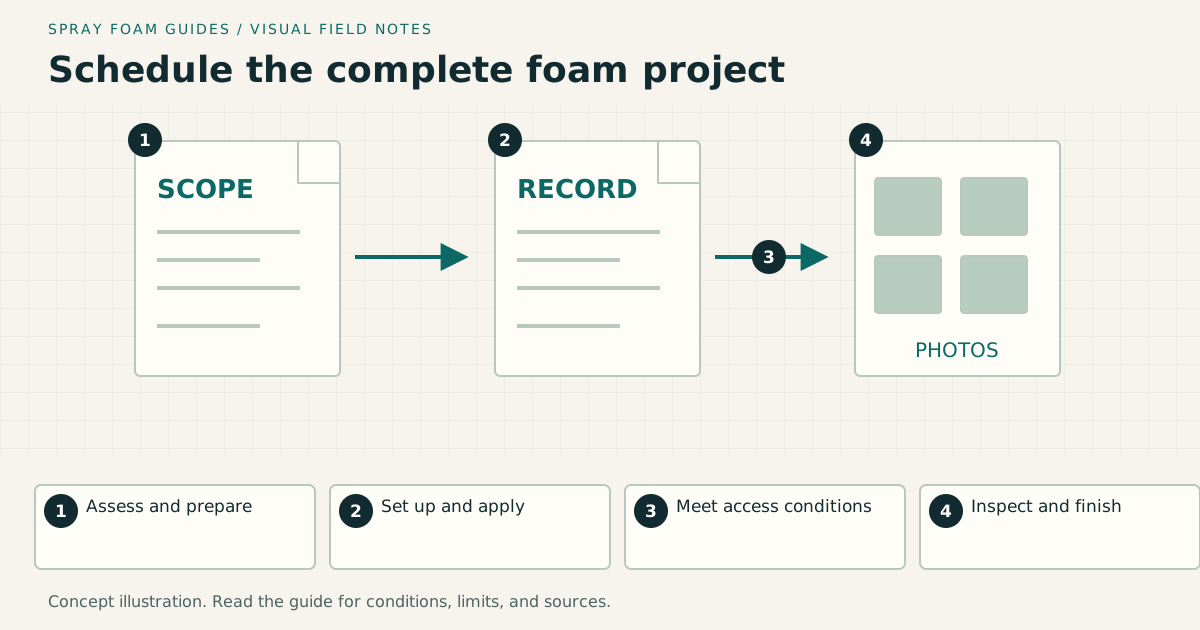
The table is a planning sequence, not an installation procedure or a promise of elapsed time. Some administrative tasks can overlap; required site and product conditions cannot be skipped.
| Stage | What must be ready | What can delay the next stage |
|---|---|---|
| Assess and specify | Defined surfaces, accepted assembly, exact product documents, and responsible installer | Unknown moisture, damaged construction, unresolved code or service details |
| Repair and prepare | Repairs completed and substrate accepted for the exact product | Drying, contamination, access changes, or further investigation |
| Set up the work zone | Required exposure controls, protected adjacent work, and access arrangements | Occupant needs, nearby trades, ventilation or ignition-control questions |
| Apply and record | Conditions and application remain within the exact instructions | Temperature changes, equipment problems, pause limits, or defects |
| Meet access requirements | The actual system’s cure, ventilation, and access conditions are satisfied | Unresolved deviations or missing release information |
| Inspect and correct | Required depth, continuity, details, and records checked | Voids, incomplete interfaces, or correction work |
| Protect and finish | Accepted protection, finish work, and handover complete | Inspection availability, coatings, drywall, or other follow-on work |
The substrate-readiness guide explains what to record before the application stage. Active leaks or unexplained dampness belong before insulation conceals the surface. EPA’s remodeling guidance supports resolving moisture and ventilation concerns as part of renovation planning.
What do tack-free, trim time, and cure mean?
Tack-free refers to a surface milestone. Trim time identifies when the instructions permit a particular finishing operation. Cure describes the material’s reaction or hardening under stated conditions. None is automatically an authorization for unprotected occupants to return.
For a one-component sealant, read the milestones for that exact can and bead geometry. For a two-component kit, use its manual. Do not carry the time printed on a general gap filler into a surface-spray product, portable kit, or high-pressure system.
DuPont’s Froth-Pak manual is an example of system-specific preparation and application requirements. Its instructions are not a schedule for other brands or formulations.
When can workers and occupants return?
Worker re-entry and occupant reoccupancy are different questions. The American Chemistry Council reoccupancy guidance identifies formulation, amount applied, temperature, humidity, ventilation, and other job variables as relevant, and directs readers to the manufacturer for the particular job.
Before work, obtain the exact system’s requirements and identify who will confirm they have been met. Record any site-specific instructions and deviations. A manufacturer’s stated period must be read with its conditions; it is not a shortcut around inadequate ventilation or an unresolved installation problem.
The ventilation and re-entry guide owns the detailed safety explanation. EPA’s archived workplace guidance provides planning context; current product instructions and appropriate professional advice remain necessary.
Do not use smell, touch, foam color, or the absence of a complaint as clearance. If anyone develops symptoms or there are signs of unusual heat, stop and seek the appropriate medical or emergency help. Do not bring other trades into an unreleased work zone to keep a schedule moving.
What needs to be on the job before work starts?
Have the accepted scope, current product documents, measured takeoff, substrate-condition record, and installer questions available. The installer must plan compatible equipment and the product-specific exposure controls. A generic shopping list cannot replace that planning.
Keep follow-on trades in the conversation. Electrical, plumbing, mechanical, fire-protection, and finish work can change access or conceal a detail that still needs inspection. The work-zone guide explains those boundaries. Do not choose respiratory protection from a product photograph or a short checklist in a video.
Schedule inspection before the work disappears
Put inspection and correction into the schedule before finishes hide the foam and its connections. Ask what evidence the inspector or responsible professional needs and when it must be available.
Record the actual product, conditions, application dates, depth observations, unresolved details, and corrections. Keep any required protective assembly separate from the foam itself. The inspection and handover guide provides the closeout path.
Can I finish the whole job in a weekend?
Only a defined scope and its actual conditions can answer that. A calendar opening does not establish product suitability, safe access, inspection availability, or readiness for a finish. Have unresolved conditions checked before committing to that deadline.
How do I compare two contractors’ promised durations?
Ask both to identify preparation, application, access restrictions, inspections, corrections, and finishing. Compare the same start and completion milestones. Use the contractor quote guide for scope and the price-unit comparison for arithmetic; a faster spray day is not necessarily a faster completed project.
Research & references
Sources used for this guide
- Reoccupancy Related to Spray Polyurethane Health and Safety
- Froth-Pak Foam System Kit Instruction Manual
- Remodeling Your Home and Indoor Air Quality
- Safer Workplace Practices for Spray Polyurethane Foam Installation (archived)
A citation supports a specific statement, not every possible assembly or local code interpretation.