A better written scope
How to Compare Spray Foam Contractor Quotes Before You Sign
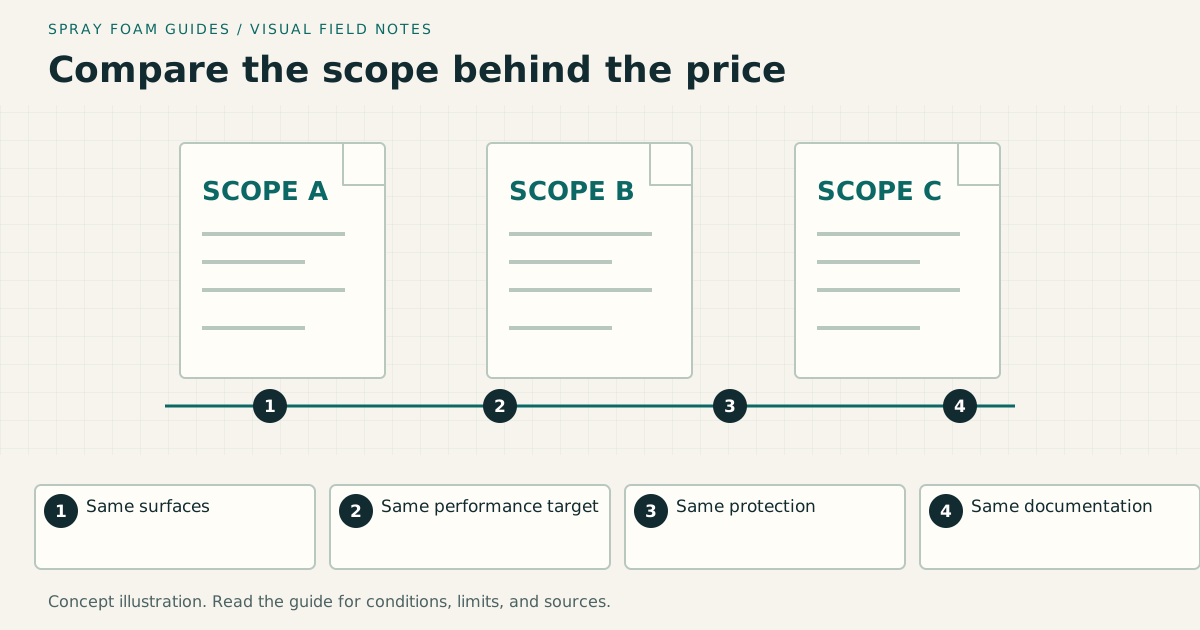
Two spray foam quotes can describe different boundaries, preparation, protection, thickness, and inspection work. Make the scope comparable before using price to decide. A lower total may reflect missing work rather than a more efficient installation.
On this page
The short answer
Ask each contractor to identify what will be insulated, what must be fixed first, which exact system will be used, who controls exposure, what covering is required, and how the result will be documented. Leave unresolved assembly or safety decisions open until the responsible professional answers them.
This answer changes when…
- Each quote covers the same boundary and measured surfaces
- The proposal distinguishes preparation, insulation, mechanical work, and finishes
- Exact product documents and proposed thickness are available
- Occupant restrictions, inspection responsibilities, and exceptions are written down
Dotted terms have plain-language definitions. Browse the glossary ↗
How do you compare spray foam quotes fairly?
First make the proposed work comparable. Each contractor should identify the same enclosure boundary, measured surfaces, preparation, insulation target, protection, verification, and finishing responsibilities. Only then does a difference in price become useful evidence about value.
A detailed proposal does not need to be long. It needs to answer the decisions that would otherwise be left to the day of installation. Use the contractor checklist to collect those answers, and keep a separate list of unresolved items rather than assuming that silence means inclusion.
Start with the problem and the boundary
Describe the outcome you want: a less drafty first floor, a repaired garage boundary, an attic conversion for ducts, or an insulated basement being finished. Ask the contractor what evidence connects the proposed insulation to that problem. A material recommendation should follow an assessment of the assembly.
For an attic, a floor-insulation proposal and a roofline proposal are different scopes. For a crawlspace, floor framing and perimeter walls describe different boundaries. Have each bidder mark the surfaces on a sketch. Include access hatches, gables, rims, knee walls, and unusual transitions where applicable.
Ask for one reasonable alternative assembly when the design is still open. Comparing air sealing plus fibrous insulation with a full spray-foam approach can reveal whether foam is solving a difficult detail or simply being specified everywhere.
Build a side-by-side scope table
| Item | Useful written information | Unresolved version |
|---|---|---|
| Enclosure boundary | Marked surfaces, area, and transitions | “Insulate attic” |
| Existing conditions | Inspection, repairs, and substrate acceptance | “Prep included” |
| Insulation | Exact system, target, and minimum installed thickness | Brand name and average depth |
| Safety and occupancy | Isolation, ventilation, responsible contact, return instructions | Fixed return time without conditions |
| Protection | Approved covering and installation responsibility | “Fire rated foam” |
| Verification | Inspection timing, measurements, records, correction process | “Quality guaranteed” |
| Other trades | Mechanical, electrical, carpentry, and permit assignments | “By others” with no named scope |
| Commercial terms | Exclusions, allowances, payment milestones, changes | Open-ended extras |
The unresolved examples are prompts for clarification, not proof that a contractor is unqualified. Give bidders the same chance to revise their scope before ranking proposals.
Separate repairs from installation preparation
Cleaning and protecting an acceptable substrate is different from correcting a roof leak, damaged sheathing, a wet foundation, or decayed wood. Ask what has been inspected and who is qualified to decide that repairs are complete.
DOE’s home air-sealing checklist connects enclosure work with existing-condition inspection and mechanical considerations. Use it as a basis for asking who owns ventilation, combustion-safety, and related commissioning decisions in your project.
Require a written process for concealed conditions. If demolition reveals damaged wood, who documents it, who evaluates it, and what work pauses? Specify whether repair allowances are provisional amounts or fixed included work. A clear sequence prevents a spray crew from becoming responsible for a structural or moisture decision outside its contracted scope.
Ask for the exact insulation system
Request the formulation or system name, intended application, proposed installed thickness, and the relevant documentation. The SDS, TDS, and evaluation-report guide explains what each document can establish.
The scope should distinguish the thermal target from an air-barrier claim, vapor-control function, and any required protection. If a product changes before installation, require review of the replacement documentation and an updated scope. A substitute with a similar marketing description may not have the same approved uses or assembly requirements.
Ask whether the quoted thickness is a minimum, nominal target, or average. If an average is used, ask how local thin spots will be controlled. Define what gets measured and when. An attractive peak depth in one location does not answer whether difficult corners meet the specification.
Compare exclusions by their consequence
An exclusion can represent a separate trade’s legitimate work, an inaccessible area, an optional upgrade, or a condition that must be resolved before installation. Those categories have different effects on the decision. Ask the bidder to explain which applies instead of treating every excluded line as an equivalent extra.
For example, excluding repainting leaves a finishing cost to assign. Excluding roof-leak investigation can leave the substrate’s suitability unresolved. Excluding a required protective covering leaves an essential portion of the completed assembly outside the quoted price. The owner needs to know the consequence and responsible party for each item.
If an estimate depends on an inspection that has not happened, keep it identified as conditional. Ask what information will allow the contractor to firm up the scope, and compare proposals again after that information is available. A precise total built on an unverified condition can be less useful than a clearly explained provisional scope.
Normalize price with a worked example
Consider two hypothetical proposals for the same 800-square-foot wall boundary. These are invented arithmetic examples, not market prices:
| Scope item | Proposal A | Proposal B |
|---|---|---|
| Insulation, defined preparation, and installation | $4,200 | Included |
| Required covering | Excluded | Included |
| Agreed inspection and records | Excluded | Included |
| Initial total | $4,200 | $5,400 |
Suppose A then provides a firm $900 price for the same covering and $300 for the same inspection and records. Its comparable total becomes $5,400. Dividing by 800 square feet gives $6.75 per square foot for either completed scope. Their initial totals looked different because the inclusions differed.
Real comparisons need more than this arithmetic. Check repair allowances, material specifications, access, taxes where applicable, permit responsibility, and warranties. Do not use the example’s dollar values as a cost forecast.
Board feet can also help reconcile foam quantity. Eight hundred square feet at an illustrative 3-inch layer represents 2,400 board feet of geometric installed volume. It does not establish chemical purchase quantity, system yield, or required insulation depth. See R-value, thickness, and board feet.
Compare an advertised package with an actual scope
A low price can be a legitimate advantage. It does not prove a contractor is using inferior material, just as a higher price does not prove a better assembly. Before comparing totals, ask whether both offers actually include the same work.
An advertisement for a number of cans is a material offer. A proposal to seal accessible joints is an air-sealing scope. A proposal for a continuous insulation layer with preparation, required protection and inspection is a larger construction scope. Calling all three “spray foam insulation” does not make them interchangeable.
Use these three questions on each offer:
- What exact product and documented application does this price cover?
- Which surfaces and final performance requirements are included, and what remains excluded?
- What records and inspections will show that the agreed scope was completed?
Do not use how strongly the foam expands in an ad as the answer to any of them. The system-format guide distinguishes a permitted sealant detail from a specified insulation layer. Once the scopes match, the lower comparable price may indeed be the better offer; the point is to compare the same job.
Agree on occupancy and communication
EPA’s archived workplace-practices guidance recommends discussing products, isolation, ventilation, and reoccupancy before installation. It also encourages checking contractor training, references, licensing, and insurance. The guidance is archived, so pair it with current system instructions and applicable requirements.
Identify the person who will communicate with occupants and other trades. Ask what happens if weather, substrate conditions, equipment problems, or extra work change the schedule. Put relocation responsibilities, access restrictions, cleanup, and written return instructions in the plan.
A universal number of hours is not a complete return protocol. The ventilation and reentry guide outlines the questions the selected system and job conditions need to answer. Avoid a contract that makes occupants infer readiness from odor or appearance.
Include coverings and trade coordination
Ask who designs, supplies, installs, and inspects the required thermal or ignition protection. If a coating is proposed, request the exact approved combination and application documentation. If gypsum is proposed, identify the assembly and the trade responsible for completing it.
The same clarity applies to attic conditioning, crawlspace humidity control, duct repairs, electrical access, and finish restoration. A contractor may reasonably exclude another trade’s work, but the project still needs that work assigned and priced before the overall proposal can be judged.
Ask which inspections occur before insulation, before covering, and at completion. Make the schedule allow corrections while the affected work is still visible.
Evaluate qualifications through evidence
Verify licensing requirements with the relevant local authority and obtain current insurance information appropriate to the project. Ask about training for the proposed system and request references for similar assemblies, not just general renovation work.
Useful reference questions are specific: Was the written scope followed? Were unexpected conditions documented? Were occupants told when plans changed? Were promised records delivered? How were callbacks handled? Answers about communication and correction behavior can be more informative than a photograph of neatly trimmed foam.
Distinguish the installer’s workmanship terms from the manufacturer’s material warranty. Ask who receives a complaint, who investigates, what evidence is required, and which costs are excluded. A warranty title alone does not explain the remedy.
Define acceptance and keep the records
Before signing, agree on the handover package: boundary drawing, product and lot identification where available, relevant substrate and installation observations, thickness records, photographs, covering documentation, and inspection results. Include a written list of exceptions and completed corrections.
Use the inspection and handover guide to define who performs each check and what the owner should receive. This quote guide addresses assigning and pricing that work; a document checklist is not an inspection method.
Tie progress payments to understandable completed milestones and use a written change process. The appropriate contract terms depend on the project and jurisdiction; this guide is a proposal-comparison aid, not a substitute for reviewing the actual agreement.
Is the lowest quote necessarily risky?
No. Efficient access, a simpler assembly, or a contractor’s scheduling can affect price. The useful question is whether the lower price covers the same accepted scope and verification. Resolve missing items before drawing conclusions.
Should I ask for a guaranteed energy-savings percentage?
Ask instead for the assumptions and method behind any estimate, including the existing house, climate, mechanical systems, rates, and occupant behavior. An insulation material by itself does not determine the home’s future utility bill.
Research & references
Sources used for this guide
- Home Air Sealing ChecklistDOE Building America Solution Center · government guidance · United States · accessed 2026-09-05
- Unvented Conditioned Attic with Spray Foam Below the Roof DeckDOE Building America Solution Center · government guidance · United States · accessed 2026-09-05
- Safer Workplace Practices for Spray Polyurethane Foam Installation (archived)U.S. Environmental Protection Agency · government guidance · United States; archived guidance · accessed 2026-09-05
- Spray Foam Interior Insulation for Existing Foundation WallsDOE Building America Solution Center · government guidance · United States; existing foundation walls · accessed 2026-09-05
- 2021 IRC Chapter 3: Building Planning (R302 and R316)International Code Council · official standard portal · 2021 model code example; not a local adoption determination · accessed 2026-09-05
A citation supports a specific statement, not every possible assembly or local code interpretation.