Price and scope comparison
Spray Foam Cost: Price per Square Foot vs Board Foot
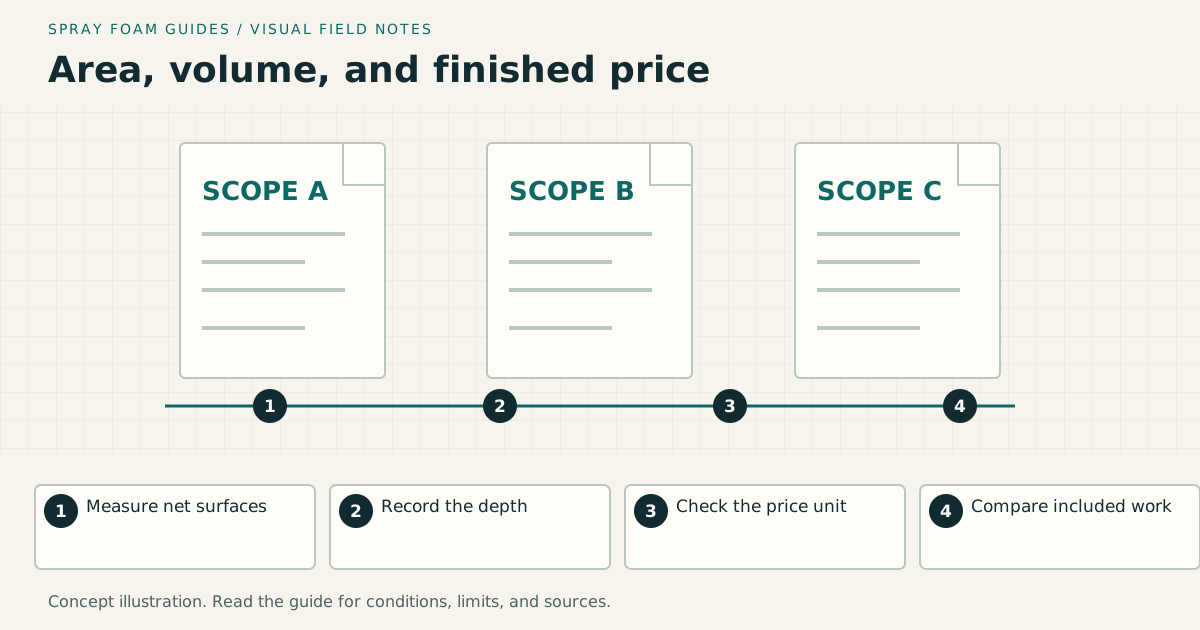
A spray foam price per square foot describes area; a price per board foot describes volume. A kit price describes a package. You can compare them only after fixing the measured surfaces, specified thickness, material, and included work. A lower unit rate can still produce a higher or less complete project quote.
Updated Oct 10, 20266 min readSource-check recordIndependent specialist review pending
Report an error or submit a manufacturer update →
Edition and authorship details
- Published
- Oct 10, 2026
- Last source check
- Oct 10, 2026
- Review record
- Oct 10, 2026 source review
- Editorial maintenance
- Oct 30, 2026
Current sectionContents
The short answer
Compare written totals for the same net surfaces, accepted insulation specification, and finished scope. Board feet equal square feet multiplied by thickness in inches. A square-foot rate must state the thickness it includes. A package's advertised yield is not a promise of installed output, and a materials-only total is not an installed bid.
This answer changes when…
- Both quotes identify the same wall, roof, floor, or other measured surfaces
- The specified thickness and material are recorded
- The quote identifies materials-only or installed scope
- Preparation, protection, inspection, finishing, and exclusions are itemized
Evidence trail
What to verify before applying this answer
Sources last checked: Oct 10, 2026. Each reference supports the point shown; it does not approve a project by itself.
Package yield has conditions
Advertised material output is not a guaranteed installed volume or an installed price; do not transfer one system’s conditions to another.
DuPont: Froth-Pak Foam System Kit Instruction ManualRead the actual insulation disclosure
The applicable insulation label identifies performance and quantity information; a shelf price alone does not define the project specification.
Electronic Code of Federal Regulations / Federal Trade Commission: 16 CFR 460.12: LabelsKeep repairs and ventilation in scope
Moisture and ventilation planning belong in the renovation scope before the finish conceals the work.
U.S. Environmental Protection Agency: Remodeling Your Home and Indoor Air Quality
Unfamiliar terms? Browse the glossary ↗
Which spray foam price is actually lower?
The lower rate wins only when it buys the same completed work. A $1.50 rate per board foot and a $3.00 rate per square foot are not directly comparable. The first changes with depth. The second may include a stated depth, or may omit it altogether.
Start with the surfaces you plan to insulate. A garage floor’s area does not give you its wall area. A shed’s footprint does not give you its sloped roof area. An attic-floor quote and a roofline quote may move the enclosure boundary and include different construction work. The attic-system comparison explains that last distinction.
This guide supplies arithmetic and a comparison method. Its dollar examples are invented, not local market rates, retailer observations, or recommended insulation specifications.
Square feet measure area; board feet measure volume
One board foot is one square foot at one inch thick. For a uniform geometric layer:
Board feet = net surface area in square feet × thickness in inches.
For a board-foot quote:
Quoted insulation subtotal = board feet × quoted dollars per board foot.
For a square-foot quote:
Quoted insulation subtotal = net square feet × quoted dollars per square foot.
Do not multiply a square-foot rate by depth again when that rate already includes the specified depth. Ask the bidder to write that depth into the quote. The board-foot calculator helps organize surface measurements; it does not establish an R-value target or a purchasing quantity.
| Quote label | What you need before calculating | What the label alone leaves unresolved |
|---|---|---|
| Dollars per square foot | Net surface area and included thickness | Material, scope, minimum charge, and exclusions |
| Dollars per board foot | Net area and specified thickness | Installed versus theoretical volume and all other work |
| Dollars per kit or case | Exact package, quantity, and stated yield conditions | Achievable field output and project suitability |
| Fixed installed total | Written surfaces, specification, inclusions, and exclusions | Changes, corrections, and work omitted from the bid |
A worked comparison with equal thickness
Assume two fictional bidders price the same 300 square feet at a specified 2-inch depth, using the same accepted material and finish scope. The depth is an assumption for this example, not a design recommendation.
| Calculation | Quote A: $1.50 per board foot | Quote B: $3.20 per square foot |
|---|---|---|
| Net area | 300 square feet | 300 square feet |
| Specified depth | 2 inches | 2 inches included in the rate |
| Geometric volume | 600 board feet | 600 board feet |
| Insulation subtotal | 600 × $1.50 = $900 | 300 × $3.20 = $960 |
| Equivalent area rate at this depth | $3.00 per square foot | $3.20 per square foot |
Quote A’s insulation subtotal is $60 lower. That comparison holds only at the stated depth and scope. If A excludes $180 of required preparation while B includes it, A becomes $1,080 against B’s $960 before any other differences. The lower insulation subtotal then produces the higher known total.
At a different depth, calculate again. Do not carry the $3.00 equivalent rate into a thicker job or change thickness just to make a quote look cheaper. Use the project budget calculator with your own quoted rate and known additional costs.
Why kit price divided by advertised yield is incomplete
A package may state a laboratory or theoretical yield. Actual output depends on the exact system and conditions. DuPont’s Froth-Pak instructions distinguish yield assumptions from application and troubleshooting conditions. That is an example for the named system, not a correction factor for every kit.
Suppose a fictional $400 package advertises 200 board feet. The division gives $2.00 per advertised board foot of material. It does not establish a $2.00 installed rate, a 200-board-foot field result, or the number of packages needed for your job.
Include required equipment, masking, exposure controls, cleanup, disposal, and accepted protective construction. Use the package’s own documented conditions and the project takeoff. Do not apply a universal waste percentage or convert can count into thermal coverage without evidence.
Named package prices and product evidence belong in the SFG product research routes and the full Best Spray Foam kit comparison. Best Spray Foam is a sister publication with the same owner; a dated shopping snapshot is separate from this estimating method.
Compare open-cell and closed-cell bids by the specification
Equal inches do not necessarily meet the same thermal or moisture design. Record the required performance and the documented product thickness for each proposed assembly. Use open-cell versus closed-cell before comparing a thin closed-cell proposal with a thicker open-cell proposal.
The FTC insulation-label provision distinguishes the performance and quantity disclosures relevant to insulation products. It is not a project design or a current installed-price schedule.
Keep the design decision separate from the price calculation. A cheaper layer is not a substitute for the accepted assembly, and a package’s R-value claim does not establish the completed wall’s performance.
Ask what the installed total includes
The most useful quote comparison is a written scope. Ask each bidder about:
- Measured surfaces, deductions, depth, formulation, and accepted assembly.
- Repairs, substrate preparation, access, masking, and protection of adjacent work.
- Work-zone controls, occupancy arrangements, cleanup, and disposal.
- Required fire protection, coatings, finish restoration, and inspection.
- Mobilization or minimum charges, tax, travel, change orders, and correction work.
EPA’s remodeling guidance explains why moisture and ventilation issues belong before finish work. Their cost should not disappear because a quote focuses on the foam layer.
Use the contractor quote guide for the full bid conversation and the bid scope comparison tool to keep three proposals on the same questions.
Is price per board foot the same as price per square foot?
Only the geometric quantities coincide at one inch of thickness. The price units still mean different things, and the quote must identify material, thickness, and included work.
Should I choose the cheapest kit or installed bid?
Choose among scopes that meet the project requirements first. Then compare documented totals, exclusions, and correction obligations. An inexpensive unsuitable product or an incomplete bid is not a lower-cost version of the same job.
Research & references
Sources used for this guide
- Froth-Pak Foam System Kit Instruction Manual
- 16 CFR 460.12: Labels
- Remodeling Your Home and Indoor Air Quality
A citation supports a specific statement, not every possible assembly or local code interpretation.
Your project, in order
Five questions before the first can.
- 01
Where are you working?
Start with the attic, wall, garage, shed, or measured joint.
Choose the project - 02
What will it cost?
Put quotes on the same area, depth, units, and finished scope.
Compare the price units - 03
What do you need?
Match the material, dispenser, and documents to the task.
Choose the format - 04
How should it be done?
Check surfaces, conditions, access, and the exact instructions.
Check readiness - 05
How long will it take?
Separate setup, application, cure, access, and finishing.
Plan the stages