Conditional material comparison
Spray Foam vs Fiberglass: Compare the Complete Assembly
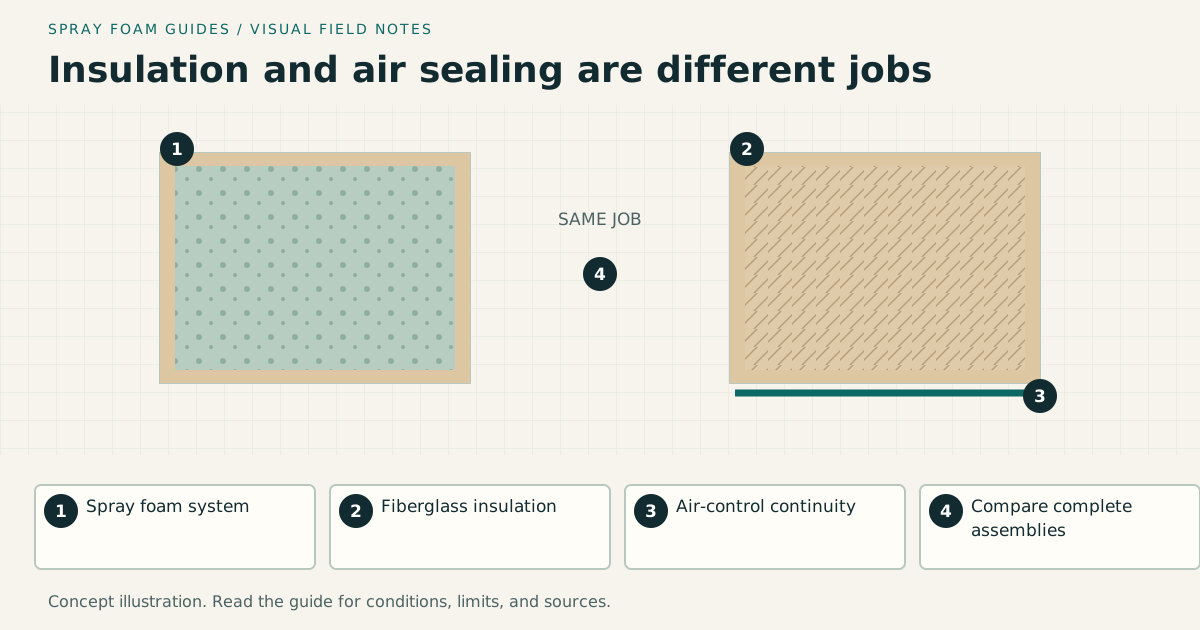
Fiberglass can provide cavity insulation but needs a separate, continuous air-control layer. Spray foam can combine air control and insulation in accessible assemblies, but it adds chemical-process, inspection, removal, and vapor-profile considerations. Compare installed costs using the same completed scope.
On this page
The short answer
Choose spray foam when its air-control and geometry advantages solve an assembly problem and the risk controls are feasible. Consider fiberglass when a separate air barrier can be detailed and inspected, especially if removable batts, future service access, or avoiding a field-sprayed insulation process matters.
This answer changes when…
- A separate air barrier can be installed and inspected
- The cavity is regular, open, and easy to fit without compression
- Drying potential and future wiring or repair access matter
- The job can support foam ventilation, isolation, and cure requirements
Dotted terms have plain-language definitions. Browse the glossary ↗
Is spray foam better than fiberglass?
Neither material is the better choice for every assembly. Spray foam can combine insulation with air control at suitable thickness and continuity, which can help in complicated open framing. Fiberglass can provide effective thermal insulation when it is fitted correctly and paired with a separate continuous air barrier. Compare the finished wall, attic, or floor rather than an isolated sample.
Start with three questions: Where is the enclosure boundary? Can a separate air barrier be installed and inspected? What must remain accessible for future repairs? The answers often narrow the choice more usefully than a generic R-value-per-inch ranking.
| Factor | Spray foam | Fiberglass |
|---|---|---|
| Available formats | Different spray and foamed-in-place systems | Batts, rolls, and blown systems |
| Air control | Possible with a suitable continuous approved layer | A separate air-control layer is needed |
| Regular open framing | Requires substrate and process control | Allows direct inspection of fit before closing |
| Complicated framing | Can conform to suitable irregular surfaces | Needs careful fitting or an appropriate blown system |
| Vapor behavior | Depends on formulation and thickness | Facings and other assembly layers are important |
| Future access | Bonded material can complicate removal | Batts can often be removed for service work |
| Installation planning | Chemical-process and occupancy controls | Dust, fiber, handling, and jobsite controls |
Give fiberglass a fair assembly comparison
Do not compare professionally installed foam with a poorly fitted old batt. DOE Building America’s batt-insulation guide emphasizes complete cavity coverage and fitting around wires and pipes. Gaps and compressed areas are installation issues that a scope and inspection can address.
In an open wall with an accessible sheathing or interior air barrier, ask for the labor to seal that layer and correctly fit the fiberglass. Include narrow cavities, headers, corners, and areas behind utilities. The low material price is only meaningful when that work is included.
Fiberglass is not limited to batts. Blown fiberglass can suit other geometries and retrofit methods, subject to the system’s density and coverage requirements. Name the actual format in the bid so “fiberglass” does not conceal two different installation approaches.
Where spray foam can earn its added complexity
Spray foam deserves consideration when irregular accessible surfaces make separate air-sealing details difficult, or when an approved system helps meet a defined depth constraint. Ask the contractor to point to those locations on the drawing. A clear explanation of the difficult detail is more persuasive than a claim that the entire material category is superior.
The benefit depends on the layer adhering, reaching its specified thickness, and connecting to adjoining air-control materials. It also depends on an appropriate moisture design and required protection. Read open-cell versus closed-cell foam before treating all spray foams as interchangeable.
A thin spot, missed transition, or substrate problem can undermine the intended result. Require an inspection plan that samples difficult areas, not just the broadest open cavity.
Compare attic floors and rooflines separately
For an accessible vented attic floor, air sealing followed by deep fibrous insulation is an important baseline option. ENERGY STAR’s attic guidance places sealing before additional insulation. Suitable foam or sealant can still play a targeted role without providing the entire thermal layer.
A roofline conversion is a different decision. Its scope includes attic moisture removal, roof condition, boundary transitions, and mechanical compatibility. Compare a complete roofline design with a complete attic-floor design using the attic guide. The proposals may have different areas as well as different materials.
If the room below is uncomfortable, ask whether the diagnosis also considered ducts, solar exposure, and other enclosure surfaces. Replacing insulation alone may not address the identified cause.
R-value, depth, and thermal bridges
Compare documented thermal values at the installed thickness and configuration. Do not assume a generic foam value applies to every formulation, or a nominal batt rating applies after an unsuitable fit or compression.
Cavity insulation also leaves framing paths in the wall. An assembly with better cavity insulation can still need attention to studs, plates, corners, and openings. Ask whether a quoted number is a product value, cavity value, or whole-assembly value. The exterior-wall guide includes a simplified parallel-path calculation that shows why the distinction matters.
For a depth-limited project, have each bidder state the available clear depth, proposed system, and accepted compliance method. Avoid treating a claimed R-value advantage as permission to omit the rest of the wall’s control layers.
Moisture and hybrid assemblies
Vapor behavior belongs to the complete assembly. Faced fiberglass, interior coatings, exterior foam, sheathing, and cladding can all affect the proposed drying strategy. Spray foam type and thickness also matter. Ask the designer to identify the intended air barrier, vapor-control layer, and drying direction.
A foam-and-fiberglass hybrid needs a reasoned design for the location and amount of each insulation. A thin arbitrary foam layer is not enough information to judge condensation control. Use air barriers and vapor retarders to frame the questions, then obtain the detail for the project’s climate and construction.
Neither material resolves an existing bulk-water leak. Keep repairs and substrate acceptance ahead of insulation in both proposals.
A worked cost-comparison exercise
Assume two bidders will insulate the same 600-square-foot open-wall area to the same accepted project target. One proposes fiberglass with a separate air-sealing phase; the other proposes a suitable spray-foam assembly. Instead of asking only for insulation price, create five lines: preparation, air control and insulation, protective finish, work-area and occupancy provisions, and verification.
If the fiberglass proposal excludes the separate air-sealing labor, request that price before comparing totals. If the foam proposal excludes the required covering or relocation-related scope, resolve those items too. Six hundred square feet is an illustrative common boundary, not a material quantity or a price estimate.
Also ask what future service work would cost in practical terms. If wiring changes are expected, an accessible service cavity may matter more than a small difference in insulation price.
Make a phased renovation comparable
If one room is open now and the rest of the house will be renovated later, ask how the new air barrier connects to the untouched construction. A perfect-looking insulated cavity can still end at an unresolved floor edge or partition. Mark the temporary boundary and the eventual connection in the scope.
| Planned later work | Detail to resolve now |
|---|---|
| Electrical upgrades | Accessible service route and restoration of any air-barrier penetrations |
| Window replacement | Connection that can be rebuilt without guessing which layer provided air control |
| Siding replacement | Compatibility with a future exterior insulation and drainage detail |
| Adjacent room renovation | Recorded termination of the current work and photographs before concealment |
This can change the practical value of removable batts, a service cavity, or a targeted foam detail. Ask for the expected repair sequence rather than assigning either material an automatic advantage. If the comparison includes blown fiberglass, use the fiberglass-versus-cellulose guide to evaluate its coverage and density evidence separately from batt fit. For another cavity option, compare mineral wool at the same thermal target and with the same air-control scope.
What to inspect and keep
For fiberglass, inspect fit at irregular cavities, utilities, edges, and supports before covering. For foam, request substrate records, installed-depth observations, continuity checks, and material identification. For either, verify the air barrier’s transitions and keep photographs before finishes conceal them.
Installation exposure planning differs. EPA’s archived spray-foam workplace guidance describes isolation, ventilation, and advance discussion of reoccupancy. Use current system instructions for the actual work. Fiberglass work also needs appropriate handling and dust controls; it should not be presented as a hazard-free installation.
Which is better for sound control?
Ask for acoustic test data for the complete proposed assembly. Insulation category alone does not establish performance through a wall or floor with doors, penetrations, and flanking paths. Thermal R-value is not an acoustic rating.
Can good air sealing make fiberglass perform well?
Yes, when the insulation is properly installed and the assembly’s other requirements are met. The practical comparison is the effort and cost of completing that air barrier versus the suitable foam alternative, including inspection and future access.
Research & references
Sources used for this guide
- Home Air Sealing ChecklistDOE Building America Solution Center · government guidance · United States · accessed 2026-09-05
- Recommended Home Insulation R-ValuesENERGY STAR · government guidance · United States · accessed 2026-09-05
- Spray Polyurethane Foam Insulation: How to Use It More Safely (archived)U.S. Environmental Protection Agency · government guidance · United States · accessed 2026-09-05
- Choosing the Appropriate Insulation TypeENERGY STAR · government guidance · United States · accessed 2026-09-05
- Batt Insulation for Existing Exterior WallsU.S. Department of Energy / Building America Solution Center · government guidance · United States; retrofit assembly guidance · accessed 2026-09-06
- Safer Workplace Practices for Spray Polyurethane Foam Installation (archived)U.S. Environmental Protection Agency · government guidance · United States; archived guidance · accessed 2026-09-05
A citation supports a specific statement, not every possible assembly or local code interpretation.