Material comparison
Spray Foam vs Mineral Wool: Air Control, Fire Evidence, and Access
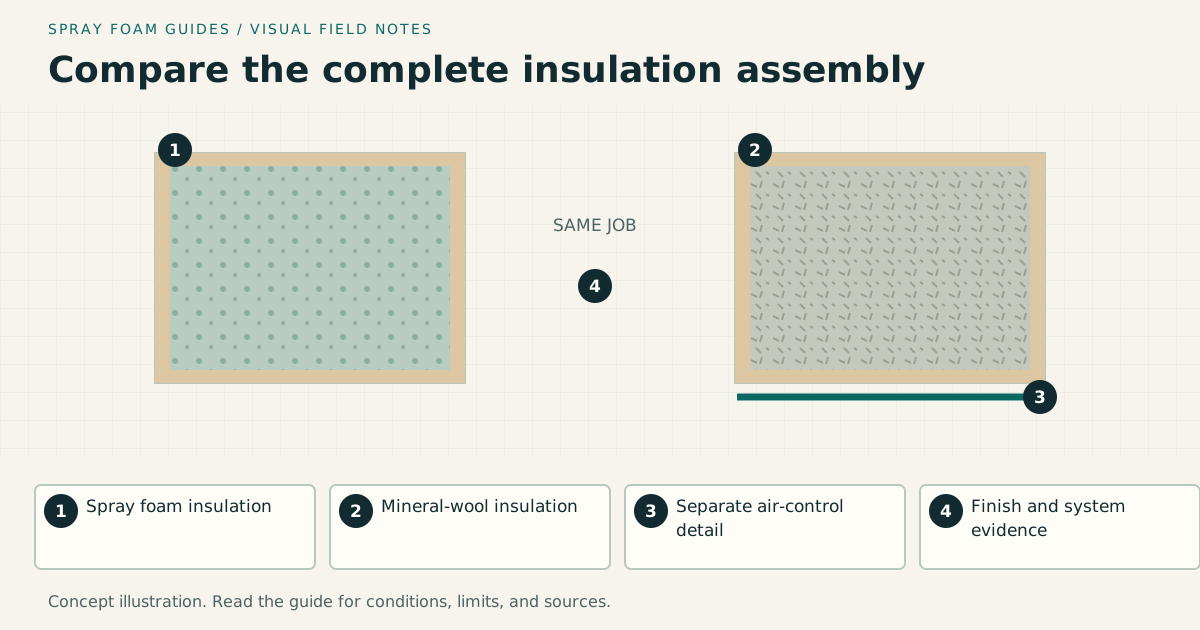
Spray foam can combine insulation and air control in suitable assemblies. Mineral wool batts and boards provide thermal insulation while relying on separate air-control details. Their formats, protective construction, moisture design, and future accessibility matter more than a universal winner.
On this page
The short answer
Choose the insulation format that fits the accessible assembly and its control layers. Give mineral wool a complete air-sealed assembly comparison, and require spray foam to solve a specific problem that justifies its installation and removal implications.
This answer changes when…
- The project uses cavity batts, exterior boards, or an approved spray system
- A separate continuous air barrier can be detailed and inspected
- Fire or acoustic requirements apply to a complete assembly
- Wall drying and future service access are priorities
Dotted terms have plain-language definitions. Browse the glossary ↗
Which is better: spray foam or mineral wool?
Mineral wool deserves consideration where cavities can be fitted well, a separate air barrier is achievable, and access or specific assembly requirements favor a fibrous system. Spray foam deserves consideration where its ability to follow suitable irregular surfaces helps complete insulation and air control. Neither choice settles the wall’s water management, fire protection, or acoustic performance by itself.
First identify which mineral wool format is under discussion. Cavity batts and exterior insulation boards are different products with different jobs. Comparing a batt between studs with a continuous board outside the studs confuses material choice with insulation placement.
This guide uses “mineral wool” for stone- or slag-wool insulation commonly described that way in U.S. residential specifications. Verify the product description rather than assuming any dense fibrous panel has the same approved use.
Match the format to the construction
| Situation | Mineral wool option to evaluate | Spray foam question |
|---|---|---|
| Regular open wall cavities | Correctly sized thermal batts with separate air control | What difficulty justifies a field-sprayed system here? |
| Exterior wall being re-sided | A suitable continuous-insulation board and attachment design | Is a proposed spray system approved for this exterior application? |
| Irregular accessible framing | Cut and fitted batts or another suitable fibrous arrangement | Can the foam bond, reach specified depth, and connect reliably? |
| Interior partition with a sound goal | A tested partition assembly using the specified infill | What complete acoustic test supports the proposed assembly? |
| Services likely to change | A detail that permits removal and restoration | What must be cut out and rebuilt for a future repair? |
| Roofline conversion | A complete designed roof assembly | How are roof moisture and attic conditioning resolved? |
For a finished wall that will remain closed, neither ordinary batts nor exposed-cavity spray foam is a direct substitute for a qualified retrofit method. Ask how the wall will be accessed and how hidden conditions will be evaluated. See exterior-wall insulation before choosing by material alone.
Give mineral wool its own air barrier
A friction-fitted batt can look tight while adjacent framing joints still leak. Ask the designer to identify the air barrier and trace its connections around the wall, windows, floors, and roof. Do not assign that job to cavity insulation merely because it holds its shape.
DOE Building America’s batt guide addresses fiberglass and mineral wool batts and emphasizes fitting cavities and obstructions without substantial gaps. Use that as a reason to inspect narrow bays, corners, piping, and wiring before the wall is covered.
For an exterior board system, the air barrier may be a separately detailed layer behind the insulation. Ask how fasteners, windows, and penetrations affect it. A continuous thermal layer is valuable, but “continuous insulation” does not mean every required air and water connection is already complete.
Spray foam can provide air control when its documented properties, thickness, continuity, and connections support that role. Wood-to-wood joints and transitions to other materials still need attention. The air-barrier guide explains how to separate this question from vapor resistance.
Distinguish cavity insulation from exterior insulation
A wall with mineral wool only between studs still has heat-flow paths through its framing. A suitable board layer outside the framing can address those paths, but it adds a different construction scope. DOE’s continuous-insulation guidance explains the thermal-bridging reason for exterior insulation.
Ask whether the comparison holds the insulation placement constant. A bid for cavity foam and a bid for cavity batts plus exterior board may differ in siding removal, trim, window details, and attachment. Their insulation labels do not explain the complete cost or thermal result.
Exterior mineral wool also needs an attachment design suitable for the board and cladding. Do not transfer a fastening schedule from a different foam-board assembly without review. Have the responsible designer explain how the cladding load reaches the structure and how insulation thickness is maintained around attachments.
Read fire evidence without turning it into a promise
Mineral wool is often selected partly for its fire-related properties, but ask for the exact evidence. Noncombustibility, surface-burning behavior, and the fire resistance of a wall or floor assembly answer different questions. None should be summarized as “this room is fireproof.”
For example, the ROCKWOOL board technical data sheet separately reports ASTM E136 noncombustibility information and ASTM E84 surface-burning information. It is a document-reading example for one board, not an endorsement or a statement about every mineral wool product.
If a project needs a rated wall, garage separation, or approved protection over foam plastic, obtain that complete assembly detail. A mineral wool layer should not be assumed to replace gypsum or another required protective system merely because a material test looks favorable. The thermal and ignition barrier guide provides the relevant distinctions.
Sound absorption is different from room-to-room isolation
Begin an acoustic request with the actual complaint: voices through a partition, footsteps above a bedroom, plumbing noise, or traffic through an exterior wall. The insulation is only one part of each problem.
The same board data sheet reports absorption results by thickness under ASTM C423. Those results do not state the sound transmission class of your finished bedroom wall. Ask for a complete assembly test matching framing, gypsum, cavities, attachment, and other relevant details when a bid promises a particular sound-isolation result.
Discuss doors, penetrations, ducts, and paths around the partition with the designer. Selecting denser insulation without addressing those paths may leave the principal complaint unresolved. Avoid ranking spray foam and mineral wool acoustically from a sample’s weight or thermal R-value.
Moisture and drying still belong to the assembly
Identify the layers that limit vapor movement, including facings, membranes, coatings, and any exterior foam. Ask where incidental moisture can dry and how rainwater is kept out. A vapor-open insulation choice does not guarantee that the layers around it permit drying.
Likewise, do not choose foam solely to make a damp wall more resistant to water. Repair the wetting source before either insulation hides the substrate. At foundations, clarify approved substrate and water-exposure conditions; a cavity batt and an exterior mineral wool board are not interchangeable foundation treatments.
For spray foam, compare open-cell and closed-cell properties at the proposed thickness. If a hybrid assembly is proposed, require a reason for the placement and amount of each layer rather than treating the mixture as automatically safer.
A worked comparison for a renovation
Assume a room renovation exposes 480 square feet of net exterior-wall area. Proposal A uses mineral wool batts and a separately detailed air barrier. Proposal B uses a suitable spray-foam system. Both target the same accepted thermal requirement and restore the same interior finish.
Ask each bidder to price the same five scopes: substrate preparation, insulation and air control, service details, required finishing, and verification. In A, the air-barrier work must appear somewhere. In B, chemical-process controls, any occupancy arrangements, and required protection must appear. This is a scope example, not a claim that the options have equal material quantities or cost.
Now assume the homeowner expects to move two plumbing connections later. Ask each bidder to describe that repair, including access, removal, restoration of air control, and finish repair. The answer makes future access a concrete decision instead of a vague claim that one material is more convenient.
Inspection and occupancy planning
For mineral wool, inspect fit, support, and the separate air barrier before finishes conceal them. For exterior boards, document attachment and transitions. For foam, request substrate observations, actual material identification, installed-depth records, and continuity checks. For both, keep the approved assembly and correction record.
EPA’s archived spray-foam guidance addresses isolation, ventilation, and advance reoccupancy discussions. Pair it with current system instructions for the actual job. Mineral wool cutting and handling also need the product’s specified controls; avoiding field-sprayed chemistry does not eliminate dust or contact precautions.
Can acoustic mineral wool replace a thermal batt?
Verify the product’s declared thermal performance and approved use at the installed thickness. A panel marketed for acoustic infill should not be assigned an assumed R-value to satisfy an exterior-wall requirement.
Can mineral wool replace foam at every rim joist?
Only with a complete air-control and moisture detail. A batt alone does not resolve the framing and foundation joints. Compare the actual rim-joist assembly, including access and inspection requirements.
Research & references
Sources used for this guide
- Batt Insulation for Existing Exterior WallsU.S. Department of Energy / Building America Solution Center · government guidance · United States; retrofit assembly guidance · accessed 2026-09-06
- Continuous Rigid Insulation SheathingU.S. Department of Energy / Building America Solution Center · government guidance · United States; assembly guidance · accessed 2026-09-06
- Comfortboard 80 Technical Data SheetROCKWOOL · manufacturer document · United States; specific nonstructural continuous-insulation board · accessed 2026-09-06
- Safer Workplace Practices for Spray Polyurethane Foam Installation (archived)U.S. Environmental Protection Agency · government guidance · United States; archived guidance · accessed 2026-09-05
A citation supports a specific statement, not every possible assembly or local code interpretation.