Work-zone control
Spray Foam Ventilation, Re-Entry, and Re-Occupancy
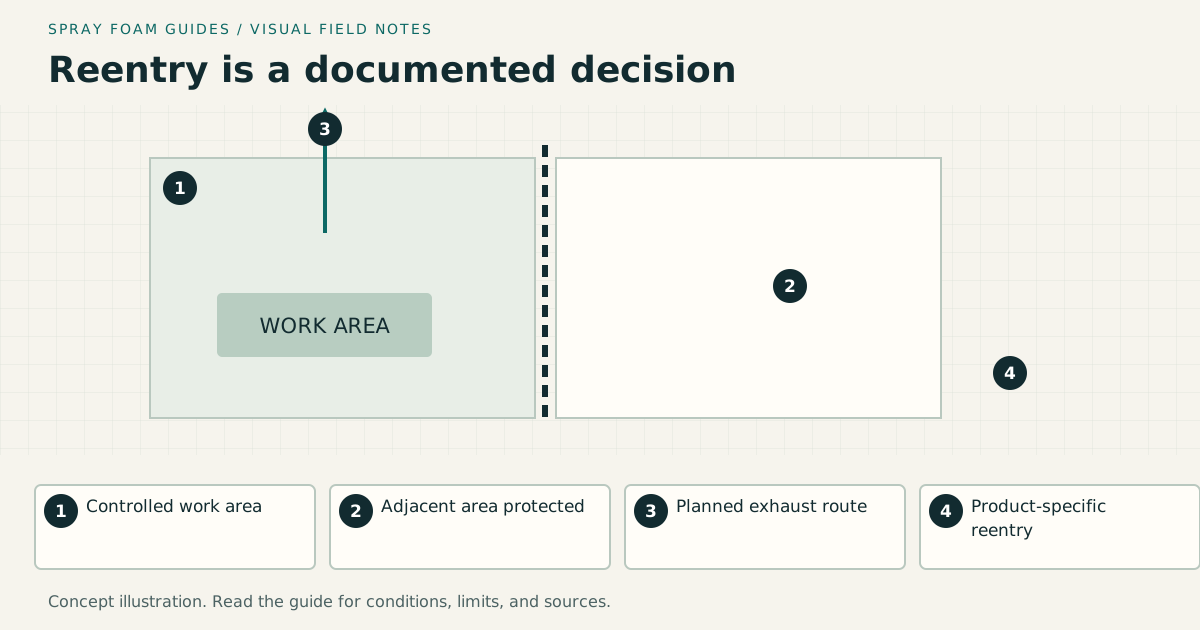
Ventilation must move air across the full spray area toward a safe exterior exhaust while preventing short circuits and migration into occupied spaces. Re-entry for protected workers and re-occupancy for residents are different decisions.
On this page
The short answer
There is no reliable universal re-entry hour. Follow the exact product and manufacturer instructions and account for formulation, cure, temperature, humidity, ventilation, cleaning, work scope, and who is entering. Restrict access when those conditions cannot be verified.
This answer changes when…
- The work zone can be fully isolated from occupants, pets, neighbors, and air intakes
- Make-up air and safe outdoor exhaust can be established
- HVAC openings and pathways can be protected without creating another hazard
- Manufacturer cure and re-entry instructions match the exact product and conditions
Dotted terms have plain-language definitions. Browse the glossary ↗
Ventilation is a flow path
EPA’s archived ventilation guidance describes make-up air entering on one side of the zone and exhaust collecting contaminants near the source, with work progressing away from the exhaust. The zone should remain isolated and under appropriate pressure so contaminants do not move into the rest of the building.
Key plan elements:
- Defined clean-air entry and exhaust collection locations.
- Outdoor exhaust away from people, vehicles, neighboring buildings, and air intakes.
- Enclosure and warning signs at every access point.
- HVAC registers and pathways protected against migration.
- Filters and fans suitable for the material and potential hazards.
- Continued ventilation after application according to product and site conditions.
Placing a box fan in a window without verifying the complete path is not a ventilation design.
For two-component insulation work, plan for residents, pets, and unprotected trades to vacate the building during application. Containment does not by itself authorize staying in another room. EPA’s occupant-access guidance limits presence during installation to appropriately protected workers. Resolve adjacent units and shared systems with the responsible professionals before work; do not assume a closed door establishes a safe boundary.
Re-entry is not re-occupancy
Re-entry may refer to trained, protected workers returning for a task. Re-occupancy means residents, children, pets, or other unprotected people using the space again. The second threshold can be more demanding.
The manufacturer should establish product-specific guidance. The job plan should state who can enter, for what purpose, with which protection, and what conditions end the restriction.
Do not use odor as clearance
Odor can persist for reasons that need investigation, and lack of odor does not measure air concentration. If symptoms or persistent odor occur, restrict access and escalate rather than extending an arbitrary timer.
Put the occupancy decision in the contract
Before the installation date, obtain the exact manufacturer’s return guidance and ask the contractor how the proposed site conditions match it. The written plan should distinguish the application period, continued restricted access, cleanup, protected worker access, and return by residents. These are different milestones, even when some occur on the same day.
Name the person responsible for checking completion and communicating the return decision. Include a contact method that works after the spray crew leaves. Residents should not have to infer permission from an unlocked door, a departed truck, or an automated text saying the job is complete.
Ask what happens if the actual product differs from the proposal, work runs late, the substrate is outside accepted conditions, or the ventilation system stops. A plan with no contingency can turn a lodging reservation or another trade’s schedule into pressure to return prematurely.
Read time statements carefully
A document may list a tack-free time, a trim time, a cure interval, a coating interval, and a re-occupancy recommendation. Copy each under its own heading. If a time statement does not say who can enter and under which conditions, ask the manufacturer to clarify that point in writing.
An advertised return interval may assume a specified application and ventilation scenario. Do not extend it to a different formulation, unusual thickness, failed foam, or an area that could not be ventilated as planned. Elapsed time cannot correct an unresolved installation problem.
For example, if residents were originally told to return the next afternoon but a ventilation failure occurred overnight, the original schedule requires reassessment. The homeowner’s task is to report the interruption and follow the revised professional guidance, rather than calculate an extra number of hours independently.
Account for the complete building
Review attached rooms, shared corridors, service chases, and HVAC connections with the contractor. A room door is not evidence that air paths are isolated. Exhaust placement also requires attention to neighboring occupants and air intakes, not only the interior work zone.
Discuss heating, cooling, freezing weather, and combustion equipment before any HVAC shutdown or enclosure change. Do not improvise shutting off essential equipment or blocking a combustion-air opening to make containment easier. Those conflicts require a competent site assessment and may change when or how the work can proceed.
For multifamily buildings or connected commercial spaces, involve the party responsible for the shared systems. Written access and notification arrangements should be established before installation. A plan suitable for a detached, empty room may not transfer to a unit served by common air paths.
Cleanup and later access need their own handoff
Ask who removes application debris, checks affected surfaces and access routes, restores protected building systems, and verifies that the area meets the agreed return conditions. The completion record should identify the product actually used and any departures from the original plan.
Keep that record for another trade that may return later. A drywall crew needs to know whether its access is permitted and whether any surfaces remain under investigation. Trimming, removal, and hot work raise different questions from simply occupying a completed room; the original return decision does not authorize every future task.
When the plan no longer fits
Unexpected persistent odor, suspected uncured material, or reported symptoms need a response beyond a routine calendar adjustment. Move away from possible exposure and obtain appropriate medical help for symptoms. Ask the installer and manufacturer to document the concern, and seek an independent exposure assessment where warranted.
Do not stay in the space to test whether an odor produces symptoms. Do not use a household air-quality display as a universal clearance instrument for foam chemistry. A qualified assessor should explain any proposed measurement, what it can detect, and how its result affects the return decision. The odor-response guide provides a record-building workflow for that situation.
Keep the final instructions accessible to every resident, including anyone returning after others have moved back. Clear communication is part of the handoff: the product, affected areas, completed checks, unresolved concerns, and responsible contact should be identifiable without reconstructing the entire project history.
Research & references
Sources used for this guide
- Ventilation Guidance for Spray Polyurethane Foam Application (archived)U.S. Environmental Protection Agency · government guidance · United States · accessed 2026-09-05
- Spray Polyurethane Foam Insulation: How to Use It More Safely (archived)U.S. Environmental Protection Agency · government guidance · United States · accessed 2026-09-05
- Safer Workplace Practices for Spray Polyurethane Foam Installation (archived)U.S. Environmental Protection Agency · government guidance · United States; archived guidance · accessed 2026-09-05
- Vacate and Safe Re-Entry Time for Spray Polyurethane Foam Application (archived)U.S. Environmental Protection Agency · government guidance · United States; archived product-specific occupant access guidance · accessed 2026-09-06
A citation supports a specific statement, not every possible assembly or local code interpretation.