Conditional material comparison
Spray Foam vs Cellulose: Air Sealing, Depth, Drying, and Retrofit
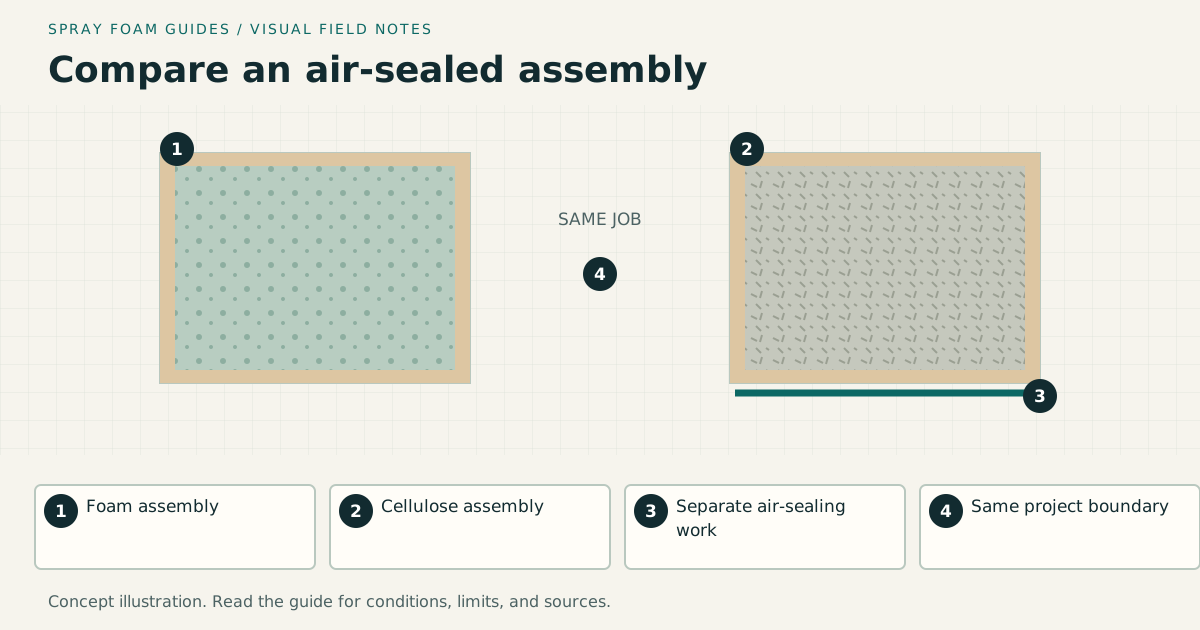
Cellulose can provide loose-fill attic insulation or dense-pack suitable cavities, while spray foam can create air and thermal control in one installed layer. Their strongest applications often differ. Compare local prices for the same completed boundary, thermal target, and air-sealing work.
On this page
The short answer
For a conventional vented attic, detailed air sealing plus deep blown cellulose is a practical option to assess. Spray foam deserves consideration at complex transitions, depth-constrained areas, or a designed roofline conversion when its documented properties address a specific assembly requirement.
This answer changes when…
- The insulation belongs at an attic floor, roofline, or enclosed wall
- A separate air-sealing phase is possible
- Cavity depth and settling or density control are documented
- Future access and leak detection are priorities
Dotted terms have plain-language definitions. Browse the glossary ↗
Should you choose spray foam or cellulose?
Cellulose often deserves a quote for deep vented attic insulation and suitable closed-wall retrofits. Spray foam can be useful at complex open transitions and in assemblies where a designed foam layer provides insulation and air control. Their strongest uses overlap only partly, so begin by identifying the location and access conditions.
For a conventional vented attic, compare air sealing plus loose-fill cellulose with any proposed full foam layer. For a roofline conversion, compare complete roof designs. For existing walls, distinguish dense-pack retrofit work from exposed-cavity spraying. These are different construction methods, not just different materials in the same shopping cart.
| Factor | Spray foam | Cellulose |
|---|---|---|
| Typical planning context | Open suitable surfaces and designed foam assemblies | Loose fill or specified dense-pack systems |
| Air-control role | Can provide air control when approved and continuous | Needs a separately defined air barrier |
| Deep attic floor | Requires a reason for a full foam layer | A practical format to evaluate after sealing |
| Enclosed wall | Requires a specifically approved closed-cavity system | Suitable cavities may be assessed for dense packing |
| Quantity verification | Installed area and depth, plus process records | Coverage, depth or density, and material records |
| Future access | Bonded foam can be difficult to remove | Loose material can be moved, with cleanup and restoration |
| Moisture planning | Formulation, thickness, and assembly drying | Water control, drying, and format-specific installation requirements |
Loose fill and dense pack are different cellulose jobs
Loose-fill attic cellulose builds thermal depth across a horizontal surface. Dense-pack wall insulation is installed in a confined cavity to a specified density. Do not use an attic depth assumption to estimate a wall cavity, or assume a wall system’s density requirements describe loose fill on an attic floor.
DOE Building America’s blown-wall guide calls for identifying framing and blocking, meeting the manufacturer’s dense-installation density, verifying cavity fill, and restoring affected air and drainage layers. Those details explain why a closed-wall retrofit needs more than a total bag count.
If a proposal uses a damp-spray cellulose system in open framing, ask for its own drying and enclosure criteria before finishes are installed. The Greenfiber fact-sheet example combines a minimum elapsed period with measured moisture acceptance and separate restrictions where finishes impede drying. Elapsed time alone is not clearance to close the wall. Name the actual format and documentation rather than relying on the single word “cellulose.”
Vented attics: seal the ceiling before adding depth
ENERGY STAR recommends air sealing before adding attic insulation. This sequence lets the contractor address ceiling penetrations and transitions while they remain reachable, then add the thermal layer.
Ask the bid to identify access protection, eave details, dams, service routes, and the method for verifying depth and coverage. Specify how the insulation around the hatch will remain effective after routine entry. A photo of a uniformly fluffy surface does not show every concealed ceiling opening.
Foam may still be appropriate at particular suitable air-leak locations. Ask why a proposal extends it across the entire floor. If the contractor cites limited depth, inaccessible transitions, or another specific constraint, evaluate that claim against the actual attic geometry and a fibrous alternative.
Rooflines require their own design
The comparison changes when insulation moves to the roofline. A designed roof assembly might use foam, cellulose, other fibrous insulation, rigid insulation, or combinations. The layout must resolve ventilation or unvented construction, moisture control, air-barrier continuity, and required protection.
Do not assume cellulose can simply be packed against any roof deck because it performs well on attic floors. Do not assume spray foam makes every unvented roof safe because it adheres to sheathing. The attic assembly guide explains the boundary decision and the associated mechanical and inspection questions.
If ducts are the reason for considering a conversion, compare duct repairs and other complete alternatives as part of the assessment. The choice should address the identified problem rather than follow a material preference.
Existing walls: access can decide the comparison
If interior finishes will remain, a qualified dense-pack assessment may fit the renovation better than opening all cavities for spray application. Ask how the contractor will handle existing batts, blocked cavities, narrow spaces, and areas above or below windows.
Any proposed foam injection needs documentation for that closed-cavity use. A surface-spray system should not be assumed suitable for injection through drilled holes. Ask how coverage will be confirmed and how unexpected resistance or damage will be handled.
If walls are already open, compare cavity systems and their separate air and water-control details. Use the opportunity to investigate leaks and inspect window flashings. The exterior-wall guide explains why adding insulation can make existing drying limitations more consequential.
Compare thermal performance using the actual installed system
Ask for the documented thermal value at the proposed depth, density, or installed configuration. A generic R-value per inch does not replace the selected system’s coverage information. For loose fill, the product’s stated installed and settled conditions need to be understood; for foam, the depth and formulation must be identified.
The entire assembly also includes framing and other layers. When a bidder claims a large performance advantage, ask whether the comparison holds area, thermal target, and air-sealing quality constant. An unsealed attic with deep fill is not a fair stand-in for a completed cellulose assembly.
ENERGY STAR’s material-selection page emphasizes installation quality and distinguishes insulation formats. Use it to frame project fit, then rely on the specific documentation for quantities and performance.
A worked coverage example
Assume a hypothetical loose-fill product’s coverage chart says one bag covers 20 square feet at a chosen thermal target when all listed depth and weight requirements are met. For a simple 1,000-square-foot area, the arithmetic minimum would be 1,000 ÷ 20 = 50 bags under those assumed chart conditions.
This is an invented coverage example, not a real product specification. The actual chart may require a particular minimum installed depth, settled depth, and weight per square foot. The estimator must also account for obstructions, existing insulation, and the real project area.
A foam quote for that same area needs its own specified thickness and installed verification. Do not convert the example’s bags directly into foam kits. Compare the complete thermal and air-control scope, including access, covering where required, cleanup, and inspection.
Wall density checks need a cavity volume
For a dense-pack proposal, ask how installed material quantity relates to the cavity volume and specified system density. As a simplified example, assume a group of unobstructed cavities has 120 square feet of net cavity-face area and 3.5 inches of depth. Its volume is 120 × 3.5 ÷ 12 = 35 cubic feet. At a hypothetical specified density of 3.2 pounds per cubic foot, that volume would contain 112 pounds of material.
The density is an invented arithmetic assumption, not a cellulose installation recommendation. Actual system requirements and cavity geometry control. Framing, existing insulation, blocking, spills, and material used elsewhere mean a delivery receipt cannot establish that every cavity is correctly filled. Ask what verification complements the quantity record and how excluded or inaccessible cavities will be documented.
The DOE blown-wall guide connects specified density with fill verification. A foam proposal needs different acceptance evidence, including approved use, substrate condition, and installed thickness. If the alternative is another blown fiber instead of foam, the fiberglass-versus-cellulose comparison provides a more direct format comparison.
Moisture, exposure, and future access
Neither insulation is a repair for roof or wall leaks. Before installing either, agree on substrate condition and the response to unexpected wetting. Ask how the finished assembly will dry and how a future leak will be investigated.
Cellulose installation involves dust and handling controls. Foam adds a reactive chemical process and an isolation, ventilation, and return plan. Consult ventilation and reentry if foam is proposed, and request the current instructions for the selected system.
Future work also has costs. Loose fill may be moved for access and then restored to its required coverage; bonded foam may require cutting and removal. Tell the estimator about expected wiring, plumbing, or roof work before finalizing the material choice.
Will cellulose settle and leave empty wall sections?
A suitable dense-pack wall system is specified and verified differently from loose attic fill. Ask for the manufacturer’s density requirements, cavity assessment, and fill verification. The possibility of poor installation is a reason to specify quality control, not to assume every cellulose wall will fail.
Which is the cheaper option?
Obtain local prices for the same completed boundary and target. Cellulose deserves a serious comparison where deep fill or suitable retrofit access fits the project. The total depends on air sealing, preparation, access, restoration, and inspection as well as material cost.
Research & references
Sources used for this guide
- Adding Attic InsulationENERGY STAR · government guidance · United States · accessed 2026-09-05
- Recommended Home Insulation R-ValuesENERGY STAR · government guidance · United States · accessed 2026-09-05
- Home Air Sealing ChecklistDOE Building America Solution Center · government guidance · United States · accessed 2026-09-05
- Choosing the Appropriate Insulation TypeENERGY STAR · government guidance · United States · accessed 2026-09-05
- Blown Insulation in Cavities of Existing Exterior WallsU.S. Department of Energy / Building America Solution Center · government guidance · United States; retrofit assembly guidance · accessed 2026-09-06
- Unvented Conditioned Attic with Spray Foam Below the Roof DeckDOE Building America Solution Center · government guidance · United States · accessed 2026-09-05
- SANCTUARY Fact Sheet, Revision KGreenfiber · manufacturer document · United States; specific product coverage and installation conditions · accessed 2026-09-06
A citation supports a specific statement, not every possible assembly or local code interpretation.