Foam sealant decision guide
Big Gap Filler vs Gaps & Cracks Foam
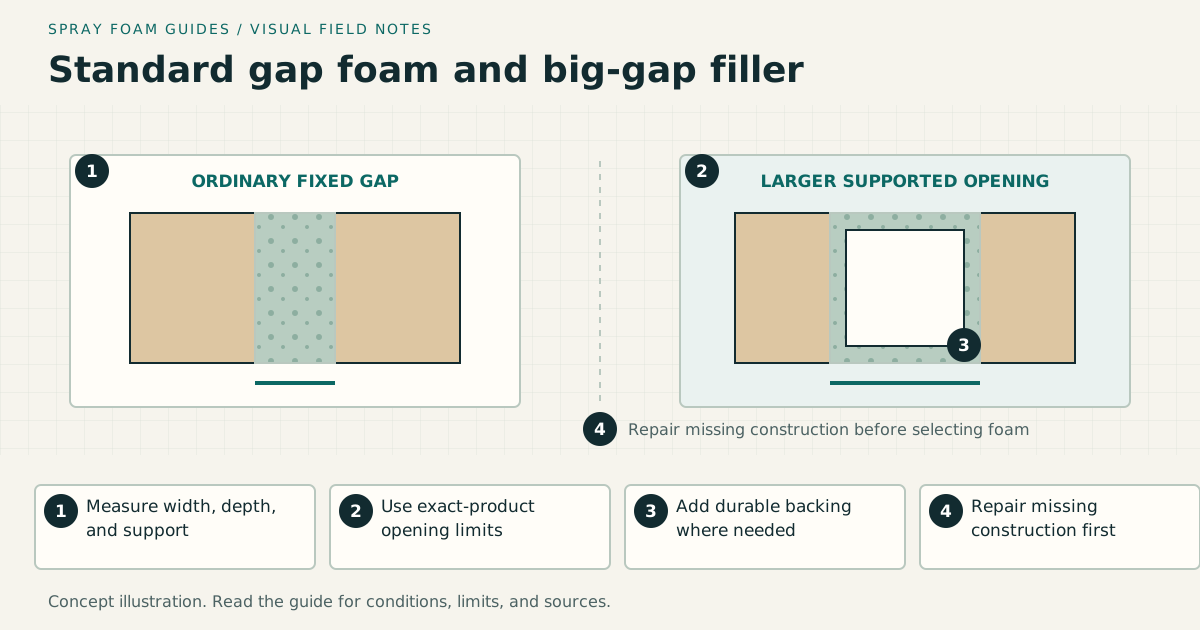
Big-gap filler is a higher-expansion branch of one-component gap sealant intended for larger eligible openings. The label's maximum gap is a limit for that exact product, not permission to fill a deep cavity, bridge a missing building component, bury a service, or replace durable backing.
On this page
The short answer
Measure the opening and identify what should physically span it. Use standard gaps-and-cracks foam for a compatible ordinary joint within the exact product's range. Research big-gap foam when the opening exceeds that range but remains visible, supported, and specifically allowed. Repair missing construction or add suitable backing when the opening needs structure, durability, pest resistance, fire performance, or controlled geometry.
This answer changes when…
- The narrowest and widest parts, depth, and support of the opening are visible and measured
- The gap is a fixed joint rather than a moving joint, drainage path, vent, or required clearance
- Wiring, plumbing, ducts, hot surfaces, pests, moisture, and rated assemblies have been checked
- The product's exact opening limit, fill guidance, substrates, exposure, and cure conditions are available
- A rigid repair, mesh, mortar, backer, escutcheon, or compatible sealant may be a better primary closure
Dotted terms have plain-language definitions. Browse the glossary ↗
The category relationship
Big-gap filler is a specialized gaps-and-cracks foam. Both categories fill and air-seal eligible fixed openings. A big-gap formulation is marketed for a larger opening range and typically expands more. That added capacity does not turn the cured bead into framing, sheathing, flashing, pest-proof metal, firestop, or a structural patch.
The useful question is not “Which foam expands the most?” It is “What complete closure does this measured opening need, and which exact product is documented for the sealant part of that closure?”
A current example shows why limits stay product specific
DuPont currently describes one GREAT STUFF Gaps & Cracks variant for gaps up to one inch and its Big Gap Filler line for openings up to three inches. That comparison is useful inside the named product family. It does not create a universal rule that every standard foam is a one-inch product or every big-gap foam is safe at three inches.
Another manufacturer may publish a different limit, define the dimension differently, require backing, restrict the substrates, or give different fill and cure instructions. Package variants under one familiar product name can also differ.
Record the full name, can size, dispenser, revision date, and exact page or data sheet. Do not transfer the largest number found on a family page to a different can in the cart.
Side-by-side decision table
| Question | Standard gaps-and-cracks foam | Big-gap filler foam |
|---|---|---|
| Base function | Fill and air-seal a compatible fixed gap | Fill and air-seal a compatible larger fixed opening |
| Selection trigger | Opening falls within the exact standard product’s documented range | Opening exceeds the standard range and falls within the exact big-gap product’s range |
| Expansion | Product specific; often positioned for ordinary gaps | Product specific; commonly positioned for greater expansion |
| Required visibility | Opening and adjacent conditions still need inspection | More important because greater volume can hide depth, services, voids, and support |
| Structural role | None unless exact documents establish a separate use | The name “big gap” does not establish structural capacity |
| Backing | May be needed to control geometry or bridge missing material | Often central to the repair when the hole cannot support a visible, controlled bead |
| Pest role | Seals an entry path but is not assumed chew-proof | More foam does not make a rodent-resistant closure |
| Fire role | Only the exact documented and accepted use | Size capacity does not create fireblock or firestop approval |
| Weather role | Needs an exterior water and UV plan | Larger exposure increases the importance of flashing, finish, and durable construction |
Gap width is only one dimension
A tape measure across the face gives a width, but a real opening also has height, depth, taper, support, and connected volume. A one-inch crack between two solid framing members is different from a one-inch slot that opens into an unbounded wall cavity.
Record at least:
- Minimum and maximum face width
- Opening height or length
- Accessible depth
- Whether the back and sides are solid, porous, dusty, wet, damaged, or absent
- Whether the path widens behind the visible face
- What room, chase, cavity, or exterior condition lies beyond it
- Whether nearby materials or services can move
If a straw disappears into the opening and foam keeps flowing out of sight, the installer no longer has useful control of the geometry. Stop and create an inspectable closure design.
Joint, hole, missing component, and cavity are different jobs
Fixed joint
A narrow stationary connection between compatible materials can be a good sealant joint. Examples may include an eligible framing seam, sill transition, or annular service opening after all other conditions are cleared.
Bounded hole
A larger opening through a solid element may support a big-gap product if the exact documentation covers its dimensions, materials, depth, and exposure. Backing or a durable collar may still be required.
Missing building component
Broken sheathing, damaged masonry, absent blocking, open siding, failed trim, or a removed vent screen should be repaired as construction. Filling the space with more foam hides the failure without restoring the intended water, structural, pest, or finish function.
Connected cavity
A wall, floor, soffit, or ceiling void is not a gap-filler target simply because the nozzle fits. One-component canned foam is not a generic closed-cavity injection system. The exact instructions can prohibit filling closed cavities or voids. Broad insulation work belongs with a documented insulation system and a complete assembly plan.
Backing controls the closure
Backing gives a sealant a defined shape and prevents material from disappearing into an empty volume. Depending on the detail, the primary closure might use:
- Repaired wood, sheathing, gypsum, masonry, or trim
- A compatible backer material for a sealant joint
- A metal escutcheon around a service
- Corrosion-suitable mesh or sheet metal for pest exclusion
- Approved fireblocking material
- Components specified in a listed penetration system
Foam may close the irregular edge after that durable element is placed. This is especially useful at a pipe through a rough masonry opening or an irregular framing transition. The backing carries the span; the compatible sealant carries the air seal.
Do not assume any improvised filler is chemically compatible, moisture safe, or acceptable in a fire-sensitive assembly. The detail and product instructions have to agree.
Greater expansion creates different control needs
Expansion helps fill irregular space, but it also increases the need to control placement. The practical risks include:
- Material projecting beyond the intended joint
- Adhesion only at the visible face while a deeper route remains open
- Foam covering a leak, damaged conductor, valve, connector, or pest evidence
- Pressure on a vulnerable finish or component
- Large beads curing differently from the conditions used for published cure statements
- Hidden voids or unsupported sections inside an oversized opening
A big-gap label does not answer those concerns. Follow the exact fill, moisture, temperature, trimming, layer, and cure instructions. Where the completed geometry cannot be inspected, redesign the access or closure rather than treating extra volume as verification.
Windows and doors remain a separate formulation decision
A frame-to-rough-opening joint can fall within the same width as an ordinary gap while still requiring a designated low-pressure window and door product. Width does not override sensitivity to pressure, seasonal movement, shims, anchorage, alignment, operation, drainage, or flashing.
Do not move from window foam to big-gap foam solely because one section of the perimeter looks wider. Correct the rough-opening detail, support, or installation condition and confirm the unit manufacturer’s permitted seal before selecting material. The window and door versus general foam guide owns that decision.
Pests turn the opening into an exclusion detail
An opening large enough to invite big-gap foam may also admit rodents, insects, or other animals. EPA pest-entry guidance warns that rodents can chew through spray foam and other common materials. More foam does not solve that limitation.
Where gnawing or displacement is plausible, the complete repair may use metal, mesh, mortar, an escutcheon, or a repaired building component as the durable barrier. Compatible foam can seal irregular edges. Pest-block foam can add an exact-product pest claim, but it remains a gap sealant and does not automatically replace the durable component.
Use the pest-block versus gaps-and-cracks guide to classify that specialty separately from opening size.
Electrical, heat, and service access can disqualify the opening
Large openings often occur where several services pass through one framing or masonry location. Inspect before reducing access.
- Keep foam out of electrical boxes, terminals, connectors, and serviceable junctions
- Do not bury damaged wiring or plumbing leaks
- Preserve access to valves, cleanouts, dampers, and equipment panels
- Identify hot pipes, flues, chimneys, exhausts, fixtures, motors, and manufacturer clearances
- Separate ordinary air sealing from required fireblocking and listed firestop systems
- Confirm compatibility with cable jackets, piping, insulation, conduit, and adjacent sealants
A crowded service opening may need qualified trade work and a designed sleeve or collar. The fact that a three-inch foam product could fill the visible space is not a reason to conceal it.
Exterior openings need a water-shedding repair
Water resistance on a product page does not convert cured foam into flashing, a drainage plane, a foundation waterproofing system, or a repair for missing cladding. At an exterior opening, trace how water reaches the location and how it exits.
The primary exterior work can include repairing flashing, restoring a weather-resistive layer, replacing damaged trim or siding, adding a sloped hood or collar, and using the correct exterior sealant joint. Foam may sit behind that weather surface as an air seal if the exact detail supports it.
Confirm UV protection and coating requirements. A thick exposed mound can weather badly, hold debris, interfere with drainage, and make later service difficult even if its center remains cured.
Fire and code roles override gap size
If the opening is at a required fireblocking location, select an accepted fireblocking detail. If it penetrates a fire-resistance-rated assembly, use the listed firestop system for the exact construction and penetrant. Neither standard gap foam nor big-gap foam becomes eligible from opening size alone.
A Class A surface-burning result is another separate piece of evidence. It does not prove the foam can replace required blocking, maintain an hourly rating, or remain exposed. The fireblock versus firestop guide provides the full classification sequence.
Choose the dispenser after the formulation
Standard and big-gap products can use an original straw, an integrated controlled dispenser, or a compatible threaded gun depending on the manufacturer and variant. Delivery affects:
- Start and stop control
- Bead placement
- Reach and visibility
- Restart and storage conditions
- Can size and job scale
- Tip and cleaner compatibility
It does not prove the opening range. A gun capable of dispensing a wide bead does not make the attached product a documented big-gap filler. A high-expansion straw product does not become safer because the installer applies less trigger pressure.
Match the formulation to the opening first, then use the dispenser comparison for access and workflow.
Worked decision examples
Half-inch pipe gap through solid framing
The opening is visible, stationary, dry, supported, away from heat, and within an exact standard product’s permitted range. General gaps-and-cracks foam may be the proportionate category after electrical, plumbing, fire, exterior, and pest checks.
Two-inch irregular hole around a pipe through masonry
The face width alone points toward big-gap research, but the final detail depends on depth, water, pipe movement, exterior finish, pest exposure, and backing. A rigid collar or compatible backing may carry the opening while foam seals the irregular annular path.
Four-inch missing piece of sheathing
This is a building repair, not a request for the largest-expanding can. Restore the sheathing, water layer, cladding detail, pest resistance, and interior control layers. Use sealant only at the defined joints created by that repair.
Slot at the top of a framed wall
The location may be part of required fireblocking. Classify the code function before looking at standard or big-gap foam. An approved solid blocking detail may be the primary solution.
A practical selection sequence
- Expose and measure the complete opening. Record face dimensions, depth, taper, support, and the space beyond.
- Preserve required functions. Check ventilation, drainage, combustion air, movement, and service access.
- Inspect hazards. Resolve water, damage, pests, wiring, heat, and unknown materials before concealment.
- Classify the repair. Decide whether it is a sealant joint, bounded hole, missing component, connected cavity, fireblocking location, or rated penetration.
- Choose the primary closure. Repair construction or add approved backing, metal, mesh, blocking, or another durable element where needed.
- Select the exact sealant family. Standard gap, big gap, window and door, pest block, fireblock, or another compatible material.
- Select delivery and application controls. Match straw, controlled dispenser, or gun to visibility, quantity, restart, and exact compatibility.
- Inspect before covering. Verify continuity, product identity, exterior protection, preserved services, and required code inspection.
What to compare after the opening is solved
For exact products, compare supported gap range, package variant, dispenser, substrates, application temperature, cure conditions, yield basis, weather and UV instructions, technical documents, and special claims. Treat all values as exact-product evidence.
Best Spray Foam’s gap-filler research contains the product layer. Use it after the project record establishes whether ordinary gap foam, big-gap foam, another sealant, or a built repair actually belongs in the opening.
Research & references
Sources used for this guide
- GREAT STUFF Gaps & Cracks Insulating Foam SealantDuPont · manufacturer document · United States; exact-product example of a general fixed-gap sealant and stated opening limit, not a transferable category limit · accessed 2026-09-07
- GREAT STUFF Big Gap Filler Insulating Foam SealantDuPont · manufacturer document · United States; exact-product example for larger gaps and stated opening limit, not permission to fill an unsupported or uninspected void · accessed 2026-09-07
- Attic Air Sealing and InsulationDOE Building America Solution Center · government guidance · United States; distinction between narrow sealant joints and larger blocked openings, not a universal product specification · accessed 2026-09-07
- Air Sealing Electrical WiringDOE Building America Solution Center · government guidance · United States; electrical air-sealing concepts and model-code links, subject to the actual assembly and local requirements · accessed 2026-09-07
- Indoor airPLUS Technical Bulletin: Pest Entry PreventionU.S. Environmental Protection Agency · government guidance · United States; durable pest-exclusion details and chewing limitations, subject to the actual opening, service, weather exposure, and local requirements · accessed 2026-09-08
- Quick Safety Tips for Spray Polyurethane Foam Users (archived)U.S. Environmental Protection Agency · government guidance · United States; archived guidance · accessed 2026-09-05
A citation supports a specific statement, not every possible assembly or local code interpretation.