Rough-opening product comparison
Window & Door Foam vs General Expanding Foam
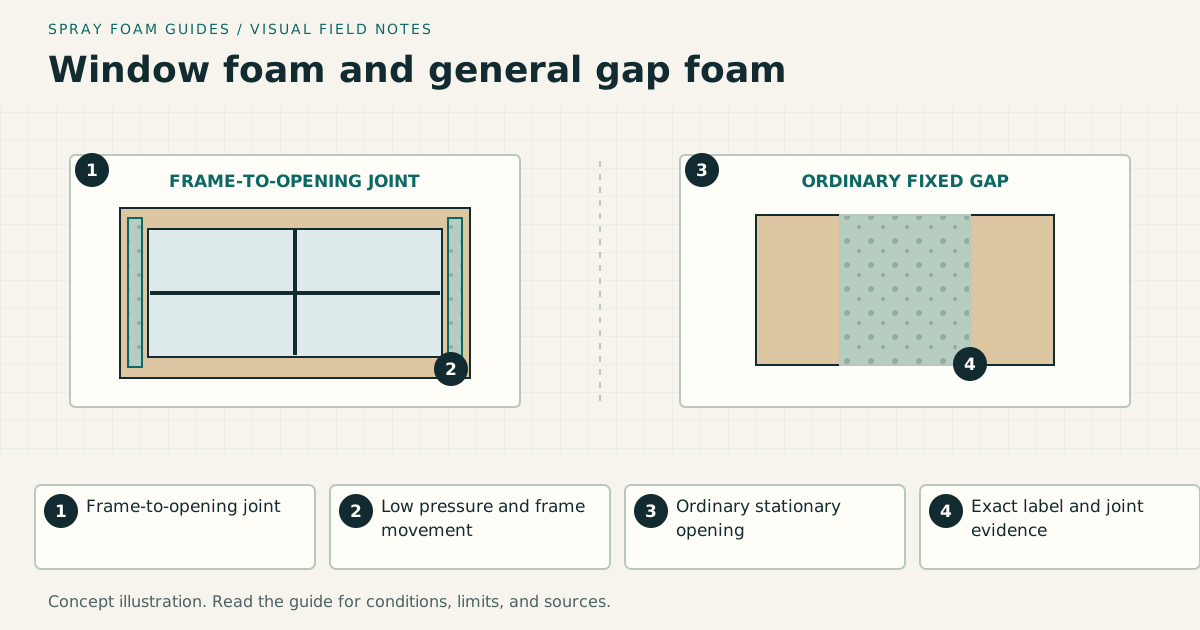
Window and door foam is a specialized gap filler designed for the joint between a frame and its rough opening. Its selection depends on documented low pressure or minimal expansion, and often flexibility. General gaps-and-cracks foam belongs at compatible stationary openings where frame distortion and seasonal frame movement are not the controlling concerns.
On this page
The short answer
Use a low-expansion foam designated for windows and doors when foam is allowed at the frame-to-rough-opening joint. Use general gaps-and-cracks foam for other eligible fixed joints within the exact label. Do not spray hinges, tracks, weatherstripping, weep holes, or flashing paths, and do not assume a pro-gun package automatically contains window and door formulation.
This answer changes when…
- The joint touches a window or door frame that must remain square and operable
- The unit manufacturer allows foam and identifies a location or material requirement
- The gap is an interior air-seal joint, an exterior weather joint, or part of a drainage path
- The opening width and depth require foam, backer rod and sealant, or another approved detail
- Seasonal movement and cured flexibility matter to long-term continuity
- The exact straw or pro-gun formulation documents low pressure or minimal expansion
Dotted terms have plain-language definitions. Browse the glossary ↗
Both products fill gaps, but only one is selected for the frame
Window and door foam and general gaps-and-cracks foam can both be one-component polyurethane sealants. Both can expand into an eligible void, adhere to compatible building materials, and reduce air leakage when properly installed. That shared base function is why store categories can feel confusing.
The decisive difference is the building component beside the bead. A window sash, window frame, or door jamb must remain aligned and operable. Excess pressure in the rough-opening joint can bow a frame or jamb. Seasonal movement can stress the cured seal. A product designated for windows and doors is selected because its exact documents address those conditions through low pressure, minimal expansion, flexibility, or a combination of those properties.
General gap foam is the broader category for compatible fixed openings. Even when a general product is described as minimal expansion, that wording alone does not establish the low pressure and frame-use evidence needed at a rough opening.
The quick comparison
| Decision point | Window and door foam | General gaps-and-cracks foam |
|---|---|---|
| Primary location | Between an installed window or exterior-door frame and the framed rough opening | Compatible stationary cracks, holes, and service penetrations |
| Controlling risk | Pressure on the frame, frame movement, unit operation, and continuity of the perimeter air seal | Filling the eligible opening without blocking another building function |
| Evidence to seek | Designation for windows and doors, low-pressure or minimal-expansion statement, and any flexibility or movement claim | Stated gap range, substrates, exposure, and intended general air-sealing uses |
| Can it fill a gap? | Yes, within the exact product instructions | Yes, within the exact product instructions |
| Can it be used at a window? | When the product and unit instructions allow the exact joint | Only if the exact evidence establishes suitability for that rough opening; do not infer it from generic expansion wording |
| Can it be used elsewhere? | Sometimes, if the exact label permits that compatible stationary joint | Yes, for its documented ordinary gap-sealing uses |
| Straw or gun? | Either can exist | Either can exist |
| What it does not replace | Shims, anchors, flashing, pan drainage, sealant joints, weatherstripping, or adjustment | Structural repair, flashing, firestop, moving-joint sealant, or broad insulation |
The right comparison is exact product against exact joint. Category names are the first filter, not the final specification.
Identify the joint before choosing the can
A window or exterior door contains several different connections. Calling all of them “the gap around the window” hides their separate jobs.
- Frame-to-rough-opening joint: The concealed space between the installed unit and the framing. This is the usual location for window and door foam, backer rod and sealant, or another allowed air-sealing detail.
- Exterior perimeter joint: The weather-facing connection between cladding, trim, flashing, and the unit. It must manage water and movement according to the wall and window system.
- Operating joint: The connection at the sash, door slab, weatherstripping, threshold, sweep, hinges, and latch. It must move and close as designed.
- Drainage path: Weep holes, sill-pan exits, flashing laps, and other routes that direct water out.
Foam at the first joint cannot replace the other three. Spraying a hinge, track, weep hole, or failed exterior caulk joint can create a new problem while leaving the actual air path open.
Why low pressure matters
DOE Building Science Education tells installers to use low-expansion foam designated for doors and windows when foam is used in the rough opening. The guidance is tied to the vulnerability of the frame, not to a preference for one brand.
Manufacturer documents show how the category is expressed. DuPont describes its Window & Door product as minimal-expanding with low pressure build and flexibility. DAP describes No Warp as a low-pressure product that allows trapped gas to escape rather than building pressure on the frame. Loctite describes window and door formulations as low expanding and flexible around seasonal movement.
These claims are useful only when attached to the exact product and package. Do not compare cans by visible expansion in an open test pile. Free-rise volume on scrap does not tell you the pressure generated inside a restrained joint.
“Minimal expansion” is not a universal grade
General gaps-and-cracks products may also use phrases such as minimal expansion. Window products may say low expansion, low pressure, low force, flexible, or no bow. Marketing vocabulary is not a common test scale unless the documents identify a shared standard and result.
For the exact window product, look for:
- A clear statement that it is intended for window and door rough openings
- Pressure, force, expansion, or no-bow language tied to that use
- Any cited window-installation standard or evaluation
- Cured flexibility or movement information, when claimed
- Maximum and minimum joint dimensions
- Substrate compatibility
- Temperature, moisture, cure, trimming, and finish conditions
- Compatibility with the unit manufacturer’s instructions and warranty
If the can only says “fills gaps” and the technical sheet does not address frames, keep it in the general gap category.
Where general gap foam belongs
General gaps-and-cracks foam is useful at compatible, stationary construction openings within its documented size range. Examples can include ordinary annular spaces around permitted plumbing or wiring penetrations, a fixed sill or framing joint, and accessible gaps in an attic or basement after moisture, heat, electrical, fire, and pest conditions are resolved.
The word “general” does not mean universal. Do not use it in:
- Moving or serviceable joints that need a flexible sealant or access
- A window or door rough opening without the required frame-use evidence
- Open wall cavities as a substitute for continuous insulation
- Unsupported large holes that need blocking or repair
- Drainage, ventilation, or combustion-air openings
- Hot clearances or electrical-box interiors
- A rated penetration unless it belongs to the applicable listed system
The whole-house product selector separates these conditions before shopping begins.
A window product can overlap with ordinary gap filler
Window and door foam still fills a gap. Some exact labels permit additional stationary air-sealing locations. That can make one window product useful beyond the rough opening. The permission must come from that product’s current label, not from the category name.
This overlap does not work automatically in reverse. The fact that a general gap foam fills the same width does not prove low pressure at a restrained frame. The more sensitive detail sets the evidence requirement.
For a mixed renovation, the practical material schedule might include one window and door formula for six rough openings and a separate general formula for ordinary utility gaps. If the exact window product also permits those utility gaps, a smaller project may consolidate products. Record the label basis for that decision rather than assuming all polyurethane foam is interchangeable.
Straw and pro gun describe delivery
Window and door foam exists in straw, controlled-dispenser, and threaded pro-gun packages. General gap foam does too. “PRO” identifies a compatible application system and often a larger can. It does not guarantee low-pressure window chemistry.
A pro gun can help meter a narrow bead, stop flow, reach behind an accessible jamb, and continue across many openings. A straw or integrated controlled dispenser can be more practical for one or two exposed joints. The formulation still comes first.
Check the front and back label for the complete name. “PRO Window & Door” and “PRO Gaps & Cracks” can fit the same gun while serving different decision categories. A long barrel improves reach, but it cannot make a blind cavity appropriate to fill.
The straw versus pro-gun guide covers output control, restart, maintenance, access, and job scale separately from formulation.
Measure the rough opening as a joint
Before buying material, remove only the trim necessary to inspect the accessible perimeter. Record:
- Joint width at several points
- Accessible depth and backing
- Shims, anchors, and fastener locations
- Existing fiberglass, backer rod, caulk, or foam
- Signs of water entry, staining, decay, corrosion, or insects
- Interior and exterior air or water paths
- Window or door operation before work
- Unit manufacturer, model, and available instructions
Fibrous insulation placed loosely in the cavity can slow heat flow, but DOE guidance notes that it does not create the air seal by itself. The air-control detail must be continuous around the perimeter.
Do not remove structural shims to create room for foam. Shims and fasteners hold alignment and transfer loads. Foam is not a replacement unless a specific tested installation system says otherwise.
Foam, backer rod, and sealant are different options
Not every rough opening should be filled with foam. DOE guidance includes canned window foam, caulk, or foam backer rod as possible parts of the air-sealing approach. The actual choice depends on joint size, depth, movement, access, and unit instructions.
Backer rod controls sealant depth and creates a joint shape that can move. Sealant creates a surface joint. Window and door foam can fill a deeper irregular space and create an air seal. A project can use different materials at the interior and exterior faces because those faces have different jobs.
Do not pack the entire void without understanding drainage. The exterior side must preserve the window or door system’s path for water to exit. An interior air seal can be continuous while the exterior water-management detail remains drainable.
Install for control and verification
This comparison does not replace the exact application instructions, but several planning controls apply across the category:
- Protect finishes, glass, hardware, and adjacent surfaces before opening the can.
- Confirm product, surface, and air conditions against the label and technical sheet.
- Test output on disposable material, especially with a new gun setting or dispenser.
- Apply only to the permitted frame-to-opening joint and keep the bead visible enough to inspect.
- Follow the stated fill fraction and wait time rather than filling the joint solid at once.
- Allow the stated cure before trimming or reinstalling trim.
- Check sash or door operation, reveal, latch, and weatherstripping after the foam has developed.
- Correct the cause if the unit binds. Do not force hardware to compensate for a distorted frame.
One-component polyurethane foam can expose workers and occupants to isocyanates and other chemicals. Follow the exact label and safety data sheet for ventilation, eye and skin protection, work-area control, cure, and occupancy. Retail package size does not make those instructions optional.
Diagnose drafts before filling
Air felt near a window does not prove that the frame-to-rough-opening joint is the leak. Possible routes include:
- Failed or missing weatherstripping at the operating sash or door slab
- An unsealed rough-opening perimeter behind trim
- A hole in the wall air barrier that connects to the trim cavity
- An outlet, baseboard, or framing bypass nearby
- An exterior seal or flashing defect that also brings water
- Normal cold-surface downdraft that feels like infiltration
Inspect and test before selecting the repair. A smoke pencil or blower-door-assisted investigation can help locate leakage when used safely and appropriately. Water staining, soft wood, corrosion, or active leakage needs diagnosis before the opening is concealed.
Renovation and replacement create different access
During new installation or full replacement, the rough opening is visible. The crew can verify flashing, shims, anchors, joint depth, backing, and perimeter continuity before trim. During an occupied-house retrofit, removing interior casing may reveal only one face. Injecting foam through a few drilled holes gives less control and can conceal incomplete coverage or pressure effects.
For an existing unit, first decide whether the problem is at the operating joint, perimeter air seal, exterior water detail, or the unit itself. The window, door, and small-gap project guide covers access, old paint, lead-safe work, concealed deterioration, and final operation in more detail.
Buying checklist
Use this checklist on the product page, can, and technical sheet:
- Exact name includes window and door use
- Low-pressure, low-force, no-bow, or equivalent performance is documented
- Joint-size range covers the measured opening
- Substrates include both sides of the proposed joint
- Unit instructions allow the material and location
- Dispenser matches the job quantity and access
- Cure and trimming schedule fits the work sequence
- Exterior exposure and UV protection are addressed
- Safety data sheet and work controls are available
- Remaining can and dispenser can be stored or cleaned exactly as directed
For an exact-product comparison after these gates are settled, continue to Best Spray Foam’s window and door category. The building detail defines eligibility; the product research compares the variants that remain.
Research & references
Sources used for this guide
- Rough Opening Flashing: Air SealingU.S. Department of Energy Building Science Education · government guidance · United States; rough-opening air-sealing guidance, subject to unit instructions, flashing design, local code, and the actual project · accessed 2026-09-08
- Air Sealing Window and Door Rough OpeningsDOE Building America Solution Center · government guidance · United States; window and door rough-opening details · accessed 2026-09-06
- GREAT STUFF Window & Door Insulating Foam SealantDuPont · manufacturer document · United States; exact-product example of minimal expansion, low pressure build, and rough-opening use, not approval for another product or window assembly · accessed 2026-09-07
- GREAT STUFF Gaps & Cracks Insulating Foam SealantDuPont · manufacturer document · United States; exact-product example of a general fixed-gap sealant and stated opening limit, not a transferable category limit · accessed 2026-09-07
- No Warp Window & Door Foam SealantDAP Global · manufacturer document · United States; exact low-pressure window and door foam example, not approval for another product, rough opening, or moving joint · accessed 2026-09-08
- How to Use Window Insulation Foam for a Draft-Free HomeHenkel / Loctite · manufacturer document · United States; manufacturer application example distinguishing straw and pro-gun window and door products, not a universal rough-opening procedure · accessed 2026-09-08
- Quick Safety Tips for Spray Polyurethane Foam Users (archived)U.S. Environmental Protection Agency · government guidance · United States; archived guidance · accessed 2026-09-05
A citation supports a specific statement, not every possible assembly or local code interpretation.