Foam sealant decision guide
Pest Block Foam vs Gaps & Cracks Foam
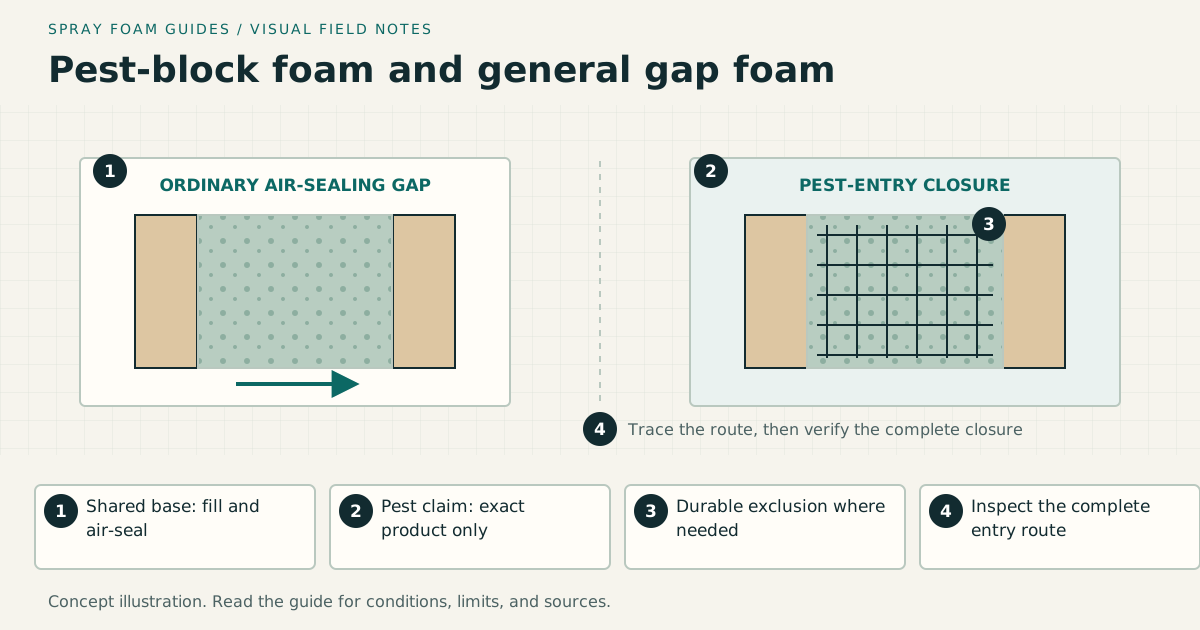
Pest-block foam and general gaps-and-cracks foam share the same basic job: filling and air-sealing an eligible stationary opening. Pest-block is the specialty branch. The important difference is the exact product's pest claim and supporting instructions, not a belief that every pest-labeled foam repels animals or cannot be chewed.
On this page
The short answer
Use general gaps-and-cracks foam for an ordinary compatible air-sealing joint. Investigate pest-block foam when the same opening is also a confirmed pest entry path and the exact label supports the location. For rodent-prone holes, make durable metal, mortar, or another gnaw-resistant component the primary closure where the detail allows it, then use compatible foam or sealant to close the remaining air path.
This answer changes when…
- The opening is an ordinary air leak, an active pest route, or both
- The target pest can pass through, nest at, or chew the proposed closure
- The hole needs rigid backing, metal protection, drainage, ventilation, or future service access
- The exact pest product makes a physical-blocking, additive, or pesticide claim
- The location is exposed to weather, UV, soil, water, heat, wiring, or a rated assembly
- The straw, controlled-dispenser, or pro-gun variant supports the measured opening
Dotted terms have plain-language definitions. Browse the glossary ↗
The category relationship in one sentence
Pest-block foam is a specialized gaps-and-cracks sealant. It fills an eligible opening and reduces airflow while the pest-specific label addresses entry through that opening. General gaps-and-cracks foam performs the first job without necessarily making the second claim.
That relationship explains why the products can look similar on a shelf and still belong in separate comparisons. It also prevents two common buying errors:
- Assuming a pest label changes foam into an unchewable structural patch.
- Assuming any ordinary gap filler provides the same documented pest performance as a product made and labeled for pest-entry closure.
Current manufacturer examples show the overlap directly. DuPont describes both its general Gaps & Cracks product and its Pestblock products as foams that fill, seal, and insulate gaps. The Pestblock line adds a pest-entry claim and a gray cured color. DAP describes Mouse Shield as both a pest blocker and a sealant for gaps and cracks. These examples establish that the categories overlap. They do not make one manufacturer’s claim transferable to another can.
Side-by-side decision table
| Question | General gaps-and-cracks foam | Pest-block foam |
|---|---|---|
| Base job | Fill and air-seal a compatible fixed gap, crack, or penetration | Fill and air-seal a compatible fixed gap while closing a pest entry path |
| Reason to select it | The detail needs ordinary gap sealing within the label | Pest entry is part of the problem and the exact product documents that use |
| Pest claim | May mention insects as a result of closing openings, or may make no pest claim | Carries a named pest-blocking or pest-control claim that must be read exactly |
| Repellency | Do not infer it | Do not infer it; some products explicitly contain no pesticide and work as physical barriers |
| Resistance to chewing | Do not assume cured foam is chew-proof | Do not assume it; the product may close entry without being gnaw-resistant |
| Primary repair for a rodent-prone larger hole | Often insufficient by itself | Often insufficient by itself; durable exclusion may still be needed |
| Dispenser | Straw, controlled dispenser, or compatible gun, depending on the exact variant | Straw, controlled dispenser, or compatible gun, depending on the exact variant |
| Opening limit | Product and package specific | Product and package specific |
| Fire or rated use | Only as documented | Pest wording does not establish fireblock or firestop approval |
The table compares decision roles. It does not claim that all products within a column have the same chemistry, density, expansion, adhesion, cure time, weather resistance, or opening limit.
Start by proving that the opening should be closed
A pest sighting does not automatically identify an exterior entry point. Trace the route before adding material. Look for rub marks, gnawing, droppings, damaged screens, daylight, air movement, and openings around utility runs. Inspect from both sides where possible. A hole behind a cabinet may connect to a plumbing chase, a crawl space, or only the cabinet void.
Then determine whether the opening has another required function. Do not close:
- A combustion-air or exhaust opening
- A soffit, ridge, foundation, crawl-space, or equipment vent that the design requires
- A window or wall drainage path
- A service connection that must remain accessible
- A clearance around a hot vent, flue, chimney, motor, or fixture
- An opening in a rated assembly without the applicable listed system
If an animal may still be inside, exclusion requires a plan that avoids trapping it in the building. Evidence of droppings, nesting, urine, or carcasses also creates a cleanup question separate from sealing. The CDC rodent guidance maps common inspection points, while its cleanup guidance should be used before disturbing contamination.
The closure has two layers: exclusion and air sealing
At a tiny insect path through an ordinary stationary joint, a compatible sealant may be the whole closure. A rodent-prone hole often needs a more durable design.
EPA pest-entry guidance explains that rodents can chew through spray foam, wood, and some plastics. It recommends corrosion-resistant metal mesh for qualifying holes and metal protection around penetrations in vulnerable details. CDC guidance similarly names steel wool with caulk or foam for small holes and lath screen, hardware cloth, sheet metal, or cement for larger holes.
Translate that guidance into two separate functions:
- Durable exclusion: The component resists displacement, weather, impact, and gnawing appropriate to the opening. Examples can include corrosion-suitable mesh, sheet metal, an escutcheon, mortar, or a properly repaired building component.
- Air and edge seal: A compatible sealant closes the smaller irregular path around the durable component and bonds to the supported substrates.
Foam can be useful in the second role. A pest-block product may add a documented specialty claim. Neither label removes the need to decide what physically spans the opening.
What “pest block” can mean
Read the exact wording instead of treating the category name as a chemistry specification. A product may work primarily by eliminating a point of entry. It may be specially treated. It may name particular animals or insects. It may explicitly say it contains no pesticides. Those are different claims.
For example, the current GREAT STUFF Pestblock line says it blocks entry without pesticides. Its manufacturer also states that determined rodents and small animals can chew through many materials, including the foam. DAP’s current Mouse Shield page says the product is crafted to block mice and other pests while sealing gaps and cracks. The proper conclusion is narrow: both are pest-oriented gap sealants, and their exact claims must remain attached to their exact products.
Avoid copy such as “repels rodents” unless the product’s current label actually makes a repellency claim. “Pest resistant,” “pest blocking,” “treated,” “pesticide free,” and “contains a repellent” are not interchangeable phrases.
Opening size belongs to the variant, not the category
Package type can change more than convenience. Within one current manufacturer line, the controlled-dispenser Pestblock version is described for gaps up to one inch, while the gun-applied PRO Pestblock version is described for gaps up to three inches. That is a variant-specific example, not a universal one-inch-versus-three-inch category rule.
Measure the narrowest and widest portions of the opening, its accessible depth, and what will support the foam. If the product label states a maximum gap, do not interpret that number as permission to fill an unsupported hole of the same width. A three-inch bead capability on a gun is also not the same thing as a product’s permitted three-inch opening.
For a deep or irregular route, filling until material stops disappearing gives no proof of continuity. Use visible backing and staged inspection where the building detail and product instructions allow it. Repair missing sheathing, damaged masonry, loose trim, failed flashing, or broken screening as building components rather than hiding them behind foam.
Straw and pro-gun versions do not define the specialty
Both pest-block and general gap products can be sold with more than one delivery system. The application package is a separate choice:
- A disposable straw can suit a few accessible openings and avoids maintaining a separate gun.
- A controlled can dispenser can improve shutoff, restartability, and bead control within that exact product line.
- A threaded pro gun can provide adjustable output, larger cans, repeat use, and reach through compatible tips.
A gun-applied can is not automatically pest-block foam. A straw can is not automatically generic foam. Read the formulation name and label first, then choose the delivery system. The straw, controlled-dispenser, and pro-gun guide compares these tools without assigning them a chemistry.
Common locations and the hidden condition at each one
| Location | Why foam may be considered | What to inspect before sealing |
|---|---|---|
| Pipe or cable through siding | Irregular annular gap can leak air and admit pests | Flashing, slope, UV exposure, service movement, water entry, and a durable collar |
| Under-sink cabinet penetration | Small utility gap provides an interior travel path | Leaks, escutcheon fit, pipe movement, contamination, and the actual wall connection |
| Garage sill or wall joint | Exterior pests and garage air can reach connected cavities | Required garage separation, water, slab movement, and continuity at adjoining assemblies |
| Crawl-space or basement rim area | Multiple utility entries and framing joints converge | Moisture source, termite inspection needs, foundation movement, and exterior access route |
| Eave, soffit, or roof edge | Insects or animals may use damaged construction | Required ventilation, roof drainage, damaged screening, nesting, and safe access |
| Door threshold or sweep | Light and insects show at a moving closure | Alignment, weatherstripping, threshold, drainage, and operating clearance; foam is rarely the moving seal |
The visible interior gap is often the last part of a longer route. An exterior repair may be necessary to stop water and pests before an interior air seal is useful.
Weather, UV, and finish are separate checks
“Interior/exterior” does not mean cured foam should remain exposed indefinitely. Exact products can require paint or another coating for UV protection. A foam described as water resistant is not automatically a flashing membrane, below-grade waterproofing, or repair for a leaking pipe.
At exterior service penetrations, plan the water-shedding layer first. Select compatible flashing, sealant geometry, and finish for the substrate and movement. Keep foam behind the weather surface unless the exact exterior detail and product documents support exposure. At ground-contact or termite-inspection locations, verify local practices before concealing a path that inspectors need to see.
Electrical, heat, and fire conditions can override pest selection
Pest routes often follow pipes and wiring, but the presence of a pest does not reduce electrical or fire requirements. Keep foam out of electrical boxes and connectors. Do not cover a damaged conductor or a junction that must remain accessible. Maintain required clearances from hot equipment and venting.
If the opening is at a prescribed fireblocking location, the relevant question becomes whether an exact fireblocking material and detail are accepted there. If the penetration crosses a fire-resistance-rated wall or floor, the project may need a listed firestop system. Pest-block wording, gray color, Class A surface-burning language, or a general fire claim cannot substitute for that system.
Purchase by evidence, not label color
Before choosing an exact product, record:
- Full product name, can size, color, and dispenser version
- Pest species or category actually named by the manufacturer
- Whether the product claims physical blocking, treatment, repellency, or pesticide-free performance
- Supported substrates and opening range
- Interior, exterior, weather, UV, and finish requirements
- Application temperature, surface preparation, cure, trimming, and storage instructions
- Personal protective equipment and ventilation instructions from the label and safety data sheet
- Evaluation report or local acceptance needed for any code-sensitive use
Gray, cream, orange, or black foam is easy to recognize, but color does not prove formulation, chewing resistance, weather durability, or code role. Save the label and data sheet for the installed exact variant.
A practical selection sequence
Use this sequence for a real opening:
- Locate both ends of the route. Identify where the pest enters and where the opening connects.
- Preserve required functions. Confirm drainage, ventilation, combustion air, clearances, and service access.
- Classify the opening. Record dimensions, movement, substrates, exposure, and whether a rated assembly is involved.
- Choose the primary closure. Repair the building component or add suitable metal, mortar, mesh, blocking, or another durable element when needed.
- Select the sealant family. Use pest-block foam when its documented specialty fits; use general gap foam for an ordinary eligible air-sealing joint.
- Select the delivery system. Match straw, controlled dispenser, or compatible gun to access, quantity, control, and maintenance.
- Verify and document. Follow the exact label and SDS, inspect the completed path from the accessible sides, protect exterior work, and schedule follow-up for renewed activity.
This process may produce a hybrid repair: a metal escutcheon around a pipe, compatible foam at the irregular annular space behind it, and exterior sealant or flashing at the weather face. That is more complete than asking which can is “strongest.”
When general gap foam is the better answer
Choose the ordinary gaps-and-cracks category when there is no established pest condition and the job is simply a compatible stationary air leak within the product’s documents. Examples may include an eligible pipe penetration, a narrow sill-plate joint, or another ordinary fixed gap after heat, water, electrical, movement, and code concerns are cleared.
This choice keeps the product claim proportional to the work. It can also provide more exact-product options for substrate, color, opening size, dispenser, and availability. Do not downgrade a known pest route merely to use a can already on hand.
When pest-block foam is the better research category
Move to pest-block products when inspection shows that closing the opening is part of an exclusion plan and the exact product names the relevant use. The specialty is most valuable where the foam must both seal the residual air path and carry a documented pest-entry claim.
That still leaves several separate decisions: whether a durable gnaw-resistant component is required, whether an infestation must be addressed first, whether exterior water management needs repair, and whether the exact package can reach and fill the measured joint without losing visibility.
After those decisions are made, compare exact candidates at Best Spray Foam’s pest-block category. Use its product research as the final product layer, not as a substitute for the opening assessment.
Research & references
Sources used for this guide
- How to Seal Up to Prevent RodentsCenters for Disease Control and Prevention · government guidance · United States; pest-exclusion material guidance and inspection locations, not approval of one foam product or a substitute for infestation cleanup · accessed 2026-09-08
- Indoor airPLUS Technical Bulletin: Pest Entry PreventionU.S. Environmental Protection Agency · government guidance · United States; durable pest-exclusion details and chewing limitations, subject to the actual opening, service, weather exposure, and local requirements · accessed 2026-09-08
- GREAT STUFF Pestblock Insulating Foam SealantDuPont · manufacturer document · United States; exact pesticide-free entry-sealing product example and manufacturer chewing limitation, not a complete pest-exclusion design · accessed 2026-09-07
- GREAT STUFF PRO Pestblock for PRO Dispensing GunDuPont · manufacturer document · United States; exact gun-applied pest-block gap-sealant example with variant-specific opening limit and pesticide-free entry-blocking claim · accessed 2026-09-07
- GREAT STUFF Gaps & Cracks Insulating Foam SealantDuPont · manufacturer document · United States; exact-product example of a general fixed-gap sealant and stated opening limit, not a transferable category limit · accessed 2026-09-07
- Mouse Shield Foam Sealant & BlockerDAP Global · manufacturer document · United States; exact pest-block foam example that also seals gaps and cracks, not a transferable pest or substrate claim for other products · accessed 2026-09-08
- Quick Safety Tips for Spray Polyurethane Foam Users (archived)U.S. Environmental Protection Agency · government guidance · United States; archived guidance · accessed 2026-09-05
A citation supports a specific statement, not every possible assembly or local code interpretation.