One-component dispenser field guide
Straw vs Controlled Dispenser vs Pro Foam Gun
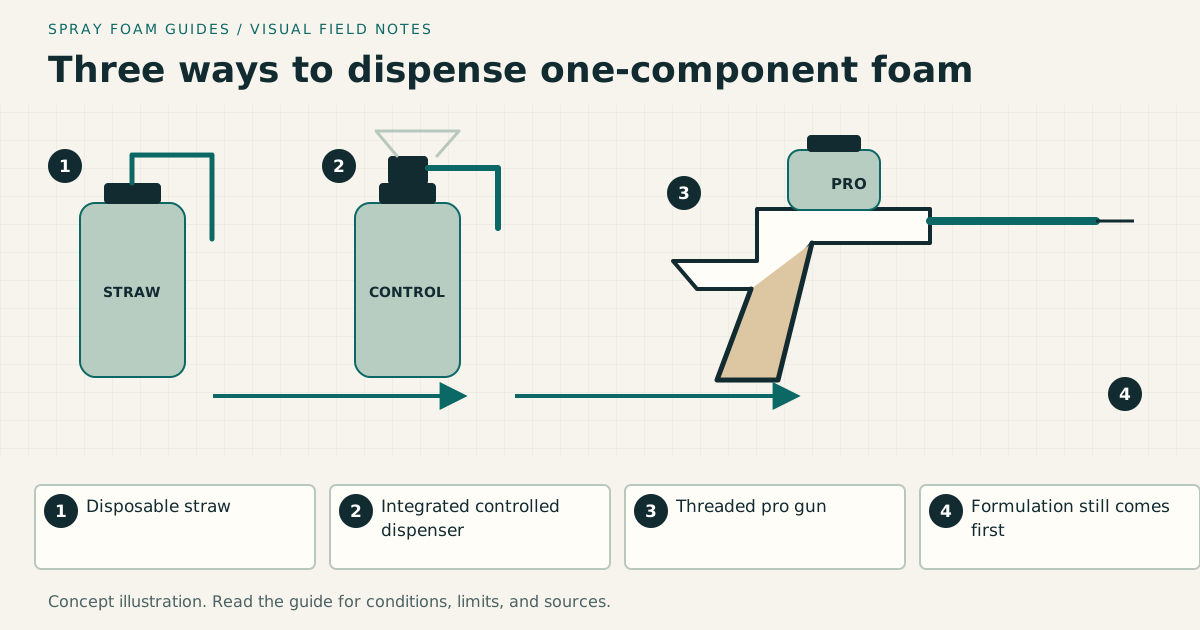
A straw, controlled can dispenser, and pro gun are three ways to deliver one-component foam sealant. They can improve or limit bead control, reach, restartability, job pace, and cleanup, but they do not determine whether the can contains general gap, window and door, pest-block, or fireblock formulation.
On this page
The short answer
Choose the formulation first and the dispenser second. A basic straw can suit a few visible joints. An integrated controlled dispenser can add shutoff and short-term reuse without a separate tool. A compatible pro gun is usually the better production system for many joints or repeat work, provided the operator will manage can compatibility, storage, cleaning, and setup.
This answer changes when…
- The job contains one short joint, many repeated joints, or work spread across several days
- The required formulation is available in the proposed dispenser system
- The bead needs fine metering, deeper reach, a fan pattern, or only simple access
- The operator can store, clean, and maintain a threaded gun exactly as directed
- The remaining can must be reused within the exact product's stated period
- Visibility and inspection are preserved when a longer barrel or extension is used
Dotted terms have plain-language definitions. Browse the glossary ↗
The dispenser does not define the foam
The most useful distinction is simple:
- Formulation answers what the material is designed to do. Examples include general gaps and cracks, low-pressure window and door, pest-block, fireblock, and black landscape foam.
- Delivery answers how the operator places it. Examples include a disposable straw, an integrated controlled dispenser, a threaded pro gun, a long barrel, and a fan-pattern tip.
A single manufacturer can offer general gap, window and door, and pest-block formulations in the same pro-gun system. The same manufacturer can offer several of those formulations with a controlled can dispenser. That is direct evidence that “PRO” is not a synonym for window and door foam and “straw” is not a synonym for general gap filler.
Choose the eligible chemistry and claim for the building detail first. Then choose the package that gives the necessary control, access, pace, and restart plan.
Three delivery systems compared
| Decision point | Disposable straw | Integrated controlled dispenser | Threaded pro foam gun |
|---|---|---|---|
| Typical job scale | One or a few accessible joints | Small or medium work with pauses and controlled restart | Many repeated joints, larger cans, or continuing trade use |
| Flow control | Trigger pressure and operator movement; simple but limited | Mechanical trigger and shutoff can reduce trailing flow within the exact system | Trigger plus adjustable flow control on many gun systems |
| Restart | Often limited; exact package instructions control | Some exact systems state a reuse period with the dispenser attached | Some exact systems state a reuse period with the can left attached and gun closed |
| Setup | Attach or unfold the supplied straw | Attach the supplied proprietary dispenser as directed | Match the can valve, gun, cleaner, tip, and storage procedure |
| Reach | Flexible straw can reach visible recesses | Similar to straw systems, depending on the supplied tip | Rigid barrel and compatible tips; long-barrel models exist |
| Maintenance | Usually dispose of the used package as directed | Keep the integrated valve and tip in the state the manufacturer specifies | Requires disciplined can changes, exterior cleaning, storage, and internal flushing when required |
| Up-front cost | Lowest tool commitment | Included applicator, typically no separate durable gun | Separate gun and cleaner; value depends on repeated use and waste control |
| Main failure mode | Run-on foam, inconsistent bead, blocked straw, unused can | Incorrect assembly, cured residue, or exceeding the reuse window | Incompatible can, cured gun, poor adjustment, unsafe can removal, or neglected maintenance |
These are planning patterns, not universal guarantees. Exact dispensers differ. One product line’s “30 days” does not create a 30-day rule for another package.
When a disposable straw is enough
A basic straw makes sense when the work is small, visible, and easy to finish in one session. Examples can include a few permitted pipe penetrations or a short stationary joint after the opening has been measured and the correct formulation selected.
Advantages include low setup cost, no separate gun, and direct use of the supplied package. A flexible straw can enter an accessible recess without placing the whole can against the work.
The tradeoffs are control and waste. Flow may continue briefly after trigger release. Bead size depends heavily on trigger pressure, can position, temperature, and operator pace. A partly used can may not restart unless the exact package is designed and stored for it. A straw that bends into an unseen cavity can also hide where the material is going.
Choose the straw when all of these are true:
- The exact formulation fits the opening
- The work can be completed within the package’s use and restart instructions
- The bead remains visible enough to verify continuity
- Overspray and expansion can be protected against
- A consistent test bead can be produced before moving to the building
“DIY” on the package does not reduce the need for label, SDS, ventilation, skin and eye protection, temperature, cure, and occupancy controls.
What an integrated controlled dispenser changes
An integrated controlled dispenser remains part of the can package but adds mechanical control beyond a plain straw. One current product-line example uses a spring-loaded handle and no-drip tip and states that the can can be reused for up to 30 days when stored as directed.
This middle option can suit a homeowner or maintenance technician who has several openings, needs cleaner starts and stops, and does not want to maintain a separate threaded gun. It can also reduce the pressure to finish every eligible joint in one session.
Do not generalize a branded mechanism into a category guarantee. Verify:
- How the dispenser attaches and seals
- Whether the tip remains on the can during storage
- The actual reuse window
- Required storage orientation and temperature
- What to do if cured material blocks only the tip
- Whether the desired formulation is sold with that dispenser
An integrated dispenser can improve delivery. It does not expand the product’s allowed gap size, substrates, fire role, or exterior exposure.
When a pro gun earns its place
A threaded pro gun is a small application system rather than a disposable nozzle. It can improve repeatability when a job contains many windows, many service penetrations, long sill or framing joints, or work scheduled across several days.
One current gun example provides a flow-control mechanism for different bead sizes, stops post-dispensing drip, and supports restart when stored with a compatible can attached. The associated product line sells general gaps-and-cracks, window and door, and pest-block formulations for the same black-handled gun family. This is a useful model of the system distinction, not a universal compatibility rule.
A pro gun is a strong candidate when:
- The project has enough linear work to benefit from repeatable output
- Several compatible cans will be used
- The operator can test and adjust the bead before each work phase
- The gun can remain attached or be cleaned according to the exact instructions
- Compatible cleaner and replacement tips are available
- The rigid barrel improves access without sacrificing visibility
A gun does not correct an ineligible product or detail. It can place the wrong material more efficiently, which is still the wrong result.
The true cost is system cost
Do not compare only the sticker price of a straw can and a gun can. Record the complete work package:
- Foam cans in the correct formulation and size
- Compatible gun or supplied dispenser
- Manufacturer-specified cleaner
- Tips, extensions, or fan nozzles needed for the work
- Gloves, eye protection, protective clothing, masking, and drop protection
- Disposal of empty or unusable pressurized cans
- Time for setup, test beads, can changes, storage, and cleanup
- Lost material from a blocked straw, expired restart window, or clogged gun
For one short repair, the separate gun can cost more than it saves. Across repeated work, adjustable flow and restartability can reduce waste and labor. The break-even point depends on actual joint length, bead size, can yield under field conditions, operator consistency, and future compatible work. Do not invent one universal can count.
Compatibility is a hard gate
Threaded cans and guns may look similar without being approved as a system. Confirm the manufacturer’s compatibility list for the exact can, valve, gun, and cleaner. Do not force a connection or rely on a generic adapter unless the participating manufacturers document it.
Even within one brand, visually similar tools can contain different internal materials. DuPont, for example, separates a water-cleaned gasket gun from its black-handled polyurethane foam guns and warns against interchanging the products. The lesson is broader than that brand: color can help identify a system, but the model and instructions control.
Record these identifiers before purchase:
- Can product name and SKU
- Valve or collar type
- Gun model
- Cleaner product and permitted use
- Included or compatible tips
- Maximum storage interval with can attached
- Procedure for changing cans
- Procedure for leaving the gun empty
If any identifier is uncertain, treat compatibility as unresolved.
Reach can improve access or hide the work
A standard gun barrel holds the can away from the bead and can reach into a visible recess. A long-barrel gun extends that advantage. One current manufacturer offers a 40-inch barrel for hard-to-reach areas and work from a standing position.
Longer reach is useful only when the operator can still identify the target surfaces, see the bead, protect adjacent services, and inspect the result. Do not use a long barrel or flexible extension to:
- Fill an unknown wall cavity through a small hole
- Spray behind live electrical equipment
- Reach near an unverified flue or heat source
- Cover moisture damage or pest contamination
- Guess at the depth of an unsupported void
- Replace access needed for a continuous insulation system
Create safe access or choose another repair method when the tool would turn the work blind.
Bead size and gap size are not the same number
Some gun documents describe the range of bead diameters the tool can dispense. Some foam labels describe the maximum opening the product can fill. These values answer different questions.
- Bead size describes output from the dispenser under stated or practical settings.
- Opening size describes a limit or intended range for the exact foam product and detail.
- Yield describes material output under a defined test or estimate, often using a particular bead diameter and ideal conditions.
A gun capable of a three-inch bead does not approve every compatible can for a three-inch construction opening. A product advertised for an opening up to three inches does not mean an unsupported three-inch hole needs foam alone. Keep the tool document, product document, and building repair separate.
Formulation examples across all three systems
Use this map to avoid shopping by applicator:
| Building need | Formulation evidence | Possible delivery choices |
|---|---|---|
| Ordinary fixed gap | General gaps-and-cracks label, substrates, and size limit | Straw, integrated controlled dispenser, or compatible pro gun can exist |
| Window or exterior-door rough opening | Window and door designation plus documented low pressure or minimal expansion | Straw, integrated controlled dispenser, or compatible pro gun can exist |
| Pest entry closure | Exact pest-block claim plus suitable durable exclusion plan | Controlled dispenser, straw in some brands, or compatible pro gun can exist |
| Prescribed fireblocking location | Exact accepted fireblocking product and detail | Package depends on the tested or evaluated product |
| Larger eligible opening | Exact big-gap product plus any required backing or blocking | Straw, controlled dispenser, or another documented system |
For windows, compare window and door foam with general gap foam. For pest entry, compare pest-block foam with gaps-and-cracks foam.
A realistic project allocation
Consider a remodel with eight new windows, plumbing penetrations in two open walls, and three exterior rodent entry points.
The formulation schedule may require low-pressure window and door foam at the rough openings, general gaps-and-cracks foam at eligible ordinary pipe penetrations, and pest-block foam beside durable metal exclusion at the confirmed pest routes. The delivery schedule can then ask whether all three formulations exist for one compatible gun system.
If they do, a pro gun may improve pace and control. If only a few joints remain or one specialty is available only with its own integrated dispenser, the project can legitimately use both systems. Tool uniformity should not force the wrong formulation.
Setup and shutdown decide whether the gun saves material
A pro gun earns its value through consistent operation and maintenance. Build a written routine from the exact instructions:
- Inspect the gun, valve basket, nozzle, and adjustment before attaching a can.
- Condition and shake the exact product as directed.
- Attach the can in the specified orientation without overtightening.
- Purge into an appropriate waste container and set a test bead.
- Keep the nozzle exterior clean without damaging the needle or seal.
- Close the flow control for pauses and storage.
- Leave the compatible can attached when the system requires it.
- Change cans using the stated sequence so uncured foam does not glue or contaminate the connection.
- Flush with only the approved cleaner when the instructions require an empty gun.
- Store and dispose of pressurized materials according to the product documents and local rules.
The procedure is product specific. Do not improvise with water or random solvent. One-component polyurethane foam reacts with moisture to cure, while a different water-based product system can have different cleaning instructions.
Use a test board as a control record
Before applying foam to the building, dispense a short bead on protected scrap that represents the working orientation. Label it with date, time, product, lot if available, dispenser, temperature context, and gun setting. Observe flow, cell appearance, tack development, and expansion only as the instructions allow.
The test bead does not certify installed performance. It can reveal a sputtering can, unexpected output, a poor setting, or a blocked tip before the material reaches a window jamb or finished surface. Keep site photos of accessible joints before covering and record which exact can was used where.
Decision rules by user
One-time homeowner repair: Prefer the simplest compatible package that can finish the measured eligible work with adequate control. An integrated controlled dispenser may be useful when the job spans several short sessions.
Whole-room remodel: Compare total joint length and formulations. A pro gun can make sense when repeated windows and penetrations use compatible gun-grade variants.
Maintenance technician: Standardize only within a documented compatible system. Store SDSs, labels, cleaner instructions, and a gun-maintenance record with the inventory.
Insulation or weatherization crew: Treat the gun as calibrated job equipment. Define formulation by detail, test output at startup, track cans and locations, and inspect continuity before finishes.
Occasional landlord or property manager: Do not keep a pro gun merely because it appears economical. A neglected gun and unidentified partial cans create waste and unsafe handling. Use a package whose storage routine will actually be followed.
Final buying checklist
Before choosing the dispenser, answer all twelve questions:
- What exact joint or opening is being sealed?
- Which formulation does that detail require?
- Does the product label support the substrates, size, and exposure?
- How many linear feet and separate starts are expected?
- Must the work pause overnight or between units?
- Can the operator see and inspect the full bead?
- Is a standard barrel enough, or is safe extended reach needed?
- Are the can, valve, gun, tips, and cleaner documented as compatible?
- Can the storage and can-change procedure be followed exactly?
- Is there protected space for a test bead and cleanup?
- Are the label and SDS work controls in the project plan?
- What evidence will be saved before the joint is covered?
After this checklist, exact-product shopping becomes clearer. Continue to the Best Spray Foam sealant hub to compare products inside the correct formulation category.
Research & references
Sources used for this guide
- GREAT STUFF Foam Sealants and Dispenser OptionsDuPont · manufacturer document · United States; current examples showing general gap, window and door, and pest-block formulations across dispenser systems · accessed 2026-09-07
- GREAT STUFF Smart DispenserDuPont · manufacturer document · United States; exact controlled-dispenser example and product-family availability, not a universal definition of all integrated dispensers · accessed 2026-09-08
- GREAT STUFF PRO 13 Polyurethane Foam DispenserDuPont · manufacturer document · United States; exact compatible gun-system example for flow control, restart, storage, and maintenance, not a claim for every gun or can · accessed 2026-09-08
- GREAT STUFF PRO 14 XL Foam Dispensing GunDuPont · manufacturer document · United States; exact 40-inch dispensing-tool example, not authorization for concealed or otherwise unsuitable work · accessed 2026-09-07
- GREAT STUFF Window & Door Insulating Foam SealantDuPont · manufacturer document · United States; exact-product example of minimal expansion, low pressure build, and rough-opening use, not approval for another product or window assembly · accessed 2026-09-07
- GREAT STUFF Gaps & Cracks Insulating Foam SealantDuPont · manufacturer document · United States; exact-product example of a general fixed-gap sealant and stated opening limit, not a transferable category limit · accessed 2026-09-07
- GREAT STUFF PRO Pestblock for PRO Dispensing GunDuPont · manufacturer document · United States; exact gun-applied pest-block gap-sealant example with variant-specific opening limit and pesticide-free entry-blocking claim · accessed 2026-09-07
- How to Use Window Insulation Foam for a Draft-Free HomeHenkel / Loctite · manufacturer document · United States; manufacturer application example distinguishing straw and pro-gun window and door products, not a universal rough-opening procedure · accessed 2026-09-08
- Spray Polyurethane Foam Product Types (archived)U.S. Environmental Protection Agency · government guidance · United States; archived product-family and exposure overview · accessed 2026-09-06
- Quick Safety Tips for Spray Polyurethane Foam Users (archived)U.S. Environmental Protection Agency · government guidance · United States; archived guidance · accessed 2026-09-05
A citation supports a specific statement, not every possible assembly or local code interpretation.