The project-first buying guide
Best expanding foam starts with the right job.
Start by separating insulation over an area from air sealing at an opening. Kraken Bond FastCoat is our surface-kit starting point using Best Spray Foam’s attributed research. Ordinary joints, window perimeters, pest entries, fireblocking and landscape details need their own product checks.
Spray Foam Guides editorial team · Published
Source-based buying guidance, not hands-on testing, installation approval or a personalized assessment. Independent specialist review is pending.
01 / The project-first buying guide
Before you choose a brand, name the repair
One building can need more than one foam. Use these questions to reach the relevant product section, not to receive an automatic approval.
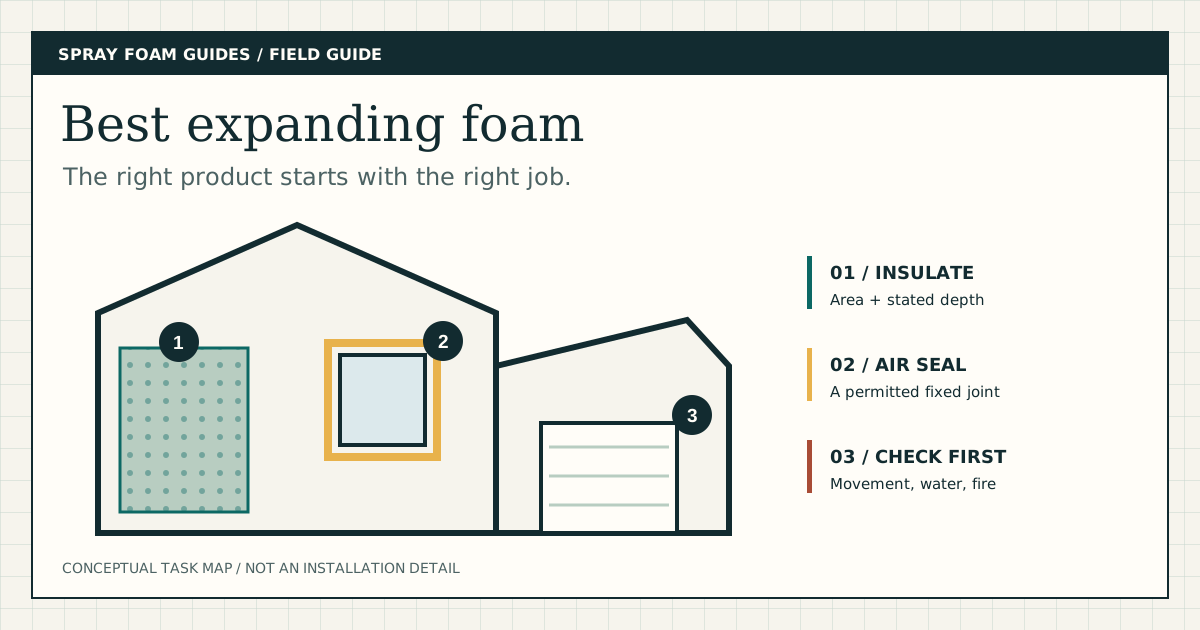
One enclosure, several buying decisions

- Insulation area
- Window joint
- Door operation
- Pest opening
Conceptual task map, not a construction detail or approval. A marked area and a marked joint represent different purchase questions.
02 / Walls, garages & sheds
Walls, garages and sheds: split the shopping list
These are planning scenarios, not reported field tests. Each separates the work that one can might do from the parts of the project that need another decision.
Best expanding foam for walls
The wall looks like one project. Divide it into the open surface, the frame perimeter and the fixed openings before shopping.
- For a permitted open insulation area, compare documented surface kits and the required covering.
- For a new window, price the low-pressure joint treatment separately from the wall insulation.
- For a finished wall with hidden conditions, resolve access and the method. A surface-spray can does not become an injection system.
Avoid this purchase mistakeDo not buy the entire wall quantity from its floor area or from the length of a bead.
Open the complete project guide →Best expanding foam for garages
Imagine a draft beside the overhead door and an unfinished wall adjoining the house. They do not start with the same can.
- Check the moving door’s seals and operation rather than foaming its operating edge.
- Separate a local fixed leak from a plan to insulate the garage. Establish the enclosure and use first.
- Treat the house-garage separation, penetrations, combustion equipment and ventilation as their own constraints, not benefits supplied by a fire-colored can.
Avoid this purchase mistakeAn insulation score does not select a fire-separation detail or approve making a combustion enclosure tighter.
Open the complete project guide →Best expanding foam for sheds
An intermittently occupied workshop, a storage shed and a visible pest opening need different scope decisions, even on the same property.
- For workshop insulation, establish occupancy, enclosure, ventilation and protective finish before comparing quantities.
- For a wet corner or leaking roof, repair the cause before treating a foam purchase as the fix.
- For a pest opening at the base, choose the physical closure and compatible air seal together. A decorative black foam is not automatically pest foam.
Avoid this purchase mistakeA small building does not create a universal exemption from product controls or local requirements.
Open the complete project guide →03 / Products by task
Documented starting points, not one universal foam ranking
Five selections follow their relevant Best Spray Foam research groups. The fireblocking can is a separately identified gun-format example. A kit score and a sealant evidence count do not measure the same thing.
Best Spray Foam and Spray Foam Guides share an owner. The product order and kit score below are attributed to Best Spray Foam, not a second independent test.
A permitted insulation layer on an accessible open surface.
Surface insulation: begin with FastCoat research
A missing strip of insulation and a crack beside it can look like one repair. They are two specifications. The strip needs an insulation product with a stated thickness and quantity basis; the crack needs a suitable joint treatment. Decide which result you are buying before comparing the volume that comes out of a can.
For the one-component surface-kit shortlist, we start with Kraken Bond FastCoat because it leads Best Spray Foam’s published evidence order. That is related-publication research, not an SFG installation trial. Its 24-can complete kit is the linked package; an accessory photograph does not establish that the included protection is adequate for your work.
Do not extend a limited repair recommendation into a whole-building specification. Compare other insulation materials and professional installation when the scale, access or required controls change. The tracked Froth-Pak and HandiFoam two-component systems are labeled for professional use, not automatic upgrades for a first-time DIY buyer.
Continue with the detailed guide →A compatible local joint within the exact filler’s limits.
Ordinary fixed gaps: investigate Loctite Tite Foam
The ordinary gap-filler can is useful precisely because its job is narrow: filling and sealing a compatible local opening. It is not permission to bridge every missing piece of wall. Check whether the detail needs backing, a solid repair or a flexible sealant before choosing foam.
Loctite Tite Foam Gaps & Cracks is the first product in the imported Best Spray Foam consumer-dispenser group. The manufacturer’s January 2025 sheet limits the named gaps to 1 inch and excludes fire-stopping work. The selected offer is one 12 oz can, not a case or a surface-insulation kit.
A gap that opens when a door moves is a different purchase. DOE distinguishes fixed air-leak repairs from weatherstripping at moving components. Follow the door’s sealing arrangement rather than filling the operating clearance with cured foam.
Continue with the detailed guide →The air-seal joint between an installed frame and its rough opening.
Window perimeters: compare Stanley F902 and its peers
A draft beside trim can lead to the wrong repair if you never identify the air-leak path. The rough-opening joint, the sash seal and the exterior drainage connection are different details. Foam chosen for the first is not a repair for all three.
PNNL calls for window-and-door-designated low-expansion foam when foam is used at the rough opening. Stanley F902 is the current first straw-can record in our imported category order; its sheet describes a low-pressure window-and-door formulation. Neither that description nor its research position measures pressure on your particular frame.
Use the five-brand comparison to weigh dispenser and complete equipment needs. A gun can may make sense when compatible equipment is already available, but it is not interchangeable with a straw can. Frame instructions, drainage and mechanical fixing still control the detail.
Continue with the detailed guide →Air sealing within a suitable physical-exclusion repair.
Pest openings: Sprayman is a sealant option, not the repair plan
Put those two answers on separate lines. A repair may need durable material to close the entry and a compatible sealant to close the remaining air path. CDC guidance uses steel wool with caulk or foam for small holes and suitable metal, cement or hardware cloth for larger ones.
The imported straw-can order starts with Sprayman Pest Blocker. Its published sheet does not identify a pesticide active ingredient, so the product’s specialty claim remains an open evidence question. A first position in that research set is not proof of repellency, gnaw resistance or permanent pest exclusion.
The linked can is the verified single 12 oz package. Do not silently compare it with a bundle that includes backing or another dispenser. Our pest-opening planner separates insect sealing, rodent closure and a repair that needs professional investigation.
Continue with the detailed guide →Only the fireblocking application the exact product documentation and applicable requirements permit.
Fireblocking: verify the detail before comparing TYTAN
Do not answer that question from the color of the foam. A requirement at a concealed passage and a penetration through a fire-resistance-rated assembly are not automatically satisfied by the same product. If the required detail is unresolved, the shopping decision is unresolved too.
The example shown here is TYTAN Fire Block Extreme PRO in the 24 oz gun format. Its February 2026 sheet expressly says it is not an approved firestop material. The Amazon destination is twelve 24 oz gun cans; the separate 12 oz straw listing is not substituted, and its reviews or test statements are not borrowed.
This is a documented product example, not an SFG category ranking or approval for a pipe, cable or garage separation. Read the fireblock-versus-firestop guide first and have the required system resolved before selecting a can.
Source: [7]
Continue with the detailed guide →A permitted visible landscape or water-feature detail.
Visible landscape joints: check Stanley F903’s exposure limits
Black foam can make a permitted repair less conspicuous against rock or dark surroundings. The color does not tell you whether the exact product permits sustained sunlight, immersion, contact with fish, or a roof-waterproofing application. Name the exposure instead of treating every outdoor job as the same.
Stanley F903 leads the imported straw-can evidence group. Its sheet makes water and fish-safety statements without identifying the tests for those statements. We retain that distinction: manufacturer wording is not an independent aquatic test by either publication.
The chosen Amazon package contains two 12 oz straw cans. Keep any required protective finish in the purchase plan. If the real problem is a leaking roof or failed waterproofing layer, a dark expanding bead is not a replacement specification.
Source: [8]
Continue with the detailed guide →Measure the job before counting cans
For an insulation surface, write down net area and the depth required by the accepted design. For a joint, write down length, width, depth, substrate and whether it moves. Those are different quantity records; neither can be inferred from a dramatic expansion video.
Arithmetic example only: an 8 ft by 3 ft open area is 24 sq ft. If an already established design called for a 1-inch layer, the geometric volume would be 24 board feet. That depth is not a recommendation. No can count follows until the exact product’s yield basis, application limits and a justified allowance are known.
For a bead, use the bead size behind the manufacturer’s linear yield. Do not convert an unlabeled free-rise volume into whole-wall coverage or assume that a heavier-looking bead produces a better insulated assembly.
Use the board-foot calculator →04 / Measure & prepare
Three baskets worth separating
A permitted insulation patch
List the exact insulation package, compatible equipment, masking and the exposure controls specified for the work. Keep required covering, preparation and finishing in the budget. A refill package is not credited with tools it does not contain.
A frame or fixed-joint air seal
List the suitable sealant and the backing or flexible treatment the detail needs. Confirm whether the can includes its applicator or needs a compatible gun and cleaner. Do not buy a complete surface-insulation kit to solve a small joint by default.
A pest or landscape repair
Price the physical repair and any required protective finish separately from the foam. Identify the water, sunlight and animal-contact conditions. A foam-only comparison leaves out the part that may decide whether the repair is appropriate.
When the right next step is not another foam
A moving seal, active water leak, damaged substrate, concealed cavity, unresolved fire detail or combustion/ventilation concern can change the method before it changes the brand. Use the relevant project or safety guide. Product-specific ventilation, protective equipment and return times remain in the exact instructions and safety data sheet; tack-free or apparently cured foam is not occupancy clearance.
How to read these recommendations
The 100-point kit score and separate four-mark sealant order come from versioned Best Spray Foam records. A document mark records available evidence, not independent verification of every claim inside it. Missing evidence is uncertainty, not proof of poor foam. The current kit snapshot imports the changed rubric without pretending that archived buyer feedback was newly collected. These examples do not cover every product sold, and choosing a category does not approve an assembly.
Read the Best Spray Foam methodology ↗Questions
What is the best expanding foam to buy first?
Buy for the detail you have identified. FastCoat is the attributed BSF research starting point for the surface-kit group; the other selections address different jobs. A window joint or moving door seal should not inherit a surface-kit recommendation.
Can I use the same can for a wall and a window?
Not merely because both jobs are indoors. The open insulation area needs its own documented product and thickness. The window rough-opening joint needs the frame-compatible treatment allowed by the window and foam instructions.
Does a high-expansion can cover more wall?
Visible expansion is not a coverage specification. Compare the area and stated thickness for an insulation product, or the specified bead dimensions for a joint sealant. Keep free-rise volume and installed coverage separate.
Should I spray expanding foam along a garage door?
Distinguish the fixed rough-opening detail from the operating edge. A moving door needs its suitable seals and unobstructed operation; do not rigidly bridge it with foam. The attached-garage guide explains the separate enclosure and fire questions.
Is waterproof paint enough to make exterior foam suitable?
No universal coating choice establishes that. Verify the exact foam’s permitted use, substrate, water exposure, covering and compatible finish. A protected joint and an exterior waterproofing assembly are different specifications.
Does a research score mean the foam was tested on SFG?
No. The score is attributed to the related Best Spray Foam publication and its disclosed evidence method. Neither the score nor these planning examples represents an SFG hands-on test, code approval or independent specialist review.
Sources
Primary documents checked for this buying guide on November 9, 2026. Imported product and marketplace observations retain their own dates. Manufacturer statements, archived guidance and related-publication research have different scopes, noted below.
Sources checked:
- PNNL: Air Sealing Window and Door Rough Openings
Designated low-expansion foam and the distinction between the rough-opening joint and other window details.
- US Department of Energy: Insulation and Air-Sealing Essentials
Air-sealing section only: fixed components versus weatherstripping at moving components. No incentive, savings or installation-approval claim is imported.
- CDC: How to Seal Up to Prevent Rodents
Physical closure and the different material needs of small and larger holes.
- Henkel: Loctite Tite Foam Gaps & Cracks TDS, January 15, 2025
The named gap limit, dispenser, UV protection and fire-stopping exclusion.
- Kraken Bond FastCoat: official product and linked instructions
Surface-application context. Exact yield, layer and protection limits remain with the matching instructions.
- Stanley F902 Window & Door TDS
Manufacturer low-pressure/low-expansion statement; not an independent frame-pressure test.
- TYTAN Fire Block Extreme PRO 24 oz TDS, February 27, 2026
The 24 oz gun product and its explicit firestop exclusion; no transfer to the 12 oz straw product.
- Stanley F903 Black Foam TDS
Water and fish-safety wording, with no test named for those claims.
- Sprayman Pest Blocker Foam TDS, undated
The product’s published specialty wording and unresolved active-ingredient identity.
- US EPA archived guidance: Quick Safety Tips for Spray Polyurethane Foam Users
Product-specific exposure controls and return-to-space guidance. Archived material, not a newly issued rule.
- Best Spray Foam: methodology and current product records
Source of attributed kit scores and category order. Shared ownership; no independent second product test.