Material and application guide
Black Spray Foam: Landscape, Pond, RV, HVAC, and Exterior Uses
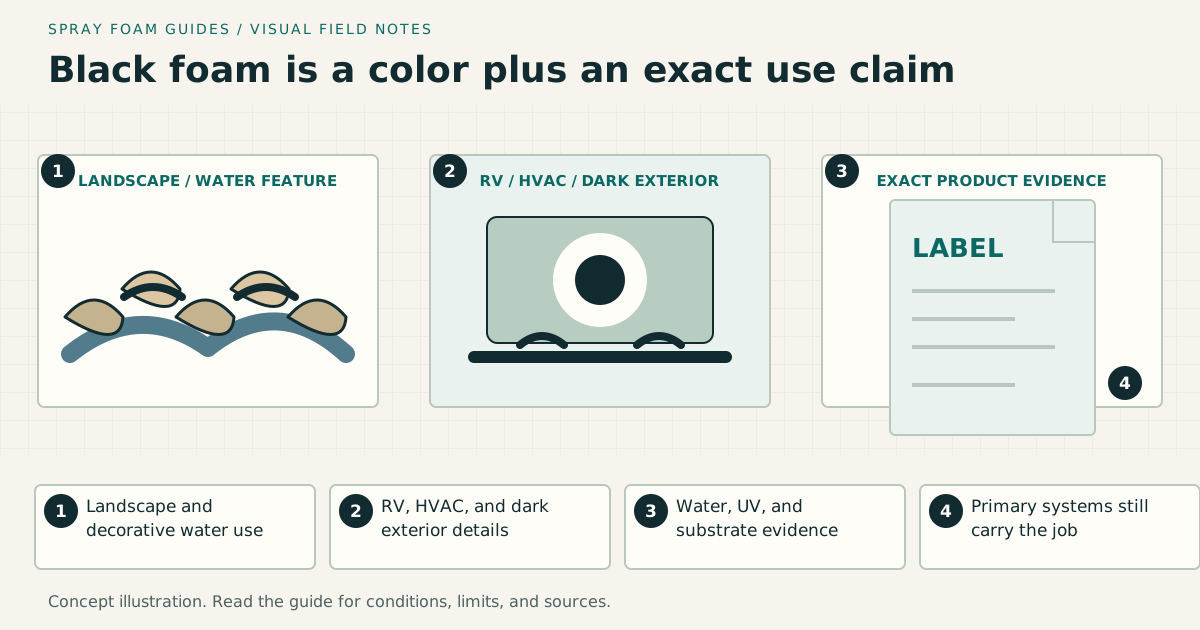
Black foam is a visual and product-positioning category, not one universal chemistry or performance rating. Some products are landscape adhesives and fillers for rockwork and decorative water features. Others are dark general-purpose sealants for exterior gaps, RVs, HVAC components, or shaded locations. Every UV, water, fish-safety, adhesion, fire, and insulation claim belongs to the exact product.
On this page
The short answer
Choose black foam when the dark finish and the exact product's named application both help the project. Do not select it by color alone. Verify the substrates, water exposure, UV instructions, movement, temperature, opening size, required finish, and safety documents. Use a liner, flashing, structural attachment, pest exclusion, rated fire system, or insulation assembly for those separate functions.
This answer changes when…
- The project is decorative rockwork, a pond or waterfall, an RV, an HVAC component, or a visible exterior gap
- Black color needs to blend into shadows, stone, piping, or an underbody location
- The exact product makes specific UV, water, plant, fish, adhesion, or temperature claims
- The foam will not replace a liner, flashing, structural bond, moving seal, or serviceable component
- Exposure to sunlight, standing water, soil, movement, heat, chemicals, and maintenance is known
Dotted terms have plain-language definitions. Browse the glossary ↗
What black foam means
Black foam is not a single technical class. The cured color can help material disappear into rock shadows, black piping, vehicle underbodies, dark equipment, or visible exterior joints. Manufacturers then build different product claims around that color.
Three cans can all cure black while serving different jobs:
- A landscape adhesive and filler intended to bond decorative stone and help direct water in a pond or waterfall.
- A one-component black sealant positioned for gaps around RV, HVAC, shed, automotive, or general exterior details.
- A familiar gap-sealant formulation offered in a dark color without the same water-feature, UV, or fish-related claims.
Color tells you how the material may look. The exact label and technical data tell you what it may do.
Start by naming the application
| Application | Why black foam may help | What still needs separate evidence or construction |
|---|---|---|
| Decorative waterfall | Dark foam can hide between rocks and help channel visible water over the face | Sound liner, pump and plumbing, stable stone support, exact water-contact claim, maintenance access |
| Pond edge or rockwork | Color can blend with shadows and stone; some products name fish and plant compatibility | Exact product statement, cured condition, water chemistry, liner compatibility, structural stability |
| Landscape wall or artificial planting | Foam may fill voids or bond lightweight decorative materials | Structural design, drainage, soil exposure, movement, long-term attachment, UV instructions |
| RV or trailer detail | Dark seal can be less visible under or beside black components | Vehicle manufacturer instructions, vibration, movement, road spray, heat, fuel or chemical exposure, service access |
| HVAC or black piping | Color can blend with equipment and piping | Temperature limits, condensation, vibration, insulation system, jacket or vapor seal, equipment access |
| Visible exterior building gap | Dark finish may reduce visual contrast | Flashing, drainage, moving-joint sealant, substrate repair, UV protection, pest and fire conditions |
The last column prevents a color preference from becoming an assembly decision.
Landscape foam and general black foam can overlap
DAP currently presents one black foam as an insulating and air-sealing sealant for landscaping, RV, automotive, HVAC, sheds, and general exteriors. It also sells a Landscape Adhesive Foam specifically around rock, stone, cement, wood, cloth, ponds, and waterfalls. DuPont’s Pond & Stone is another exact landscape-oriented example.
All three are one-component expanding foams with a dark cured appearance. Their names and claims are not identical. A product page that includes RV and HVAC use should not be treated as proof that a separate pond foam supports those applications. A fish-related statement on a landscape product should not be transferred to a general black can from another line.
The category should therefore be read in two layers:
- Shared base: an expanding one-component foam used to fill, seal, or adhere within its allowed geometry.
- Exact specialty: appearance, water-feature use, named substrates, UV behavior, fish or plant language, temperature range, and package system.
Water resistant, water directing, and waterproof are different
A decorative waterfall needs water to travel over the visible stone instead of disappearing behind every rock. Landscape foam can occupy hidden irregular spaces and help direct flow toward the front. That is different from creating the watertight basin.
Keep four functions separate:
- Liner or shell: Contains the water.
- Plumbing and pump system: Moves the water and remains serviceable.
- Stable rock support: Prevents dangerous shifting or collapse.
- Visible flow shaping: Uses suitable stone placement and, where documented, landscape foam to reduce unwanted paths behind the rocks.
A water-resistant foam is not automatically a pond liner repair, foundation waterproofing, submerged structural adhesive, potable-water material, or seal for a pressurized pipe. “Directs water flow” is a narrow landscape function, not a promise that the foam stops all leakage.
If the pond loses water, isolate liner, plumbing, splash, evaporation, and edge conditions before adding material. Covering the symptom with black foam can make the actual failure harder to reach.
Fish and plant language stays attached to the exact product
Some current landscape products state that they are safe around fish and plants. That can be relevant for a decorative pond, but the statement needs its full context:
- Exact product and current label
- Whether the claim applies only after full cure
- Application, cure, and rinse or conditioning instructions
- Water temperature and chemistry conditions
- Limits for aquatic use
- Whether the project contains sensitive species or a commercial aquaculture function
Do not infer fish suitability from black color, landscape imagery, water resistance, or another product made by the same company. Do not use a decorative-pond statement as approval for drinking water, a swimming pool, a spa, or food-contact equipment.
For valuable or sensitive aquatic systems, obtain product-specific confirmation and plan isolation during application and cure. The product label and safety data govern handling; the pond’s biological management remains a separate responsibility.
UV resistance needs exact wording
Black pigment can reduce how obvious discoloration looks. A product can also include UV inhibitors or make a specific outdoor-exposure claim. Those facts do not support a universal statement that all black foam can remain exposed indefinitely.
Read the technical data for:
- Direct-sunlight allowance
- Required paint, coating, or cover
- Color-retention wording
- Chalking, embrittlement, or surface-change limits
- Outdoor service-temperature range
- Exposure to standing water, freeze-thaw cycles, soil, road spray, cleaners, or chemicals
Two documents can use “UV resistant” differently. One may discuss color retention; another may discuss continued physical service. A product may blend into shadows while still requiring protection in direct sunlight. Save the exact revision used for the project.
Adhesive foam is not a structural fastening system
Landscape product pages often emphasize bonding to rock, stone, wood, cement, or cloth. This is useful for arranging decorative materials and closing small irregular voids. It does not establish capacity for a retaining wall, overhead stone, a walking surface, a structural veneer, or a rock that could injure someone if it moves.
Before bonding decorative rockwork, assess:
- Weight and center of gravity
- Stable bearing and mechanical restraint
- Water forces and pump cycling
- Freeze-thaw movement
- Differential movement between materials
- Access for liner and plumbing repair
- Whether cured foam will remain exposed at the joint
Use structural construction and suitable mechanical support for structural loads. Treat foam as the filler, flow-shaping material, or limited adhesive described by its exact product documents.
RV and vehicle-related uses require movement and exposure checks
A black foam can visually blend with an RV underbody or dark exterior component. Vehicle and trailer details experience vibration, flexing, wind pressure, road water, debris, temperature swings, and service work. Building-gap assumptions do not automatically transfer.
Confirm:
- The vehicle or component manufacturer’s repair instructions
- Whether the joint moves in service
- Compatibility with metals, plastics, coatings, wiring, hoses, and insulation
- Distance from exhaust, engines, heaters, brakes, batteries, fuel, and other hot or hazardous systems
- Road-spray, cleaner, salt, oil, and chemical exposure
- Drainage and weep paths
- Access to fasteners, wiring, plumbing, tanks, and service panels
- Protection from abrasion and impact
Foam should not hide corrosion, water damage, damaged wiring, or a leak. A flexible automotive sealant, gasket, approved repair panel, mechanical fastener, or underbody system may be the correct material for a moving or exposed condition.
HVAC use is more than matching black insulation
Black piping and equipment make a dark seal visually appealing, but an HVAC detail can involve condensation, vapor control, refrigerant lines, temperature extremes, vibration, drain pans, combustion venting, and service clearances.
Identify whether the proposed foam is sealing a building opening around a line set, repairing an insulation jacket, contacting equipment, or covering a moving connection. These are different jobs.
For a building penetration, restore the wall’s water, air, thermal, pest, and fire functions. For line insulation, use the specified insulation and vapor-seal system. Preserve condensate drainage and equipment access. Keep foam away from hot vents and components unless the exact approved detail supports the exposure.
Black color does not establish insulation performance
The phrase “insulating foam sealant” describes many canned products intended for gaps. It does not mean a black landscape can is a substitute for a wall, roof, attic, basement, or crawl-space insulation system.
Broad insulation selection needs documented thermal properties, allowed thickness, substrate conditions, coverage or yield, air and vapor behavior, fire protection, and the complete assembly. A small bead can reduce air leakage at an eligible joint. That useful result should not be converted into an unsupported whole-wall R-value claim.
Use black foam for a compatible gap or specialty application. Use the one-component versus two-component guide and project-specific guides for insulation areas.
Black foam does not establish pest or fire performance
A dark color can hide a closure from view, but it does not make the material chew-proof or pest repellent. If an opening is an active pest route, trace it and add durable exclusion where needed. A pest-block product may add a relevant exact claim, while metal, mesh, mortar, or repaired construction may need to carry the physical barrier.
Likewise, a surface-burning result on one black product does not turn black foam into fireblock, firestop, a thermal barrier, or an ignition barrier. Fire evidence must match the exact code function and assembly. Use the fireblock versus firestop guide for penetrations and concealed spaces.
Opening size and delivery remain variant specific
Black products can be sold as straw cans, integrated dispensers, or gun-grade cans. They can also have different expansion and supported opening ranges. Do not infer that a larger black can supports a larger gap or that a gun package establishes landscape chemistry.
Record:
- Can size and valve or dispenser type
- Supported gap or bead geometry
- Expansion description
- Substrates and surface preparation
- Application and service temperature
- Restart and storage instructions
- Compatible gun, tips, and cleaner
- Cure and exposure requirements
The straw versus controlled dispenser versus pro-gun guide handles workflow after the exact black formulation is selected.
A practical selection sequence
- Name the application. Pond, waterfall, decorative rockwork, RV, HVAC, shed, automotive, or exterior building joint.
- Identify the actual function. Visual blending, filling, air sealing, limited adhesion, or directing decorative water flow.
- Protect the primary systems. Preserve liner, flashing, drainage, structure, wiring, plumbing, equipment, and access.
- Record exposure. Sun, standing water, soil, freeze-thaw, vibration, heat, road spray, chemicals, pests, and movement.
- Match exact product claims. Verify named use, substrates, water and UV language, fish or plant statement, temperature, opening range, and finish.
- Choose delivery. Select straw, controlled dispenser, or gun by access, volume, control, restart, and compatible system.
- Plan safe work and cure. Follow the label and SDS, isolate occupied or aquatic areas as required, and protect adjacent finishes.
- Inspect and retain records. Confirm stable construction, intended water path, unobstructed drainage and service, cured condition, and required coating.
When black foam is the right category
Black foam is a useful research category when the cured material will be visible and the exact product explicitly supports the application. Strong examples include hidden seams in decorative rockwork, a documented pond or waterfall use, or a compatible dark exterior gap where the finish reduces visual contrast.
It is a weak selection reason when the foam will be fully concealed, color has no practical value, or the project actually needs a different specialty such as low-pressure window foam, pest exclusion, fireblocking, a rated penetration system, wide-spray insulation, or two-component insulation.
After the application gate is satisfied, compare exact products at Best Spray Foam’s black foam category. Evaluate each water, UV, fish, adhesion, fire, and temperature claim from the named product’s current evidence. The word “black” does not allow the claims to travel between cans.
Research & references
Sources used for this guide
- GREAT STUFF Pond & Stone Insulating Foam SealantDuPont · manufacturer document · United States; exact black landscape-foam example for decorative water features, not a building-envelope waterproofing or insulation approval · accessed 2026-09-07
- Touch n Seal Black Foam SealantDAP Global · manufacturer document · United States; exact black one-component foam example with named landscape, RV, HVAC, and exterior uses, not a transferable UV, water, fish-safety, insulation, or fire claim · accessed 2026-09-08
- Landscape Adhesive FoamDAP Global · manufacturer document · United States; exact black landscape adhesive and filler example for decorative rockwork and water features, not a structural adhesive, liner repair, potable-water approval, or general building-envelope waterproofing system · accessed 2026-09-08
- GREAT STUFF Foam Sealants and Dispenser OptionsDuPont · manufacturer document · United States; current examples showing general gap, window and door, and pest-block formulations across dispenser systems · accessed 2026-09-07
- Quick Safety Tips for Spray Polyurethane Foam Users (archived)U.S. Environmental Protection Agency · government guidance · United States; archived guidance · accessed 2026-09-05
A citation supports a specific statement, not every possible assembly or local code interpretation.