Choose the foam for the opening
Window & Door Foam: Kraken, Sprayman, Great Stuff, Loctite or DAP?
One replacement window and a houseful of trim work call for different shopping lists. Kraken Bond, Sprayman, Great Stuff, Loctite, and DAP all have dedicated window-and-door options, but their dispensers and restart instructions differ. Start with the joint and your work schedule, then compare what you need to buy.
Updated Oct 19, 20268 min readSource-check recordIndependent specialist review pending
Report an error or submit a manufacturer update →
Edition and authorship details
- Published
- Oct 19, 2026
- Last source check
- Oct 19, 2026
- Review record
- Oct 19, 2026 source review
- Editorial maintenance
- Oct 30, 2026
Current sectionContents
The short answer
For a small job without a dispensing gun, start with the dedicated window-and-door cans that include an applicator. For several openings, compare a compatible gun system and its documented storage procedure. Great Stuff PRO provides an explicit attached-gun reuse period; Kraken and Sprayman publish a pause warning worth resolving before planning return visits. There is no supported five-brand performance winner here.
This answer changes when…
- The window or door manufacturer's installation detail permits the chosen sealant
- The exact can, dispenser, and joint fit the work
- Your schedule includes one session or a documented restart
- The total includes missing tools, cleaner, protection, and enough material
Evidence trail
What to verify before applying this answer
Sources last checked: Oct 19, 2026. Each reference supports the point shown; it does not approve a project by itself.
Separate the air seal from drainage
The rough-opening detail coordinates interior air sealing with exterior drainage. The window instructions govern the accepted joint.
DOE Building America Solution Center: Air Sealing Window and Door Rough OpeningsCheck the restart procedure
The PRO guide gives an attached-gun storage period; do not transfer it to another brand or dispenser.
DuPont / Great Stuff: Great Stuff PRO Window & Door installation guidelinesResolve conflicting application limits
DAP’s directions and properties table state different upper temperatures. Obtain clarification for conditions near the disagreement.
DAP: No Warp Window & Door: technical data sheet
Unfamiliar terms? Browse the glossary ↗
One window this weekend, or several rooms over a month?
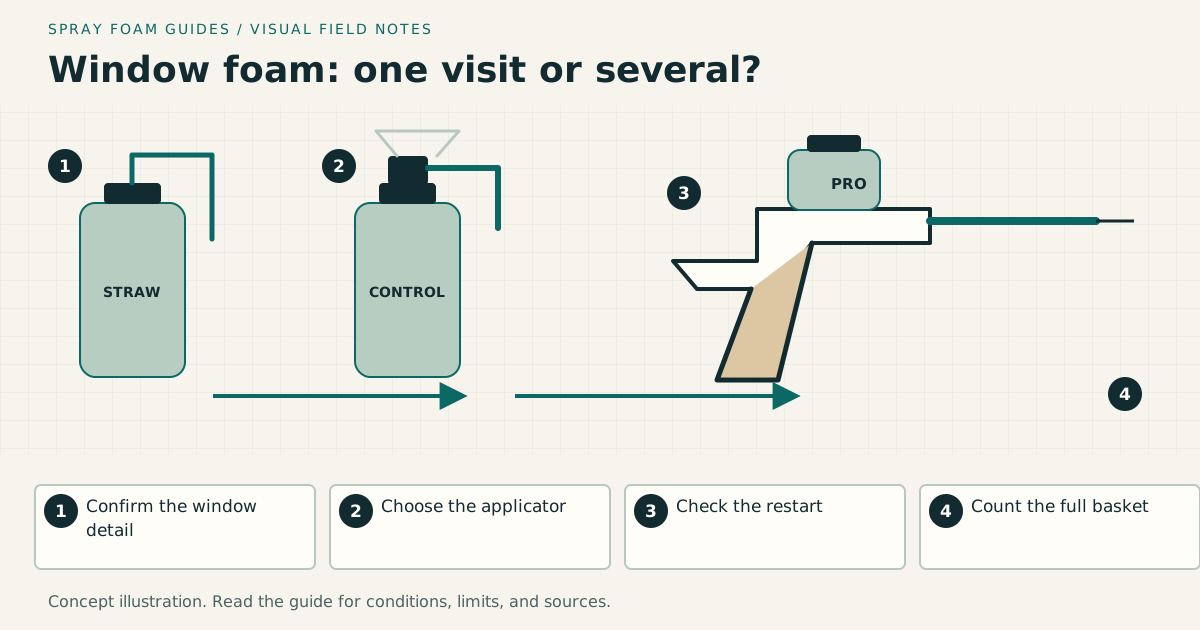
That question helps more than starting with the biggest can. If you are replacing one window and do not own a foam gun, a dedicated Window & Door can with its own applicator deserves a look. If you are air-sealing several openings, gun control and a documented way to resume work may justify the extra equipment.
The five brands below are not five interchangeable cans. Great Stuff and Loctite each sell more than one dispensing format. Kraken’s standard Window & Door product is separate from Xtreme; Sprayman’s standard product is separate from X-Climate. This guide compares the named standard products and keeps those distinctions intact.
We reviewed the linked manufacturer documents and published contractor material on October 19, 2026. We have not tested these foams side by side. The shopping cards use verified package records from Best Spray Foam, our sister publication under common ownership; they are not a ranking of all five brands.
Already own a gun? Compare these options first
| Product | What you are choosing | Detail that could change your choice |
|---|---|---|
| Kraken Bond PRO Window & Door | Gun-applied window foam; the reviewed technical sheet identifies the 24 oz can | Its January 21, 2026 sheet warns against pauses longer than five minutes. Confirm the intended restart procedure before scheduling separate visits |
| Sprayman Window & Door | Standard gun-applied foam; the store describes a 24 oz package | The linked, undated sheet also gives a five-minute pause warning. Its packaging is expressed as fluid volume; confirm the document-to-can match rather than treating weight and fluid ounces as interchangeable |
| Great Stuff PRO Window & Door | A dedicated window-and-door foam for the specified PRO dispensing equipment | Its installation guide allows the gun to remain attached for up to 30 days under its storage procedure. Check the current can and gun instructions together |
Read the Kraken sheet, Sprayman sheet, and Great Stuff PRO installation guide. A threaded can does not, by itself, prove compatibility with every gun or permission to store it attached indefinitely.
Kraken’s sheet lists a 28 to 86°F application range, and Sprayman’s lists that range for ambient and surface temperatures. Great Stuff PRO’s cited guide lists 40 to 100°F with a humidity condition. These are application limits, not forecasts of how quickly the foam will cure or temperatures the finished building may experience. A cold can is a separate preparation issue.
No gun? Keep the included-applicator products on your list
| Product | Dispenser | Scheduling question |
|---|---|---|
| Great Stuff Window & Door with Smart Dispenser | Attached dispensing system, distinct from PRO gun cans | The manufacturer describes reuse for up to 30 days; follow this package’s closure and storage directions |
| Loctite Tite Foam Window & Door | Attached straw applicator | The retrieved U.S. sheet says to expect one-time use. Budget accordingly for work on different days |
| DAP No Warp Window & Door | Stop/restart adapter and spare straw | The sheet describes a three-week reuse step and up to six weeks total with the second straw; follow the procedure for your package |
Sources: Great Stuff Smart Dispenser, Loctite U.S. technical sheet, and DAP No Warp technical sheet.
Loctite also sells a separate PRO gun product. Do not apply the straw can’s restart assumption to that other product. Likewise, a Great Stuff Gaps & Cracks can is not the Window & Door can just because the dispenser looks familiar.
There is a useful document-check lesson in DAP’s linked sheet: the directions give 60 to 120°F, while the properties table gives 60 to 100°F. Get the applicable limit confirmed if your conditions approach that disagreement. The retrieved Loctite PDF is labeled March 1, 2024; search results surfaced a newer revision for the same address, so verify the supplied edition rather than assuming the URL identifies a fixed version.
What a contractor demonstration adds
In Fine Homebuilding’s window-foam demonstration, the useful detail is the continuous seal between the frame and rough opening while preserving the exterior drainage space. Watch the location of the bead, not just how much foam leaves the can. The demonstration features Loctite; it does not compare the five brands.
Remodeling contractor Mike Sloggatt’s related door demonstration explains the control a gun tip offers around a jamb. His account of leaving a can attached is his experience, not a storage instruction for another brand.
Our takeaway: choose a dispensing method you can control in the actual opening, and use that product’s restart instructions. The installer in a video has not inspected your window or reviewed this article.
Compare a complete shopping basket
For an illustrative group of four windows, each 3 ft wide and 5 ft high, the perimeter is 4 × 2 × (3 + 5) = 64 linear feet. That does not tell you how many cans to buy. Joint width, depth, the accepted seal location, interruptions, and the product’s stated yield conditions still matter.
List the foam, compatible dispenser if needed, cleaner, masking, required exposure protection, and finish work. Then add tax and delivery. A one-can refill and a can-plus-gun bundle have different contents even when they appear next to each other on Amazon.
Here is a deliberately simple invented cost example, not a current offer or measured yield. Assume one can contains enough usable material for the stated work, and only the included-applicator option requires a new can on the second visit:
| Equipment and schedule | Included-applicator option at $18 per can | Gun option: $15 can + $35 gun + $10 cleaner |
|---|---|---|
| One visit; no gun owned | $18 | $60 |
| Two visits; no gun owned | $36 | $60, only if the product permits the planned restart and enough material remains |
| Two visits; compatible gun and cleaner already owned | $36 | $15 in new foam purchases, under the same restart and quantity assumptions |
This narrow basket leaves shared protection, preparation, finish, tax, and delivery outside the arithmetic. Existing equipment still has a cost; the last row describes new cash spending. Replace every invented price and confirm quantities before using it for a purchase. There is no universal number of windows after which a gun pays for itself.
For a real estimate, use the project-cost tool and the straw-versus-gun guide. Window-joint sealants should not be priced as if they were full-wall insulation kits.
Check the opening before choosing the can
The Building America rough-opening guide separates the interior air seal from the exterior drainage path. Follow the window or door manufacturer’s detail, including any sealant restrictions. Foam is not a substitute for flashing, shims, or fasteners.
Check that the unit operates correctly before trim hides the joint. Follow the exact label and SDS for ventilation, ignition control, and protective equipment. Cure, trim readiness, and safe occupancy are separate questions; a fast tack-free claim does not answer all three. Our window and door project guide covers that larger work sequence.
If the detail calls for sealant over backer rod, compare that method directly. The caulk, backer rod, blocking, or foam guide includes a builder’s alternative approach. You do not have to force foam into every joint.
Which would we put on the shortlist?
- One small session, no gun: compare the three included-applicator options against the actual joint and local availability. Check restart needs before paying extra for that feature.
- Several openings with a gun already owned: confirm tool compatibility and the manufacturer’s pause/storage procedure first. Great Stuff PRO’s explicit attached-gun period is useful planning information, not proof that its cured seal performs best.
- Kraken or Sprayman at an attractive delivered price: include the missing equipment and resolve the standard product’s pause warning. Similar documents and appearance do not establish identical formulations.
- Unclear drainage, a binding window, or unresolved document limits: settle that issue before buying more foam. A different brand will not repair a missing installation detail.
Can regular gap filler replace Window & Door foam?
Do not assume so. Choose the formulation permitted for the frame joint, not merely a low-expansion slogan. The Window & Door versus Gaps & Cracks comparison explains the distinction.
Does the largest published yield mean the lowest job cost?
Only comparable quantity statements can support that calculation. A volume figure, a bead length, and a number of example windows can describe different test geometries. Confirm the basis before comparing cans per job.
Are the videos an expert review of this comparison?
No. They are attributed third-party demonstrations used to illustrate a decision. Our comparison is based on the identified documents; it is not a five-product field test or approval from the featured contractors.
Research & references
Sources used for this guide
- Air Sealing Window and Door Rough Openings
- PRO Window & Door gun foam: technical data sheet
- Window & Door low-expansion foam product page
- Door & Window gun foam: U.S. technical data sheet
- Great Stuff PRO Window & Door installation guidelines
- Window & Door with Smart Dispenser
- Tite Foam Window & Door: U.S. technical data sheet
- No Warp Window & Door: technical data sheet
- Insulating Foam for High-Performance Windows
- How to Air-Seal Doors and Windows with a Spray-Foam Gun
A citation supports a specific statement, not every possible assembly or local code interpretation.
Your project, in order
Five questions before the first can.
- 01
Where are you working?
Start with the attic, wall, garage, shed, or measured joint.
Choose the project - 02
What will it cost?
Put quotes on the same area, depth, units, and finished scope.
Compare the price units - 03
What do you need?
Match the material, dispenser, and documents to the task.
Choose the format - 04
How should it be done?
Check surfaces, conditions, access, and the exact instructions.
Check readiness - 05
How long will it take?
Separate setup, application, cure, access, and finishing.
Plan the stages