Joint design
Caulk, Backer Rod, Blocking, or Spray Foam? Choose by Joint
Caulk seals a designed joint, backer rod controls sealant geometry, rigid or flexible blocking restores a missing plane, and foam fills eligible irregular openings. Many durable repairs combine them.
On this page
The short answer
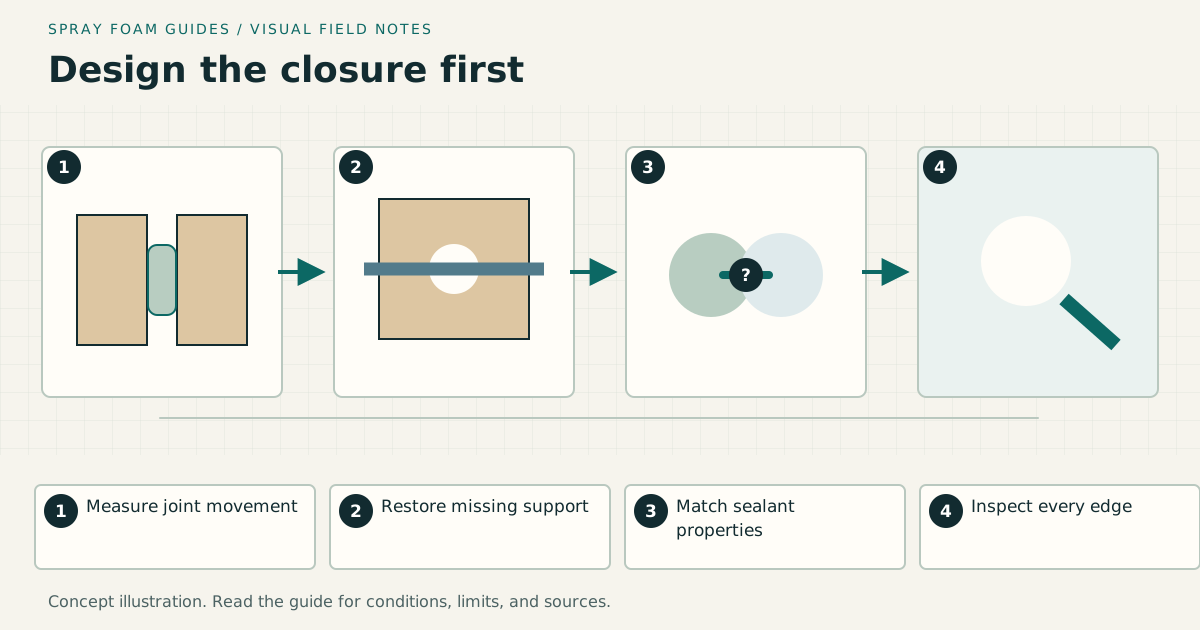
Measure the opening and identify its movement, support, exposure, and assembly. Use blocking where construction is missing, backing where the sealant needs controlled geometry, and only an exact compatible sealant at the remaining joint.
This answer changes when…
- Opening width, depth, taper, connected volume, and access
- Expected movement between adjoining materials
- Bulk water, UV, temperature, pests, and cleaning exposure
- Fireblocking, rated construction, and heat sources
- Future disassembly, finish, and inspection
Dotted terms have plain-language definitions. Browse the glossary ↗
A gap is a small construction detail
Measure it like one. Record the two edge materials, narrowest and widest points, depth, taper, backing, movement, water exposure, temperature, and what lies beyond. A dark opening may connect to a much larger cavity.
The question is rarely “Which tube or can is strongest?” It is which combination restores the missing layer and leaves a joint the selected sealant can handle.
Give each material one job
| Material | Useful role | Stop when |
|---|---|---|
| Caulk or sealant | Forms a surface joint between compatible edges | Joint is too deep, unsupported, wet, dirty, moving beyond rating, or wrong for exposure |
| Backer rod | Supports sealant and controls joint depth and shape | It would block drainage, enter a rated detail without approval, or lacks required fit |
| Rigid blocking | Restores missing air-control or construction plane | Structure, water, fire, pest, or service function is undefined |
| Flexible membrane or transition | Bridges movement or connects planes | Adhesion, support, laps, or exposure are undocumented |
| One-component foam | Fills an eligible irregular fixed opening and seals edges | Blind cavity, heat, incompatible substrate, rated system, or unsupported large void |
| Window and door foam | Seals the specific rough-opening joint with documented low-pressure behavior | Hardware, drainage, flashing, or frame anchorage is being treated as the same joint |
A repair may use blocking for most of an opening, backer rod at a moving perimeter, and sealant at the exposed edge. Combining materials is normal when each interface is documented.
Movement changes the answer
Wood, metal, masonry, plastic, and window frames move at different rates. A hard mass packed deeply into a moving joint can transfer stress or separate at an edge. An elastomeric sealant may need a particular joint shape and backing to stretch as designed.
Ask for movement capability, compatible substrates, primer, joint dimensions, tooling, cure, weather exposure, and maintenance interval from the exact sealant data. Do not infer those properties from a foam’s expansion label.
Missing construction needs construction
If a plumber left a large rectangular hole around one small pipe, the durable first step may be a fitted patch or blocking plate. Seal its perimeter and the remaining annular opening separately. This reduces unsupported volume and keeps the service understandable.
Do not fill a chase, window mullion, hollow door, or concealed wall by injecting foam through a hole. The material may not receive the moisture, mix, expansion room, or inspection the product requires. Hidden pressure can damage finishes and still leave voids.
Water and exterior exposure stay outside the insulation claim
At a window, door, pipe, deck ledger, or cladding penetration, show how water drains outward. The interior air seal, exterior weather seal, flashing, and drainage space may be different layers. Do not bridge a drainage opening with foam because air is felt there.
Verify UV and weather exposure. Many polyurethane foams require protection and are not the exterior finish. An exterior joint also needs movement and maintenance planning.
Fire, heat, and services override convenience
Stop at flues, chimneys, hot piping, recessed fixtures, rated assemblies, and unidentified penetrations. Use the equipment listing, adopted code, and accepted system. Fireblock foam and listed firestop systems have different evidence.
For electrical and plastic-pipe openings, verify exact compatibility and access. Do not cover a junction box, valve, cleanout, or service joint that must remain available.
Three worked details
A 1/4-inch trim joint: two painted surfaces meet, movement is modest, and the joint remains indoors. A compatible caulk may be enough after preparation. Foam behind the trim would add complexity unless there is a deeper air leak that has been mapped.
A tapered opening around a drain: the rough hole is much larger on one side. A fitted blocking plate can restore the plane; a compatible sealant closes the plate edges and pipe perimeter. Packing the entire volume with foam may hide leakage and make drain service harder.
A rough window perimeter: the frame is shimmed and anchored, exterior flashing drains correctly, and the interior joint varies in width. Use an exact window and door sealant for that interior air-seal joint, with documented backing where needed. Keep hardware and drainage paths clear.
These examples show reasoning, not universal dimensions or product approvals.
Record the joint before closing it
Use a short schedule with location, edge materials, width range, depth, expected movement, exposure, assembly role, backing or blocking, sealant, preparation, inspection, and finish. Photograph a ruler at representative locations and a wide view of the surrounding assembly.
The acceptance check asks whether the missing plane was restored, edges are prepared, drainage remains open, the bead is continuous, the joint can move as intended, services remain accessible, and required protection is complete. A full-looking gap is not enough.
Research & references
Sources used for this guide
- Air Sealing Plumbing and PipingDOE Building America Solution Center · government guidance · United States; penetration planning and blocking principles, not generic compatibility or firestop approval · accessed 2026-09-09
- Air Sealing Window and Door Rough OpeningsDOE Building America Solution Center · government guidance · United States; window and door rough-opening details · accessed 2026-09-06
- Rough Opening Flashing: Air SealingU.S. Department of Energy Building Science Education · government guidance · United States; rough-opening air-sealing guidance, subject to unit instructions, flashing design, local code, and the actual project · accessed 2026-09-08
- GREAT STUFF Gaps & Cracks Insulating Foam SealantDuPont · manufacturer document · United States; exact-product example of a general fixed-gap sealant and stated opening limit, not a transferable category limit · accessed 2026-09-07
- GREAT STUFF Big Gap Filler Insulating Foam SealantDuPont · manufacturer document · United States; exact-product example for larger gaps and stated opening limit, not permission to fill an unsupported or uninspected void · accessed 2026-09-07
- The Code Authority Q&A: FireblockingUL Solutions · official standard portal · United States; distinction between fireblocking in concealed combustible spaces and listed penetration firestop systems, subject to the locally adopted code and accepted assembly · accessed 2026-09-08
A citation supports a specific statement, not every possible assembly or local code interpretation.