Sound and insulation
Insulation and Sound Control: What Spray Foam Can and Cannot Prove
Thermal insulation can be part of an acoustic assembly, but R-value does not establish sound isolation. Room echo, airborne transmission, footsteps, vibration, and sound traveling around a partition are different problems. Useful evidence identifies the complete tested assembly and the noise the project is intended to address.
On this page
The short answer
Describe the sound and its path before choosing insulation. Compare complete, documented wall or floor systems, including surfaces, framing, doors, penetrations, and connections. Do not convert an R-value, cell type, absorption rating, or marketing demonstration into a promise that a room will be soundproof.
This answer changes when…
- The concern is room echo, voices, outdoor noise, footsteps, or equipment vibration
- Sound travels through the proposed assembly or around it by another path
- The proposal identifies the complete tested construction and applicable rating
- Fire protection, ventilation, moisture, and service access remain functional
- Any performance target and field verification method are agreed before construction
Dotted terms have plain-language definitions. Browse the glossary ↗
Will insulation make a room quieter?
It may help as part of the right assembly, but the answer depends on the sound and how it reaches the room. Filling a wall cavity does not necessarily address sound coming through a door, an open ceiling space, or connected framing. It also does not tell you whether the room itself will have less echo.
Start with a description that another person can investigate: speech from the next bedroom, traffic through an exterior wall, footsteps from upstairs, or a low hum when equipment runs. Record the location, timing, and operating conditions. “Soundproof the room” is too broad to guide a useful proposal or verify a result.
This guide explains how to read acoustic claims and plan an assessment. It assigns no sound rating to a generic spray foam, batt, or board and makes no promise of a particular reduction in your home.
Absorption and isolation are different goals
Sound absorption concerns how surfaces and materials affect reflected sound within a space. A room with many hard surfaces may be reverberant even when little sound passes through its walls. Appropriate acoustic finishes can change the room experience without creating a high-isolation partition.
Sound isolation concerns transmission between spaces. A wall or floor must be evaluated with its surfaces, framing, connections, openings, and other paths. A material that absorbs sound when exposed does not automatically block sound through a complete wall.
ASTM C423 addresses sound-absorption measurement. ASTM E90 addresses laboratory airborne sound transmission through building partitions and elements. They answer different questions. An absorption result cannot be substituted for a wall-transmission result.
Do not leave building insulation exposed as an improvised acoustic finish. The permitted use, protective covering, room conditions, and fire requirements still apply. Purpose-made acoustic finishes also need documentation for their location and installation.
Identify the type of sound before comparing materials
| Concern | What the assessment should distinguish |
|---|---|
| Speech or television from another room | Transmission through the partition, openings, and connected spaces |
| Footsteps or objects striking the floor above | Impact excitation and the complete floor-ceiling system |
| Traffic or aircraft outdoors | The exterior wall together with windows, doors, vents, and the relevant sound spectrum |
| Equipment hum or vibration | Airborne noise, mechanical vibration, and connections to the structure |
| Echo in the same room | Reflections, finishes, room shape, and sound absorption |
More than one mechanism can contribute. For example, an upstairs exercise room can create airborne music and impact from movement. A treatment chosen only for one concern may leave the other conspicuous.
For a substantial project, ask an acoustical professional which paths need investigation and whether measurements are warranted before construction. A phone recording can help describe an intermittent event, but it is not a standardized assembly test or a dependable basis for a guaranteed rating.
Read STC as a rating of tested construction
Sound Transmission Class, or STC, is a single-number rating derived from airborne transmission measurements using a defined method. The Acoustical Society of America’s standards terminology connects laboratory STC to ASTM E90 measurements and the ASTM E413 rating procedure.
Ask what was tested. The report should identify the partition or element, construction details, test method and edition, laboratory, and result. For a wall, relevant details include framing, cavity treatment, surface layers, attachment, and perimeter conditions. A foam name beside an STC figure does not mean the foam alone owns that rating.
The rating condenses frequency-dependent behavior into one number. ASA identifies 16 one-third-octave bands from 125 to 4,000 Hz for the STC calculation. It is a fitted-curve rating, not an arithmetic average or a promised decibel reduction for every sound. If the complaint involves bass, machinery, or another specific sound, ask the professional to review relevant test data, including frequencies outside that range where needed.
Laboratory performance is not a promise about the finished home
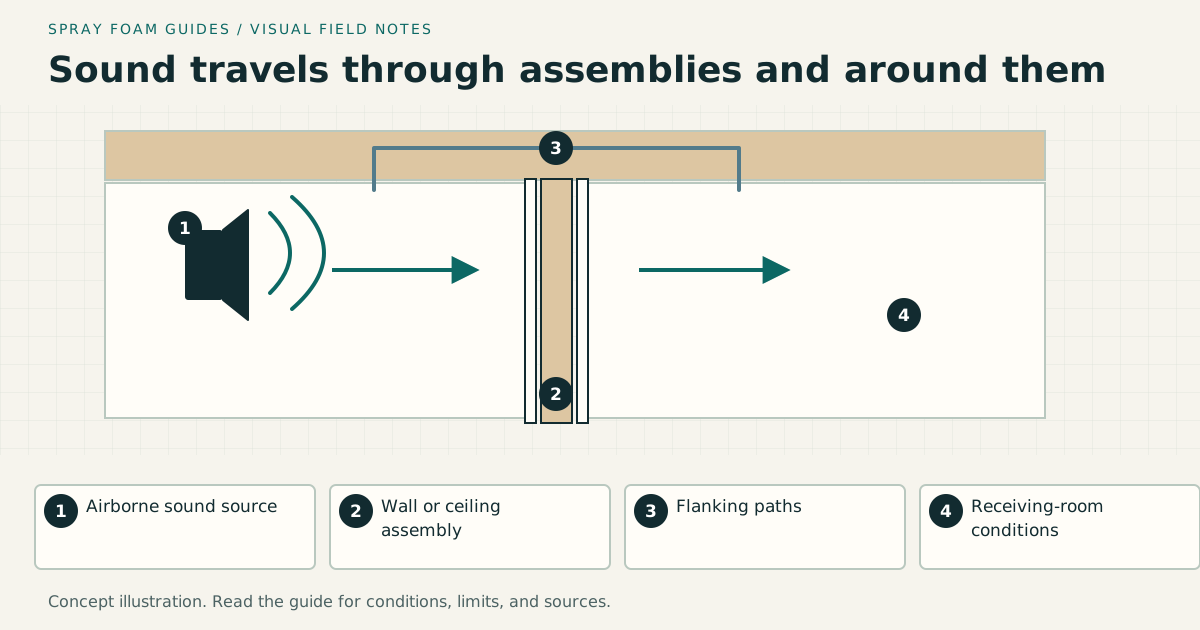
An E90 laboratory test aims to isolate transmission through the specimen. ASTM’s public scope and significance discussion explains that real buildings can have other paths, commonly called flanking transmission, which limit the direct transfer of laboratory results to field performance.
Think of a partition that stops at a suspended ceiling while the space above continues into the next room. Sound may bypass the wall through that shared space. Continuous framing, adjoining floors, ducts, doors, and wall intersections can also matter. A better cavity material alone does not close every route.
Ask whether a proposal specifies laboratory assembly performance, a field target, or simply a design intended to improve an observed problem. If field testing is included, identify its method, the locations tested, and the applicable criteria. Do not describe an ordinary before-and-after listening comparison as an ASTM result.
Compare complete assemblies with and without foam
Request at least one plausible assembly alternative for the actual access conditions. In an open partition, that might include a documented fibrous cavity treatment and surface construction. In a closed room, the better first intervention might concern a door or a connected air path rather than removal of an entire wall.
USG’s acoustical-assembly guide illustrates how wall and floor configurations, openings, and flanking details enter acoustic design. It is manufacturer evidence for the systems shown, not an independent ranking of insulation materials. Use ASA and the applicable ASTM method for rating definitions rather than treating the brochure as a test standard. We do not transfer its assembly ratings to a different product or construction.
For either a foam or fibrous proposal, request the supporting assembly and identify deviations. An extra layer, different fastener arrangement, or substituted cavity material may change the tested configuration. Have the designer evaluate substitutions instead of assuming that more insulation always preserves the result.
Thermal R-value remains a separate property. It cannot be converted into STC, and a cell-structure label cannot establish the sound performance of an installed partition. The open-cell and closed-cell guide addresses those material distinctions without assigning acoustic superiority.
A bedroom example: diagnose before opening the wall
Suppose a homeowner hears conversation from a neighboring room and is offered new insulation across the shared wall. Before approving demolition, identify the doors, any connecting grille, the ceiling configuration, and the wall’s existing construction. Record whether the sound changes when doors are closed normally.
If the proposed work only replaces cavity insulation, ask why the assessor expects that component to be the limiting path. If the design instead addresses a door, perimeter, or overhead route, ask how it will preserve necessary ventilation and access. This hypothetical example does not prescribe a particular seal or guarantee a quieter result.
The scope should state the problem it addresses and any known remaining paths. A realistic proposal can acknowledge that one phase improves a particular route while another condition limits the eventual outcome.
Preserve fire, moisture, and ventilation functions
Do not seal required ventilation or equipment openings to stop noise. A mechanical professional may need to design an alternative that maintains airflow while addressing sound transfer. A door modification can also affect operation, required clearances, or a protected assembly.
For exterior walls and roofs, retain the water and drying strategy. For partitions and floors with required fire protection, acoustic changes need review against the applicable construction. The 2021 IRC fire and foam-plastic provisions are a model-code reference, not local approval for an acoustic retrofit.
Spray application adds its own exposure and occupancy planning. An acoustic objective does not waive those requirements or make an enclosed cavity suitable for generic foam injection. Use the professional-help guide when the work involves unfamiliar construction or chemical controls.
Agree on verification before construction
Keep the accepted assembly detail, supporting reports, approved substitutions, and photographs of concealed connections. If the project includes field measurements, record the test conditions and the professional responsible. Do not let an unqualified percentage-noise-reduction promise replace the agreed method.
At completion, distinguish the construction check from the occupant’s experience. Both matter, but neither should be misrepresented. Use the inspection and handover guide to keep the final record useful for later service work that could alter the acoustic paths.
Research & references
Sources used for this guide
- E90: Laboratory Measurement of Airborne Sound Transmission Loss of Building Partitions and ElementsASTM International · official standard portal · Laboratory acoustical test scope; edition in actual report governs · accessed 2026-09-06
- C423: Sound Absorption and Sound Absorption Coefficients by the Reverberation Room MethodASTM International · official standard portal · Acoustical absorption test scope; not an assembly isolation rating · accessed 2026-09-06
- Sound Transmission ClassAcoustical Society of America · official standard portal · Acoustical standards terminology; laboratory and field distinction · accessed 2026-09-06
- Acoustical Assemblies, SA200USG · manufacturer document · United States; manufacturer assembly guidance, not independent material ranking · accessed 2026-09-06
- 2021 IRC Chapter 3: Building Planning (R302 and R316)International Code Council · official standard portal · 2021 model code example; not a local adoption determination · accessed 2026-09-05
A citation supports a specific statement, not every possible assembly or local code interpretation.