Brand and application comparison
Great Stuff vs Loctite Foam: Match the Product to the Job
Great Stuff and Loctite both sell canned foam for air-sealing jobs, but their product lines include different formulations and dispensers. Compare the wording on the exact can with your opening, access, and work schedule. A brand name alone does not tell you whether the foam belongs around a window, in a larger gap, or on an insulation surface.
Updated Oct 10, 20266 min readSource-check recordIndependent specialist review pending
Report an error or submit a manufacturer update →
Edition and authorship details
- Published
- Oct 10, 2026
- Last source check
- Oct 10, 2026
- Review record
- Oct 10, 2026 source review
- Editorial maintenance
- Oct 18, 2026
Current sectionContents
The short answer
For an ordinary accessible gap, compare the exact Gaps & Cracks products and their label limits. For a window or door rough opening, start with the opening detail and the specified window-and-door formulation. For repeated work, compare the dispenser, restart instructions, and cleanup cost. Neither brand name makes a general gap filler suitable for every task.
This answer changes when…
- The opening is accessible and its width, depth, and backing are known
- The task is general air sealing, a window or door joint, or a larger opening
- The work may be completed in one visit or spread across several visits
- The finished foam may need protection from weather, sunlight, or other exposure
Evidence trail
What to verify before applying this answer
Sources last checked: Oct 10, 2026. Each reference supports the point shown; it does not approve a project by itself.
Separate the Great Stuff packages
Original, Smart Dispenser, and PRO are separately documented formats; their labels and restart rules are not interchangeable.
DuPont / Great Stuff: Gaps & Cracks Foam: Original, Smart Dispenser, and PRO formatsSeparate the Tite Foam applications
Gaps & Cracks, Window & Door, and Big Gaps name different application lines rather than a universal brand use.
Henkel / Loctite: TiteFoam: Gaps & Cracks, Window & Door, and Big GapsResolve the joint-width discrepancy
The intended-use statement and property table show different widths; obtain manufacturer clarification for the actual package and opening.
Henkel / Loctite: Tite Foam Gaps & Cracks Technical Data Sheet
Unfamiliar terms? Browse the glossary ↗
Is Great Stuff or Loctite the better foam?
The useful comparison starts with the job, not the logo. A homeowner sealing a pipe opening and a remodeler working around a new window may need different cans from the same brand. A foam that fills the first opening can be the wrong formulation for the second.
This guide compares application labels and work planning. It does not rank brands, claim hands-on testing, or declare a stronger, safer, or better-insulating winner. For a named insulation pair, read our FastCoat versus FullStop comparison. Best Spray Foam, our sister publication under common ownership, provides additional product records and purchase comparisons.
If your goal is insulating an entire wall or roof surface, these gap fillers are the wrong starting comparison. Read surface-spray cans versus two-component kits to identify the format first.
Compare matching product lines
The following is a manufacturer-label snapshot checked October 10, 2026. It describes the named formats, not every can sold under either brand.
| Job or feature | Great Stuff example | Loctite example | What changes your decision |
|---|---|---|---|
| Ordinary gap filling | Gaps & Cracks Original and Smart Dispenser pages state gaps up to 1 inch | Tite Foam Gaps & Cracks family page states gaps up to 1 inch | Measure the joint and read the exact can’s instructions |
| Window or door opening | Use the separately labeled Window & Door line and opening instructions | The Tite Foam family lists a separate Window & Door formulation | General gap filler is not automatically interchangeable |
| Larger opening | The family page lists a PRO gun-applied Gaps & Cracks product with a different stated range | The family lists Big Gaps separately | A wider label range does not establish suitable backing or fire use |
| Restarting work | Smart Dispenser has a documented reuse procedure | Check the supplied applicator and instructions for the actual Tite Foam can | Do not transfer a restart interval between packages |
See the Great Stuff family page and Loctite Tite Foam family page for the distinctions. Products carrying “PRO,” “Window & Door,” or “Big Gaps” need their own documents.
What if the product page and technical sheet differ?
The January 15, 2025 Loctite Gaps & Cracks technical sheet introduces a one-inch gap use but also reports a 1.6-inch maximum joint width in its property table. Those entries are not a reason to quietly substitute the larger number for the intended-use statement.
If your opening falls between those values, ask Henkel technical support which limit and installation detail apply to the package you have. Keep the response with the job record. This is a document discrepancy to resolve, not evidence that every general gap foam can fill a larger opening.
The same approach applies when a retailer’s title combines several product names. Check the can and the manufacturer’s current document together. For an opening without appropriate backing, consider blocking, backer rod, caulk, or foam before choosing another can.
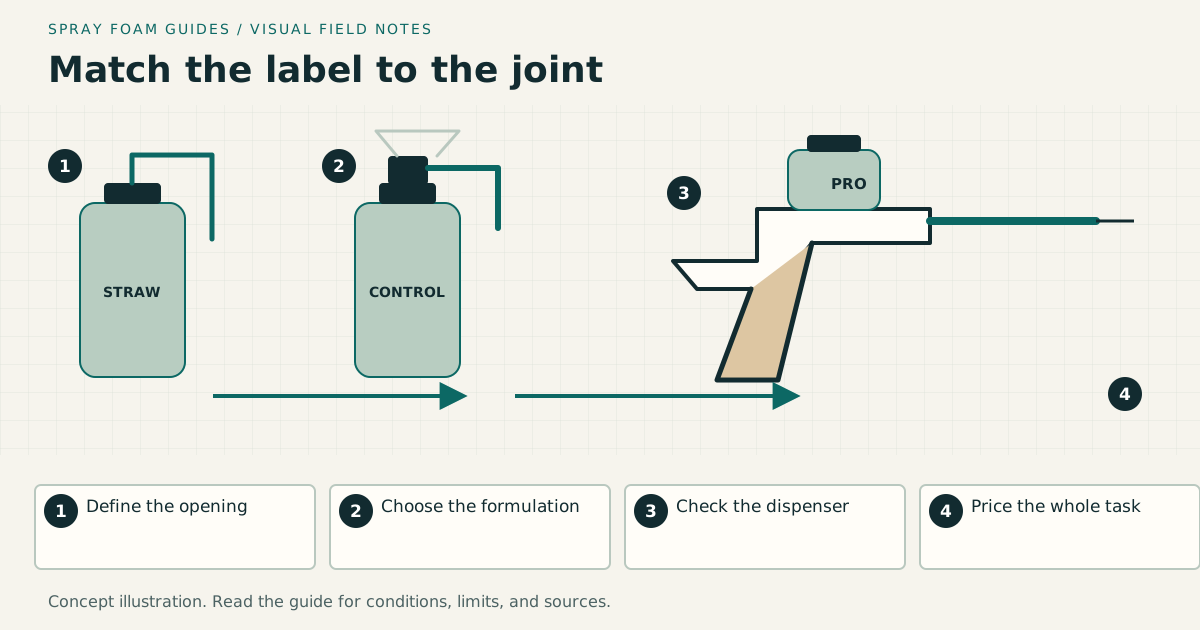
Straw, integrated dispenser, or separate gun?
The applicator affects reach, bead control, pauses, and cleanup. It does not establish the formulation’s permitted use.
A small one-visit task and a week of trim work have different needs. For repeated visits, read the actual restart and storage instructions before opening the can. For a threaded gun, confirm the compatible can and cleaner; include the gun in the budget if you do not already own it. An included applicator should not be assumed to fit a separate gun.
The Great Stuff Smart Dispenser page distinguishes that dispenser’s reuse instructions from the original straw package. Keep that distinction when comparing shelf labels. The straw-versus-gun guide explains the broader work sequence without assigning a brand winner.
Compare the cost of finishing the same job
Use a small project basket rather than can price alone:
- Correct formulation and the quantity estimated from its own coverage basis.
- Required applicator and compatible cleaning supplies.
- Masking and the product-specified exposure controls.
- Backing, trim restoration, or an exterior protective finish where needed.
- Shipping, tax, leftovers, and the next visit if work will pause.
For example, a lower-priced straw can may not reduce the total if the documented restart procedure does not fit your work schedule. A separate gun adds an initial expense; owning one does not make a gun-applied can suitable for a different joint.
These are budgeting considerations, not observed retail prices or proof of lower waste. Use a dated quote for the exact package. Do not divide can ounces by a wall’s square footage to invent installed coverage. The price-unit comparison separates package cost, surface area, volume, and installed scope.
Check the joint before applying either foam
Start with the window, door, and small-gap project guide. Identify the air-control connection, preserve drainage and movement, and resolve dampness or damaged construction before concealing it.
Read the label and SDS for protection, ventilation, ignition control, and handling. Keep foam out of drains and required clearances. A pest claim does not create rodent-proof construction, and a fireblock claim does not establish a listed firestop system for a rated wall or floor. Unknown hot surfaces, energized equipment, concealed cavities, or required fire details call for the appropriate professional and exact instructions.
Do not use a product comparison video as an installation or occupancy clearance. The visible texture of a sample cannot verify the finished joint or the surrounding assembly.
How long should you allow?
Separate preparation, dispensing, the label’s trim or finish milestone, cleanup, and any applicable access restriction. A tack-free surface and a finished job are different milestones. Conditions and bead geometry can change the schedule.
Use the project timeline guide to organize those steps. Record the product, joint location, instructions used, and any question sent to technical support before covering the work.
Can I use ordinary Gaps & Cracks around a replacement window?
Do not substitute it just because the brand also sells a window-and-door foam. Follow the window manufacturer’s opening detail and the exact sealant instructions, including movement, drainage, and frame-operation checks.
Does denser-looking foam prove better insulation?
No. A cut sample or marketing description does not establish installed thermal performance in your joint or a complete wall. Use documented properties for the exact product and intended assembly.
Research & references
Sources used for this guide
- Gaps & Cracks Foam: Original, Smart Dispenser, and PRO formats
- Gaps and Cracks with Smart Dispenser
- TiteFoam: Gaps & Cracks, Window & Door, and Big Gaps
- Tite Foam Gaps & Cracks Technical Data Sheet
A citation supports a specific statement, not every possible assembly or local code interpretation.
Your project, in order
Five questions before the first can.
- 01
Where are you working?
Start with the attic, wall, garage, shed, or measured joint.
Choose the project - 02
What will it cost?
Put quotes on the same area, depth, units, and finished scope.
Compare the price units - 03
What do you need?
Match the material, dispenser, and documents to the task.
Choose the format - 04
How should it be done?
Check surfaces, conditions, access, and the exact instructions.
Check readiness - 05
How long will it take?
Separate setup, application, cure, access, and finishing.
Plan the stages