Two products, one job
Kraken Bond FastCoat vs BEEST FullStop Spray Foam
FastCoat leads the published Best Spray Foam evidence ranking at 86.7/100 (#1) versus FullStop at 58.5/100 (#5). Its traceable yield and surface-burning documentation make it easier to plan from the record available today. The score is not a side-by-side field test, so this guide still checks coverage, layers, tools, and complete job cost.
Updated Oct 28, 20268 min readSource-check recordIndependent specialist review pending
Report an error or submit a manufacturer update →
Edition and authorship details
- Published
- Oct 18, 2026
- Last source check
- Oct 18, 2026
- Review record
- Oct 18, 2026 source review
- Editorial maintenance
- Oct 30, 2026
Current sectionContents
The short answer
FastCoat is the evidence-led choice today because its dated technical record gives a clearer basis for quantity and claim review. FullStop's headline area still needs a confirmed thickness, and its technical record is thinner. That supports a planning recommendation, not proof that FastCoat delivers better installed foam in every assembly.
This answer changes when…
- Measure the exposed surface and establish the required finished thickness
- Confirm the coverage basis and layer instructions for the exact product
- Include compatible tools, exposure controls, preparation, and finish work
- Keep cure time separate from permission to return to the work area
Evidence trail
What to verify before applying this answer
Sources last checked: Oct 18, 2026. Each reference supports the point shown; it does not approve a project by itself.
Check both pages of the instructions
The layer wording and illustration need clarification for the intended depth.
Kraken Bond: FastCoat technical data sheet, January 19, 2026, revision 1Ask for the coverage thickness
The area headline alone cannot establish an installed volume.
BEEST USA: FullStop 24-can product pageKeep closed cavities outside this scope
The quick-start guide excludes filling concealed closed cavities.
BEEST USA: FullStop quick-start guide, undated printed pages
Unfamiliar terms? Browse the glossary ↗
Which one would you use for the same job?
Suppose you have an exposed section of shed wall to insulate. You can reach the whole surface, the moisture problem has been addressed, and you are comparing two packages before ordering. FastCoat and FullStop belong on that shopping list only if their instructions and your accepted wall assembly fit the work.
The published score is not tied. In Best Spray Foam’s surface-kit ranking, FastCoat is #1 at 86.7/100 and FullStop is #5 at 58.5/100 in the September 7, 2026 scoring edition. Its published methodology rewards inspectable evidence and buying clarity; it does not claim a controlled installation test. Best Spray Foam and SFG share an owner, so use that score as disclosed sister-publication research and inspect the linked evidence before treating it as a buying conclusion.
Our first preference is the option you can size and specify without guessing. FastCoat gives you a clearer starting point for the material quantity. FullStop deserves a coverage clarification before you put its advertised area into the same calculation. Neither observation establishes which foam will perform better on your wall.
This comparison is an editorial review of the linked manufacturer materials, checked October 18, 2026. We have not applied these products side by side. BEEST USA is the product brand; Best Spray Foam is our sister publication, not that manufacturer.
Comparing the companies’ other foam products too? The Kraken Bond vs BEEST product-line map separates insulation, window foam, and pest-sealing options, with official document and support routes.
Put the published numbers on the same basis
The figures below are manufacturer claims, not results from an SFG test. Equal units make a comparison readable; they do not establish identical test methods or conditions.
| Planning question | Kraken Bond FastCoat | BEEST FullStop | What that means for your job |
|---|---|---|---|
| What thermal value does the store publish? | R-5.66 at 1 inch; R-11.32 at 2 inches | R-4.12 at 1 inch; R-8.24 at 2 inches | Compare at the required thickness; these are material claims, not whole-wall R-values |
| What quantity is advertised? | Up to 20 board feet per can | The 24-can page advertises 480 sq. ft.; the headline does not attach a thickness | Confirm the finished depth behind an area claim before converting it into volume |
| Which documents can you open here? | Product page and dated technical data sheet | Product page, quick-start guide, safety page, and SDS | Each document serves a different purpose; an SDS is not a thermal-performance report |
Sources: FastCoat product page, FastCoat technical sheet, January 19, 2026, revision 1, and FullStop 24-can product page. FullStop’s separate safety page links its instructions and SDS.
Do not turn the thermal figures into a percentage off your heating bill. Framing, air leaks, the rest of the assembly, weather, and how the building is used all stand between a material claim and household energy use.
A 100-square-foot example shows why thickness matters
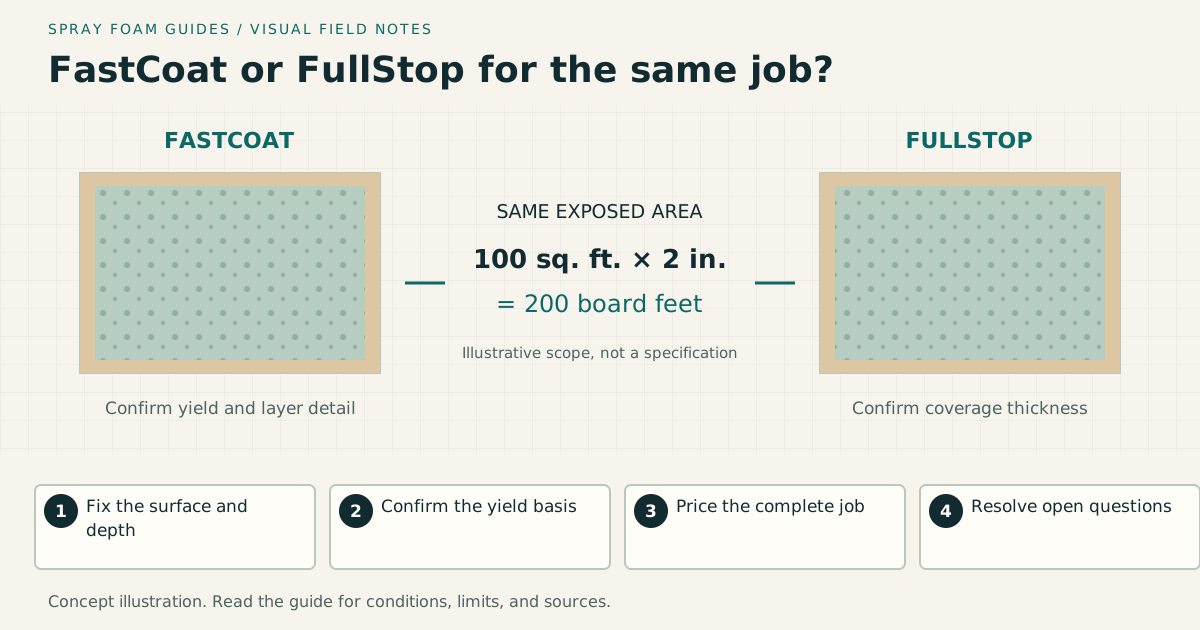
For this planning example only, assume an accepted design calls for 100 sq. ft. of net exposed surface at 2 inches. This is not a recommended insulation depth for every shed or garage.
100 sq. ft. × 2 inches = 200 board feet. One board foot is one square foot at one inch thick. Measure the actual wall area after subtracting openings; the shed’s floor area is a different number.
| Assumed finished depth | Net surface | Geometric volume |
|---|---|---|
| 1 inch | 100 sq. ft. | 100 board feet |
| 2 inches | 100 sq. ft. | 200 board feet |
Dividing 200 by FastCoat’s advertised maximum of 20 gives 10 cans at the stated maximum yield. That arithmetic is a theoretical starting point, not a purchase quantity. Uneven depth, off-target spray, conditions, and unusable remainder can increase the material needed. We have not measured a loss allowance for either product.
For FullStop, ask what finished depth the advertised area represents. If 480 sq. ft. were measured at 1 inch, it would represent 480 board feet; at 2 inches, it would represent 960. Those are alternative mathematical interpretations, not two verified FullStop yields. Do not pick the more favorable one. Get the manufacturer’s clarification for the package and use the board-foot calculator with the confirmed basis.
Compare the cost of a finished wall section
A cheaper box can still lead to a more expensive job. Write down the same work basket for both options:
- Enough material for the measured surface and specified depth, with a justified allowance.
- A compatible gun, spray tips, and cleaner, after checking what the selected package includes.
- Masking, floor protection, and the exposure controls required for the actual product and work area.
- Surface repairs and preparation.
- Required covering or finish, cleanup, tax, shipping, and any return visit.
For a simple budget exercise, suppose one complete basket costs $400 and the other $450 for that same 100-square-foot finished scope. That is $4.00 versus $4.50 per sq. ft. These are invented round numbers, not current prices for either brand. The comparison stops being useful if one basket leaves out tools or the required finish.
Use dated offers for the exact package when replacing those numbers. A discount code, a refill can, and a kit with accessories are different quotes. Our square-foot versus board-foot price guide explains which denominator belongs with each cost.
Settle these instruction questions before spraying
FastCoat’s technical sheet describes a 2-inch total in at least three layers. Its application illustration also labels a layer as 1 inch. Ask Kraken how to reconcile the layer detail for your intended thickness; do not invent a pass schedule from the drawing. The same sheet warns that pauses longer than five minutes can allow foam to cure in the applicator. That matters if you expect to move ladders or masking repeatedly. Read both pages of the technical sheet.
FullStop’s quick-start guide gives its own layering and waiting instructions. It also excludes filling closed cavities, including concealed spaces behind walls. That rules out treating an intact finished wall as an injection job based on a promotional photo. The guide is not dated on its printed pages, so keep a copy of the version supplied with your purchase.
Plan the sequence as preparation, application, the product’s waiting milestones, inspection, and finishing. A stated 24-hour cure time does not promise a one-day renovation or establish safe occupant return. Use the project timeline to separate those decisions.
“Class A” is not a complete fire or safety answer
ASTM E84 evaluates surface-burning behavior under controlled test conditions. Its scope does not make the result a complete assessment of real-world fire risk. A Class A claim does not, by itself, approve leaving foam exposed in your building or replacing a required protective covering. Resolve the assembly requirements through the thermal and ignition barrier guide.
The FullStop safety page explicitly separates its cured-foam claim from the flammable application stage. Its March 9, 2026 SDS identifies inhalation and sensitization hazards as well as ignition precautions. An accessory bundle labeled “safety kit” does not establish that it contains the respiratory protection or other controls your job requires. Read the current label, SDS, and instructions for whichever product you select.
When would the choice change?
| Your situation | Next useful decision |
|---|---|
| You need a quantity estimate now | FastCoat’s stated volume yield gives a starting basis; confirm the application detail and allowance |
| FullStop is available at a better delivered price | Resolve its coverage thickness, then compare complete baskets rather than headline area |
| You already own a dispensing gun | Confirm compatibility before treating the gun as a zero-cost item |
| The surface is hidden behind a finished wall | Reassess the method; do not assume either surface-spray product is an injection system |
| The job is a narrow window-frame joint | Use the Window & Door versus Gaps & Cracks comparison to select the appropriate formulation |
Should Great Stuff Wide Spray be in this same comparison?
It belongs in the broader discussion of product formats, but a wide spray pattern alone does not establish the same permitted job, thickness, or thermal performance. Compare each exact label before treating Great Stuff Wide Spray, Kraken ThermaFoam, FastCoat, and FullStop as substitutes. Start with wide spray versus gap-filling foam.
Are FastCoat and FullStop the same foam under different labels?
The documents reviewed here do not establish a shared formulation or interchangeable instructions. Similar packaging, dispensing equipment, or cured appearance cannot answer that question. Keep the product records separate.
What should I ask the manufacturer?
Send the surface area, intended depth, substrate, location, and proposed finish. Ask for the matching application instructions, coverage basis, and any needed assembly documentation. For FastCoat, include the layer-detail question above. For FullStop, include the thickness behind the advertised coverage. A written answer tied to your product and job is more useful than another general sales claim.
Research & references
Sources used for this guide
- FastCoat product page
- FastCoat technical data sheet, January 19, 2026, revision 1
- FullStop 24-can product page
- FullStop quick-start guide, undated printed pages
- FullStop safety information and document links
- FullStop SDS, March 9, 2026, version 1.1
- ASTM E84: public scope of the surface-burning test
A citation supports a specific statement, not every possible assembly or local code interpretation.
Your project, in order
Five questions before the first can.
- 01
Where are you working?
Start with the attic, wall, garage, shed, or measured joint.
Choose the project - 02
What will it cost?
Put quotes on the same area, depth, units, and finished scope.
Compare the price units - 03
What do you need?
Match the material, dispenser, and documents to the task.
Choose the format - 04
How should it be done?
Check surfaces, conditions, access, and the exact instructions.
Check readiness - 05
How long will it take?
Separate setup, application, cure, access, and finishing.
Plan the stages