Pattern and purpose
Wide-Spray Foam vs Gap Filler: Surface Pattern or Joint Bead?
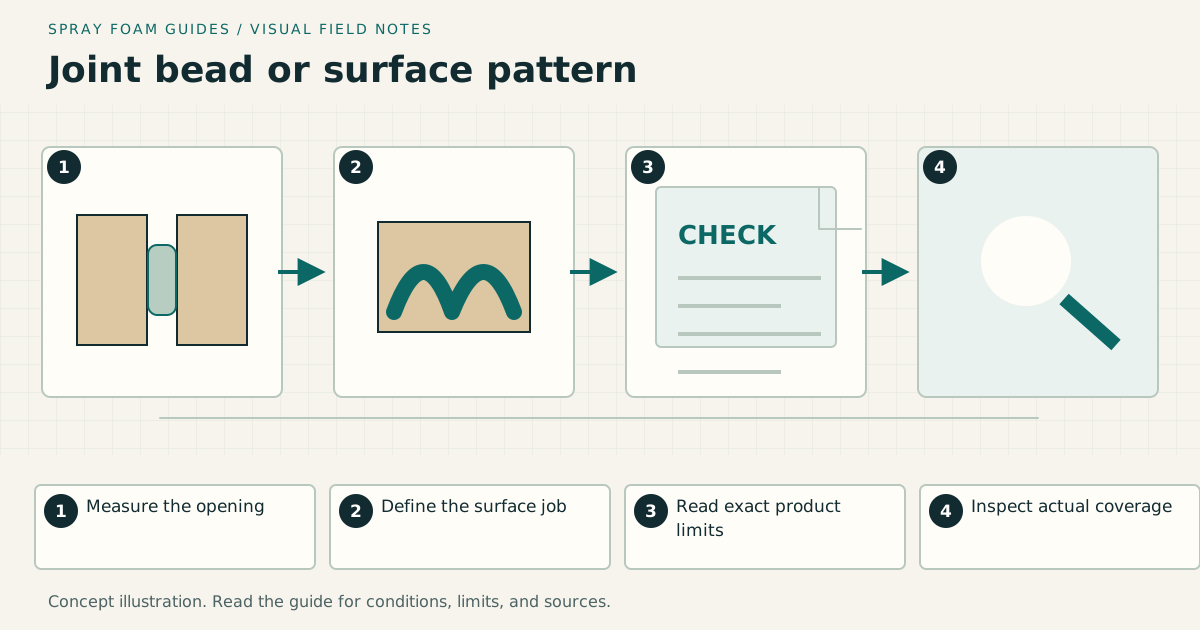
Gap filler places a bead inside a bounded joint. A wide-pattern product distributes material across an open surface. Similar packaging does not make their coverage, thickness, fire, exposure, or assembly claims interchangeable.
On this page
The short answer
Choose from the shape and function of the work. Use a gap product for an eligible joint and a surface product only for its exact documented open application. Neither format is permission to fill a blind cavity or replace a designed insulation system.
This answer changes when…
- Bounded joint versus open accessible surface
- Required air, thermal, vapor, weather, or decorative function
- Exact product coverage, thickness, substrate, and layer limits
- Work-zone, ventilation, overspray, and protective covering
- Inspection access and usable field yield
Dotted terms have plain-language definitions. Browse the glossary ↗
Look at the geometry before the package
A gap is bounded by edges and depth. A surface is measured by area and layer thickness. That difference changes application technique, quantity, inspection, overspray, and the performance evidence needed.
One-component chemistry and a familiar can do not erase the distinction. EPA groups one-component products as a family, while exact manufacturers define whether a product is applied as a bead or a surface pattern.
Compare the work, not the spray width
| Decision | Gap-filler bead | Wide surface pattern |
|---|---|---|
| Geometry | Joint, crack, annular opening, or bounded hole | Open, visible face with measurable area |
| Quantity basis | Joint length plus width and depth | Net area plus specified layer or coverage basis |
| Main continuity check | No breaks along the joint and correct edge contact | Coverage across the field, edges, transitions, and depth where claimed |
| Common misuse | Unsupported large opening or blind cavity injection | Treating a thin cosmetic coat as cavity insulation |
| Overspray exposure | Localized but still controlled | Broader masking, containment, and ventilation burden |
| Document question | Is this gap and substrate named? | Is this surface, orientation, area, and layer named? |
A wider fan can be a delivery feature on a particular product. It is not a building approval, an R-value, or evidence that the cured layer is continuous at the required depth.
A bead solves a joint only when the joint is suitable
Measure the opening at several points. Record edge materials, movement, moisture, weather, heat, electrical conditions, pest routes, and fire status. If the gap is too large to support a durable bead, restore missing construction or add documented backing before the sealant.
Window frames require an exact low-pressure window and door product. Pest-labeled foam remains a gap sealant and may need gnaw-resistant closure. A fireblock product does not replace a listed firestop system. These formulation decisions remain separate from bead width.
A surface product needs surface evidence
The current Kraken Bond FastCoat page confirms that a named one-component surface-spray format is sold. That source does not independently validate all of its fire, PPE, yield, re-entry, thermal, or broad application claims. Use the exact current label, safety data, technical data, instructions, and evaluation evidence for the intended project.
Define the receiving surface, orientation, preparation, ambient and substrate conditions, pass or layer limitations, edge transitions, expected field coverage, and required protective finish. Keep the work visible for inspection.
Do not spray through a small opening to fill a concealed wall. A visible surface application and retrofit injection are different processes with different control and verification problems.
Decide whether the project is actually insulation
A few square feet of open rim area may be within one surface product’s intended scope. A full exterior wall, roofline, or crawl-space enclosure is a building assembly with moisture, fire, thickness, equipment, and occupancy decisions. Package convenience should not set the project scale.
Ask whether the result must provide only local draft control or also a documented thermal layer across framing and transitions. If the latter, compare professional SPF, rigid insulation, fibrous insulation plus separate air sealing, or another complete system.
Work-zone demands grow with exposed area
A surface pattern creates a larger spray field and more opportunity for overspray than a short bead. Plan isolation, ventilation, safe exhaust, occupant and unprotected-trade absence, masking, cleanup, and re-entry from the exact product and job plan. Do not use “one component” as shorthand for harmless or occupied-work suitability.
Protect wiring, equipment, drains, finish surfaces, and areas that need later adhesion. Identify what happens if the pattern reaches HVAC pathways or neighboring property.
Worked comparison
Consider an unfinished 10-foot rim section with three narrow plumbing gaps and 18 square feet of open wood face. The joints and the surface are two quantity problems. Measure the three gaps by length, width, and depth. Measure the face by net area. Then decide what function the surface layer must meet and whether the product documents support it.
A gap-filler can close eligible pipe openings without becoming the insulation plan for the entire rim. A documented surface product may cover the open face without proving every joint is sealed. The final detail must connect both parts and retain pipe compatibility and inspection access.
Evidence packet
For either product, retain the exact label, SDS, TDS, instructions, package lot, purchase date, stated use, substrate conditions, photos, and installed quantity. For a thermal or air-barrier claim, add the evaluation or test evidence and measured installed result. For exposed foam, add the protective-covering decision.
Reject a comparison that uses package price alone. Normalize net area or joint geometry, required functions, usable yield, preparation, work-zone controls, masking, waste, inspection, finish, and future repair.
Selection rule
Use a bead when the work is a documented joint. Use a wide pattern when an exact product permits an open, inspectable surface and its evidence satisfies the assigned function. Use a designed insulation system when the project is an enclosure. If the geometry crosses those categories, split the scope instead of forcing one package to do every job.
Research & references
Sources used for this guide
- FastCoat Insulation Spray FoamKraken Bond · manufacturer document · United States retail product page; evidence that a named one-component surface-spray format is offered, not independent validation of its performance, safety, code, occupancy, or application claims · accessed 2026-09-09
- GREAT STUFF Gaps & Cracks Insulating Foam SealantDuPont · manufacturer document · United States; exact-product example of a general fixed-gap sealant and stated opening limit, not a transferable category limit · accessed 2026-09-07
- Spray Polyurethane Foam Product Types (archived)U.S. Environmental Protection Agency · government guidance · United States; archived product-family and exposure overview · accessed 2026-09-06
- Ventilation Guidance for Spray Polyurethane Foam Application (archived)U.S. Environmental Protection Agency · government guidance · United States · accessed 2026-09-05
- 2021 IRC Chapter 3: Building Planning (R302 and R316)International Code Council · official standard portal · 2021 model code example; not a local adoption determination · accessed 2026-09-05
A citation supports a specific statement, not every possible assembly or local code interpretation.