Failure symptom: cure
Soft or Sticky Spray Foam: What Needs Investigation?
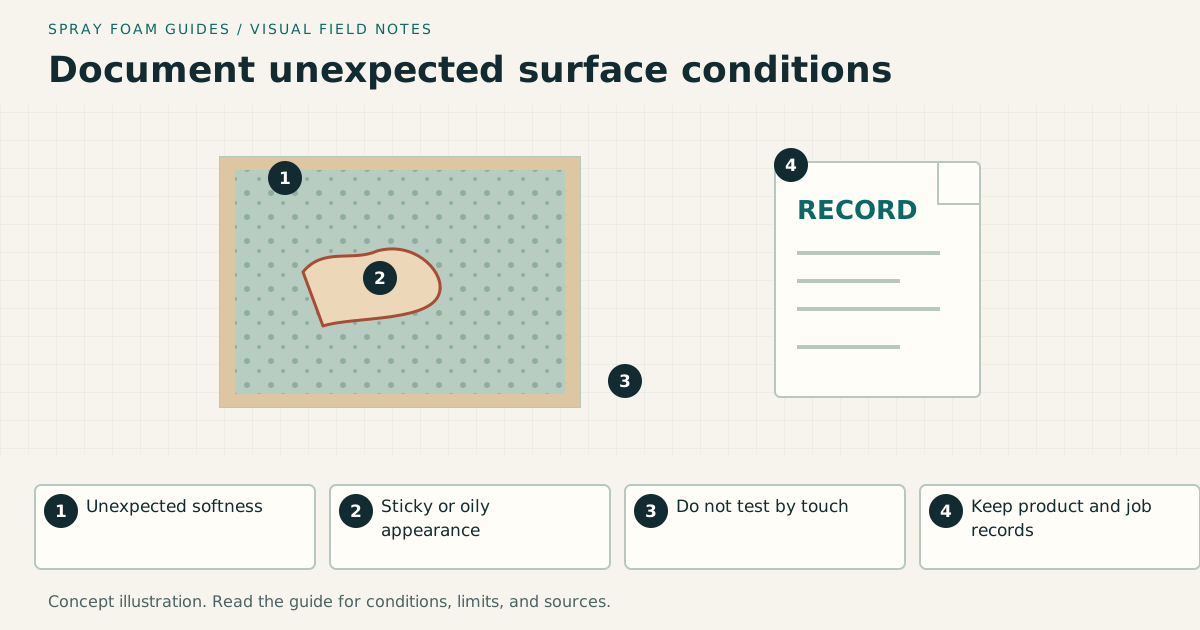
Some cured open-cell foams are flexible, so softness alone does not prove failure. Persistent tackiness, oiliness, unexpected texture, or breakdown after the documented cure period needs product-specific assessment before the material is disturbed or covered.
On this page
The short answer
For persistent tackiness, oiliness, unexpected breakdown, or accompanying symptoms, stop work and restrict access. Do not trim, heat, coat, or cover suspect foam. Document the product and pattern, then obtain manufacturer guidance and qualified assessment.
This answer changes when…
- The exact product cure time and environmental limits are known
- The failure is isolated to an edge or repeats across spray passes
- One- or two-component material was used
- Odor, discoloration, scorching, or health symptoms accompany softness
Dotted terms have plain-language definitions. Browse the glossary ↗
Compare with the intended material
Open-cell insulation can be semiflexible after curing; Natural Resources Canada’s material guide describes that physical distinction. We use this reference for material behavior only, not U.S. code requirements. Neither a hard surface nor a flexible surface establishes chemical cure or indoor-air safety.
Compare the observation with the exact formulation’s expected condition. Do not press bare fingers into suspect material as a test. Persistent oily or tacky areas, unexpected crumbling, substantial shrinkage, or accompanying symptoms warrant escalation.
What the symptom can mean
For two-component work, the investigation can review proportioning, mixing, material conditioning, nozzle performance, substrate conditions, and lift thickness. Building America’s quality-control guidance identifies several of these as installation checks. They are questions to investigate, not a diagnosis from texture.
For a product-specific example, DuPont’s Froth-Pak manual, Section 7, links incomplete cure or brittle foam to possible delivery imbalance in that kit. Its troubleshooting instructions belong to that system. Do not transfer them to an unknown installed foam or use them to identify an A-rich or B-rich mix from a photograph. A one-component product has no separately metered A-side and B-side flow at application; assess it against its own curing instructions.
Record whether the pattern follows a spray pass, a nozzle change, or a particular substrate. These observations help the manufacturer select what to investigate; they cannot identify an A-rich or B-rich mix from appearance. For smoke, unusual heat, or an active fire concern, leave the area and contact emergency services.
Build a timeline before trying to name the failure
Write down the installation date and the earliest time the unexpected condition was noticed. Add any available information about product changes, work interruptions, unusual weather, or another trade’s activity. Distinguish contemporaneous records from recollections gathered later.
Compare this timeline with the exact manufacturer’s cure and installation documentation. If that documentation is missing, the first task is to identify the material, not to substitute a generic cure interval. An unknown product remains unknown even if an online photograph looks similar.
For a homeowner, useful observations include the affected locations, whether the condition appears in adjacent bays, and whether it was already present before finishes were installed. Do not enter a restricted area or disturb foam to complete the record. Ask the responsible professional to collect information that requires access.
Separate flexibility from a suspect surface
Open-cell and closed-cell products have different expected physical characteristics, and individual formulations vary. A description such as “soft” needs context. Does the owner mean the expected flexible material, an oily-looking patch, persistent tackiness reported by the installer, or material that is visibly collapsing?
Use photographs and the installer’s documented observations to communicate that distinction. Avoid repeatedly touching, squeezing, or rubbing the foam as a cure test. A surface can look firm while an underlying area remains unevaluated, and a flexible cured foam can still be normal for its formulation.
Ask the manufacturer what acceptance criteria apply and who is qualified to check them. A written response should address the exact material and observed pattern rather than offer a general assurance about all spray foam.
Ask for records relevant to the system
For two-component work, request the contractor’s available equipment, material-conditioning, and application records, including any reported interruptions. For a one-component product, request the exact label, batch information, storage history, and documented application conditions. A homeowner need not interpret chemical balance or operate equipment to obtain these records.
Missing records do not prove a particular cause, but they limit what can be verified. Keep the distinction explicit in the assessment. An investigator may need further inspection or testing to answer a question that the original job log cannot resolve.
Do not infer which component was excessive from foam color. Likewise, do not treat a manufacturer’s list of possible causes as a confirmed diagnosis for the property. The assessment should state its evidence, conclusion, and remaining uncertainty separately.
Evaluate a proposed correction before authorizing it
Ask the contractor to describe the affected area, the reason material can be retained or must be removed, the approach to protecting occupants and adjacent surfaces, and the criteria for returning the area to use. Include restoration of substrate, insulation, and protective coverings in the scope.
A proposal to “seal in the smell” or apply another foam layer needs evidence that it addresses the actual condition. Concealing suspect material can make later investigation more disruptive. Increasing heat to force a cure is not a homeowner remedy and can introduce additional hazards.
If the parties disagree about the extent or condition, consider an independent assessor with relevant spray-foam and exposure experience. Ask the assessor what laboratory work, if any, would change the decision. The laboratory and collection method should fit the question; a random mailed fragment without a documented location and collection history may have limited value.
Decide what is needed for handoff
An adequate resolution should identify what was found, what was corrected, which material remains, and how completion was checked. Save the written manufacturer response, inspection report, repair records, and any revised occupant-return guidance. Keep a clear map of repaired areas for future trades.
Health symptoms require appropriate clinical attention separately from material acceptance. Leave possible exposure and seek medical advice promptly for breathing problems or other concerning effects; use emergency services for severe symptoms. Do not return merely to see whether symptoms recur. The isocyanate-exposure guide explains the distinction between medical advice and building investigation.
If the correction also involves widespread gaps or damaged finishes, coordinate those questions through the continuity guide and fire-protection guide. A texture complaint can require several disciplines, and the final record should show who resolved each part.
Research & references
Sources used for this guide
- Spray Polyurethane Foam Insulation: How to Use It More Safely (archived)U.S. Environmental Protection Agency · government guidance · United States · accessed 2026-09-05
- Ventilation Guidance for Spray Polyurethane Foam Application (archived)U.S. Environmental Protection Agency · government guidance · United States · accessed 2026-09-05
- Isocyanates: OverviewOccupational Safety and Health Administration · government guidance · United States workplaces · accessed 2026-09-05
- Potential Chemical Exposures From Spray Polyurethane Foam (archived)U.S. Environmental Protection Agency · government guidance · United States; archived guidance · accessed 2026-09-05
- Keeping the Heat In, Section 3: Insulation MaterialsNatural Resources Canada · government guidance · Canada; material description only, not U.S. code guidance · accessed 2026-09-05
- Unvented Conditioned Attic with Spray Foam Below the Roof DeckDOE Building America Solution Center · government guidance · United States · accessed 2026-09-05
- Froth-Pak Foam System Kit Instruction Manual, September 2025DuPont · manufacturer document · United States; exact-system example for yield and troubleshooting, not instructions for other formulations · accessed 2026-09-06
A citation supports a specific statement, not every possible assembly or local code interpretation.