Failure symptom: odor
Persistent Spray Foam Odor: What to Do and What to Document
Odor alone cannot identify a chemical or prove whether cured foam is acceptable. Persistent or strong odor, especially with irritation or breathing symptoms, warrants exposure reduction, documentation, product-specific guidance, and qualified assessment rather than masking the smell.
On this page
The short answer
If anyone has symptoms, leave the affected area and seek appropriate medical or emergency guidance. Do not heat, sand, cut, coat, or cover suspect foam to make the odor disappear. Isolate the area, ventilate only when it can be done safely, gather product records, and escalate to the manufacturer and qualified professionals.
This answer changes when…
- People or pets have eye, skin, throat, chest, or breathing symptoms
- Foam is unexpectedly soft, persistently sticky, unusually brittle, or discolored; appearance cannot establish mix ratio
- Odor is limited to the work area or is moving through HVAC and the home
- Product, lot, installer, ventilation, and application records are available
Dotted terms have plain-language definitions. Browse the glossary ↗
Immediate response
- Move occupants and pets away from the affected area when exposure or symptoms are possible.
- For severe breathing difficulty or another emergency, contact emergency services.
- Avoid disturbing the foam. Cutting, sanding, heating, or demolition can create new exposure.
- Prevent the HVAC system from distributing contaminants only if doing so is safe and consistent with professional guidance.
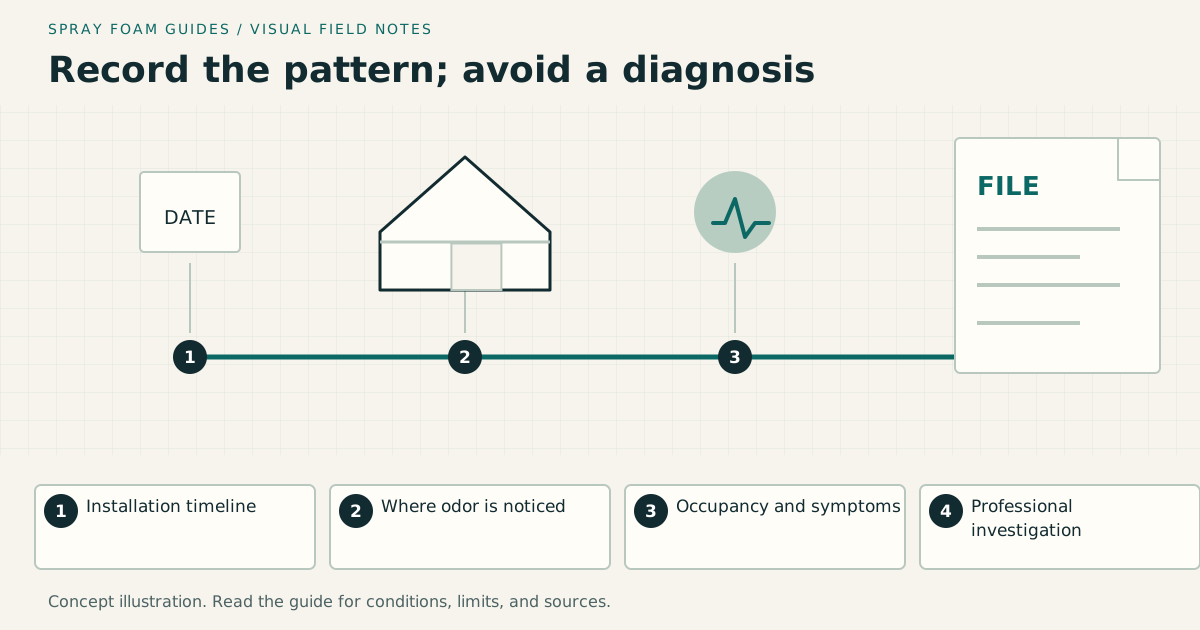
- Record when the odor appears, where it is strongest, and whether symptoms change by location.
Odor perception varies and is not a field test for chemical concentration. “It smells less today” also does not prove that suspect foam is correctly cured.
Gather the job record
Request:
- Product name, exact formulation, lot numbers, SDS, TDS, and label.
- Installer name, equipment or kit type, application date and time.
- Ambient, substrate, and material temperatures.
- Ventilation and containment plan.
- Lift sequence, thickness record, and photographs.
- Manufacturer cure and re-occupancy instructions.
This record helps the manufacturer, industrial hygienist, building professional, or remediation contractor distinguish possible sources and plan sampling or removal if warranted.
Do not use a universal re-entry time
EPA’s archived ventilation guidance ties safe re-entry and continued ventilation to the formulation, cure, ventilation, temperature, humidity, and manufacturer instructions. A generic “24 hours” statement cannot resolve a persistent-odor complaint.
EPA’s archived exposure discussion recommends qualified source investigation for unresolved concerns and does not establish a universal remediation protocol.
Make the first report factual and specific
Contact the installer and manufacturer with the job address, application date, exact product if known, affected locations, and a short chronology. State whether people reported symptoms and whether there are visible material concerns. Keep symptom details available for the clinician rather than asking the contractor to interpret them medically.
A useful report might say: “Odor was noticed in the upstairs hallway after the attic work. It was also noticed near the return grille. The installation record and written re-occupancy instructions have not yet been supplied.” That identifies observations and missing evidence without assigning a chemical cause.
Ask for a written response describing who will investigate, what records they need, and the interim access guidance. Preserve emails, job photographs, invoices, and document versions. Do not delay reducing exposure while trying to assemble a perfect file.
Keep an observation log without seeking exposure
Use information noticed during ordinary activity or reported by qualified personnel. Record the date, location, whether the building systems were operating as usual, and any relevant work that occurred. Do not repeatedly enter the affected space or intentionally sniff the foam to rate its intensity.
Odor descriptions are subjective. Their value is in showing timing and distribution, not identifying a chemical or measuring concentration. A change with weather or HVAC operation may help an assessor choose what to investigate, but does not establish a source by itself.
Include other recent products or work in the history, such as coatings, adhesives, new flooring, or cleaning treatments. This is not a reason to dismiss a foam concern. It helps the assessor avoid assuming that every smell after an installation has one origin.
Define the question before ordering air testing
Ask the assessor whether the first objective is identifying a source, evaluating a particular potential exposure, assessing migration, or supporting a return decision. Those objectives may require different methods and locations. Request an explanation of method limitations, laboratory reporting limits, and how conditions during sampling will be recorded.
A general consumer VOC display does not identify every compound relevant to a complaint. A single laboratory result also needs context: where and when it was collected, which substances were sought, and what comparison basis is being used. A number without that explanation is difficult to act on.
The assessor should explain what different outcomes would change. Would a result lead to further source investigation, a ventilation review, material evaluation, or a defined corrective scope? Avoid paying for a broad collection of numbers with no agreed decision attached.
Review remediation proposals for completeness
Ask what evidence supports the proposed source and affected extent. If removal is recommended, the scope should address containment, protection of adjacent areas, safe access, waste handling, substrate consequences, and restoration of the insulation and required coverings. It should also identify how the completed work will be evaluated.
Removal is not automatically the correct first step in every odor complaint. Equally, coating or covering the surface is not evidence that the source has been resolved. Seek an independent assessment when a proposed remedy is extensive, the source is uncertain, or the parties disagree about what the available evidence shows.
Avoid improvised heating, aggressive cleaning, fragrances, or chemical deodorizing as a substitute for investigation. Such changes can introduce new exposures and make the original conditions harder to assess. Discuss any proposed treatment with the responsible professional before it changes the evidence.
Close the complaint with explicit decisions
The final record should describe the investigated source, completed corrective work, remaining uncertainty, and the basis for access or re-occupancy guidance. Keep material records and any repair map for later maintenance. If someone still reports symptoms, seek clinical advice rather than asking them to validate the building by spending time inside.
For unresolved service disputes, local consumer-protection offices or the relevant contractor-licensing authority may be appropriate sources of process information. Their involvement does not replace an exposure or material assessment. Use ventilation and re-entry planning to keep the return decision tied to the actual product and conditions throughout the investigation.
Research & references
Sources used for this guide
- Spray Polyurethane Foam Insulation: How to Use It More Safely (archived)U.S. Environmental Protection Agency · government guidance · United States · accessed 2026-09-05
- Ventilation Guidance for Spray Polyurethane Foam Application (archived)U.S. Environmental Protection Agency · government guidance · United States · accessed 2026-09-05
- Isocyanates: OverviewOccupational Safety and Health Administration · government guidance · United States workplaces · accessed 2026-09-05
- Potential Chemical Exposures From Spray Polyurethane Foam (archived)U.S. Environmental Protection Agency · government guidance · United States; archived guidance · accessed 2026-09-05
A citation supports a specific statement, not every possible assembly or local code interpretation.