Material interfaces
Spray Foam Compatibility with Wiring and Plastic Pipe
“Spray foam” and “plastic pipe” each cover many formulations. Suitability depends on the exact foam, cable, pipe, fitting, cement, coating, temperature, geometry, and assembly. Obtain written evidence for the combination.
On this page
The short answer
Identify every product at the interface, repair damaged services, preserve access and heat clearances, and use exact compatibility and installation documents. Do not bury uncertainty in foam.
This answer changes when…
- Foam manufacturer, product, chemistry, application heat, cure, and intended use
- Cable, wire, conduit, box, connector, pipe, fitting, cement, insulation, and coating identity
- Service temperature, electrical load, bundling, movement, pressure, and future access
- Rated assembly, fireblocking, hot-surface, fixture, appliance, and penetration requirements
- Written compatibility, listing, evaluation, trade approval, inspection, and as-built record
Dotted terms have plain-language definitions. Browse the glossary ↗
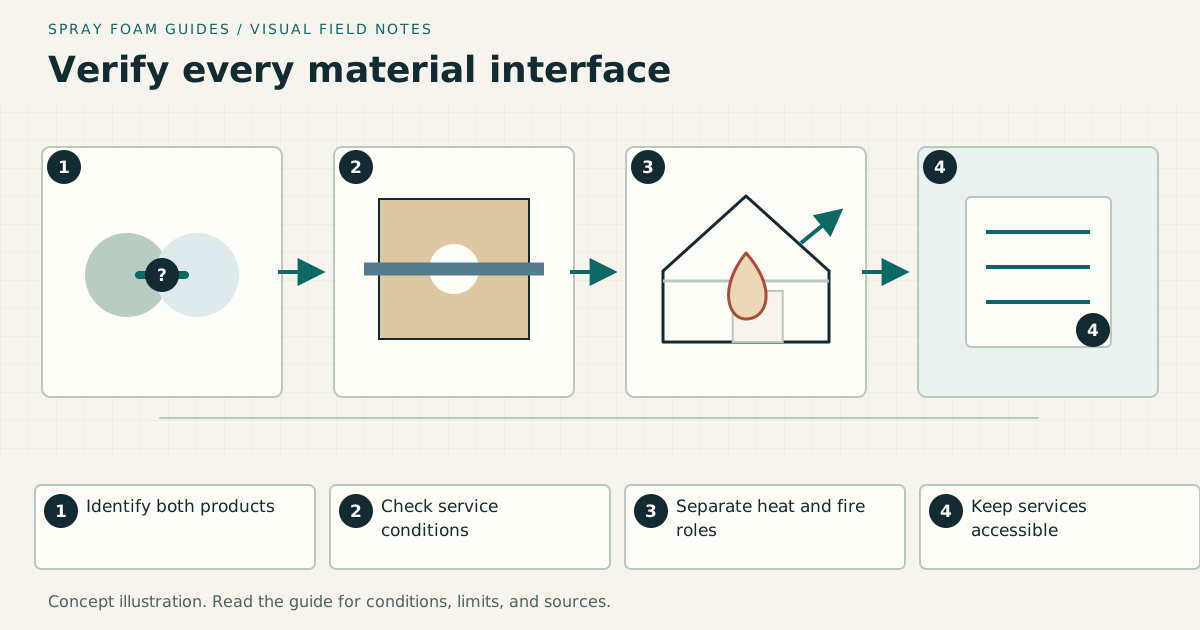
Identify both materials, then the service condition
A cable jacket can be PVC, polyethylene, rubber, or another compound. Plastic piping may be CPVC, PVC, PEX, ABS, polyethylene, or a system with proprietary fittings, cements, gaskets, coatings, and insulation. Spray products also vary. Category names cannot prove a particular interface.
Create an interface schedule that records the manufacturer and exact designation of every material touching the foam. Add service temperature, electrical load or pipe contents, movement, pressure, accessibility, and fire role. Ask both manufacturers for current written compatibility when their published documents do not address the combination.
Electrical questions extend beyond chemical compatibility
Wires produce heat under load, and bundling or thermal insulation can affect heat dissipation and allowable ampacity. The electrical designer or electrician must assess the installed wiring method. Do not cover damaged jackets, open splices, missing box covers, abandoned unidentified conductors, or junctions that must remain accessible.
| Interface | Questions before application | Stop condition |
|---|---|---|
| Cable through framing | Jacket, load, bundling, fireblocking, future pull | Damage, unidentified cable, or no compatibility evidence |
| Electrical box | Rating, fill, cover, heat, access, air-seal location | Foam entering box or burying accessible equipment |
| Recessed fixture | Insulation-contact listing and clearances | Unknown fixture or transformer condition |
| Plastic supply pipe | Resin, fitting system, temperature, movement, pressure test | Leak, unsupported pipe, unknown compatibility |
| Drain, waste, or vent pipe | Movement, cleanout, fire and acoustic role | Covered cleanout or untested joint |
| Pipe insulation or coating | Exact elastomer, adhesive, or jacket | Softening, staining, or absent written evidence |
Application and cure create temporary conditions
Two-component foam reacts and releases heat. Large masses, deep fills, rapid lifts, or material trapped in a closed volume can behave differently from the intended pass geometry. Follow the exact application limits and do not pour insulation foam into a blind service cavity.
Protect connectors, valves, labels, drains, weep paths, and service points. Overspray can enter equipment or adhere to parts that need replacement. A physical shield and clear photograph are more reliable than assuming trimming will restore access.
Fire roles require separate documents
An ordinary air seal, prescribed fireblocking detail, and listed penetration firestop system are different. Orange color and a “fireblock” name do not establish a rated system. Match the penetrant, assembly, annular space, backing, depth, and material to the accepted detail or listing. Resolve required protection over exposed foam separately.
Build an interface schedule
For each location record: assembly, service, exact service material, foam product, contact length or geometry, normal and maximum service condition, compatibility source, code or listing role, access requirement, responsible trade approval, photograph, and inspection result.
- Trace and identify services before concealment.
- Repair leaks, damaged wiring, unsupported pipe, and unsafe equipment.
- Obtain current documents for both sides of every material interface.
- Resolve electrical loading, pipe movement, heat, and fire requirements.
- Install blocking, sleeves, shields, or removable access before foam.
- Apply within exact pass, temperature, and geometry limits.
- Inspect services and test required systems before closure.
- Deliver the interface schedule and concealed-service map.
Stop if a manufacturer will not support the proposed contact, the service material cannot be identified, the line or circuit has not been tested, heat or fire conditions are unresolved, or the work would prevent maintenance. The right result is sometimes a separation layer, different sealant, listed collar, removable closure, or no foam at that location.
Research & references
Sources used for this guide
- Air Sealing Electrical WiringDOE Building America Solution Center · government guidance · United States; electrical air-sealing concepts and model-code links, subject to the actual assembly and local requirements · accessed 2026-09-07
- Air Sealing Plumbing and PipingDOE Building America Solution Center · government guidance · United States; penetration planning and blocking principles, not generic compatibility or firestop approval · accessed 2026-09-09
- The Code Authority Q&A: FireblockingUL Solutions · official standard portal · United States; distinction between fireblocking in concealed combustible spaces and listed penetration firestop systems, subject to the locally adopted code and accepted assembly · accessed 2026-09-08
- Technical DocumentsSpray Polyurethane Foam Alliance · official standard portal · United States industry guidance index; confirms distinct technical scopes, while full document access, exact system evidence, code acceptance, and site design remain separate · accessed 2026-09-09
- Isocyanates: OverviewOccupational Safety and Health Administration · government guidance · United States workplaces · accessed 2026-09-05
A citation supports a specific statement, not every possible assembly or local code interpretation.