Output and yield
Low Yield, Poor Expansion, or a Clogged Foam System: Record Before Adjusting
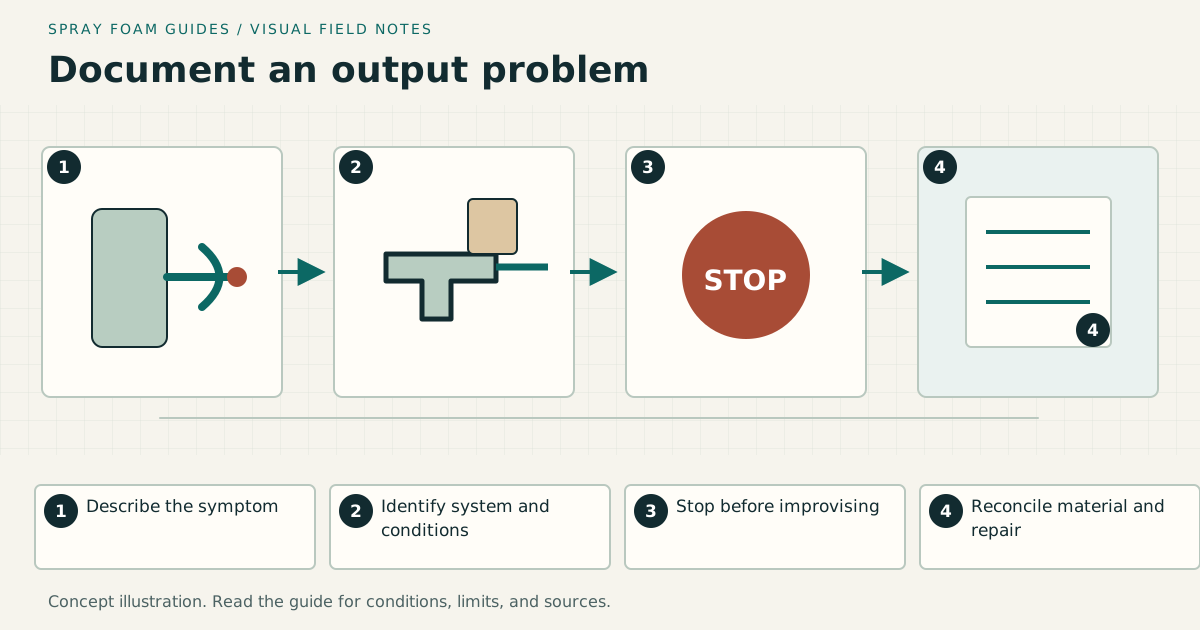
Low yield, weak expansion, sputtering, and clogged tips can come from different conditions. Stop, isolate the material, and compare the exact system, temperatures, dates, setup, and application record with current instructions.
On this page
The short answer
Do not compensate by adding uncontrolled material or changing undocumented settings. Stop safely, preserve labels and samples where appropriate, record the system and conditions, and follow the manufacturer or qualified applicator troubleshooting path.
This answer changes when…
- One-component can, two-component kit, or professional system and exact component identities
- Manufacture or expiration information, storage history, conditioning time, and container temperature
- Ambient and substrate conditions, moisture, cleanliness, geometry, and application sequence
- Pressure, hose, valve, gun, tip, ratio, spray pattern, pass, and pause observations
- Installed area, thickness distribution, waste, leftover material, cure observations, and disposition
Dotted terms have plain-language definitions. Browse the glossary ↗
Treat the symptom as a time-stamped observation
Write what happened without naming a cause: “output pulsed after a five-minute pause,” “the fan narrowed at 10:42,” or “measured coverage was below the planning estimate.” Add photographs and retain package identities. “Bad foam” and “cold kit” are conclusions that require evidence.
Yield printed on a package is a standardized or stated condition, not a promise of installed coverage. Substrate profile, thickness variation, temperature, technique, overspray, trimming, stops, and leftover material all affect the job. Use quantity as a reason to investigate, not proof of cure or performance.
Identify the dispensing system
| System | Common observation fields | Do not assume |
|---|---|---|
| Straw can | Can condition, valve, straw, orientation, shaking, pauses, bead | A clogged straw means the can chemistry failed |
| Controlled-dispenser can | Valve and reusable nozzle state, flow control, storage position | The delivery mechanism changes formulation limits |
| Threaded pro can and gun | Can-gun match, valve, adjustment, tip, cleaner, storage | Any cleaner or can fits any gun |
| Two-component kit | A and B identity, temperatures, hoses, valves, tip, flow balance | Equal-looking streams prove correct ratio |
| Proportioner system | Component temperatures, pressure, transfer, hose, gun, pattern | One setting applies to every product and condition |
Follow the exact manual before disconnecting, cleaning, purging, reheating, or disposing. Containers can remain pressurized and uncured components need controlled handling.
Separate five evidence groups
Identity and age: photograph product name, component side, lot or batch, date, label, and current instructions. Confirm that components belong together.
Storage and conditioning: record temperatures and time, not “kept warm.” Container temperature, ambient air, and substrate temperature are separate fields. Do not use improvised heaters outside the instructions.
Equipment and setup: record valves, hoses, connections, gun, nozzle, filters where applicable, pressure indications, and changes. Replace only parts permitted by the procedure.
Application: note start time, stops, spray or bead geometry, pass sequence, distance and orientation where the manual specifies them, and whether the pattern changed.
Installed material: map thickness, color, cell or surface appearance, tack, adhesion observations, odor, shrinkage, and affected area without diagnosing from any one sign.
Use a controlled stop
When output, ratio, pattern, temperature, odor, smoke, or installed appearance moves outside the instructions, stop application. Mark the last known acceptable location and isolate suspect material. Continuing can enlarge the removal area and erase the point where the change began.
Contact the manufacturer or system supplier with the complete record. A troubleshooting instruction that applies to a one-component gun should not be transferred to a two-component kit. Do not add a new layer over suspect material until its disposition is documented.
Reconcile planned and installed quantity
Calculate net sprayed area and measured average thickness by zone. List unopened, partially used, empty, and discarded containers; trimmed material; test spray; and overspray. Compare this material balance with the planning quantity. State measurement limitations and do not back-calculate density or thermal performance from package count alone.
Closeout steps
- Stop safely and control access.
- Preserve product, component, lot, and equipment identities.
- Record storage, conditioning, ambient, and substrate conditions.
- Map the timeline, pattern, output, and installed observations.
- Follow exact troubleshooting and safety instructions.
- Define removal, repair, or acceptance with supporting evidence.
- Inspect the corrected area before covering.
- Add the incident and final disposition to the owner record.
Escalate immediately for worker symptoms, fire, smoke, pressure or container damage, a suspected off-ratio two-component application, widespread soft material, or contamination outside the work zone. A clean nozzle after the fact does not clear material already installed.
Research & references
Sources used for this guide
- GREAT STUFF PRO Gaps & Cracks Insulating Foam Sealant InstructionsDuPont · manufacturer document · United States; exact legacy product-system setup, pause, storage, cleanup, and cure example, not transferable instructions or confirmation of current packaging · accessed 2026-09-09
- Froth-Pak Foam System Kit Instruction Manual, September 2025DuPont · manufacturer document · United States; exact-system example for yield and troubleshooting, not instructions for other formulations · accessed 2026-09-06
- JM Corbond IV Closed-Cell Spray Polyurethane Foam Installation GuideJohns Manville · manufacturer document · United States; exact-system examples of separate condition fields and substrate-dependent requirements, not universal limits or confirmation of the latest revision · accessed 2026-09-06
- Safer Workplace Practices for Spray Polyurethane Foam Installation (archived)U.S. Environmental Protection Agency · government guidance · United States; archived guidance · accessed 2026-09-05
- Hazard Communication Standard: Safety Data SheetsOccupational Safety and Health Administration · government guidance · United States workplaces · accessed 2026-09-05
A citation supports a specific statement, not every possible assembly or local code interpretation.