Moisture is not one problem
Spray Foam, Moisture, Condensation, and Drying Potential
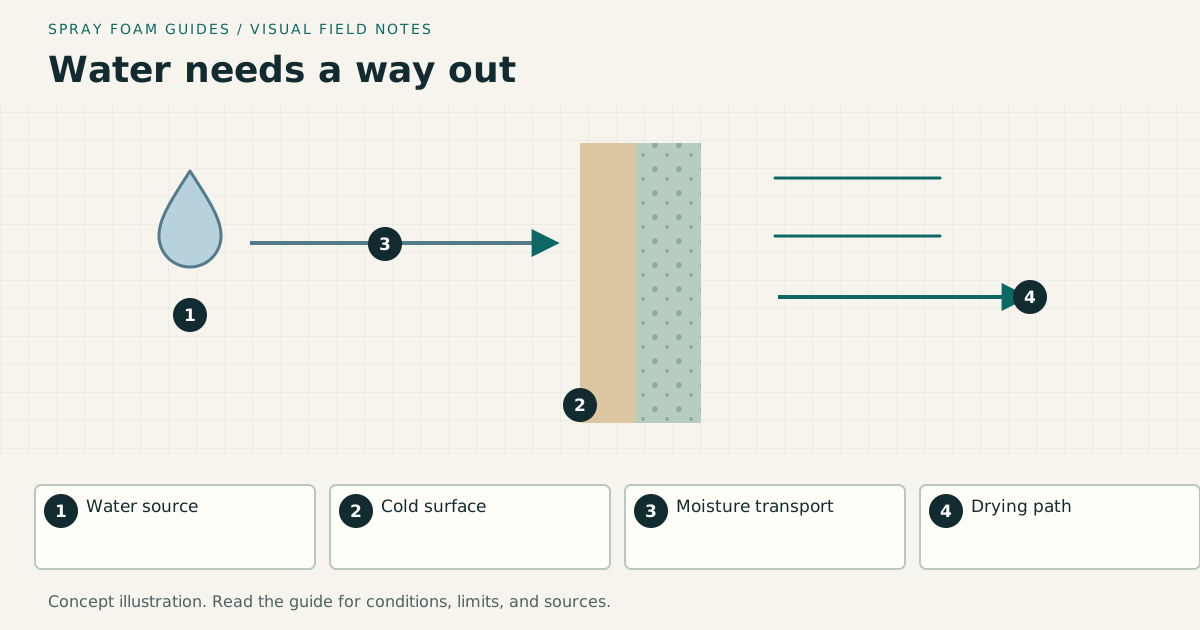
Moisture can enter through rain, leaks, soil, capillary movement, humid airflow, vapor diffusion, or wet construction materials. Spray foam may limit some air and vapor movement, but it does not remove the source or guarantee drying.
On this page
The short answer
Fix bulk-water and active moisture problems before insulating. Then design how the assembly will manage air, vapor, and incidental wetting over time. Foam should be one verified layer in that strategy, not a cover placed over unexplained staining, wet wood, mold, or leakage.
This answer changes when…
- The source is rain, plumbing, ground water, indoor humidity, or construction moisture
- Wood, masonry, or sheathing is currently wet or damaged
- The assembly can dry inward, outward, both ways, or neither way
- A roof or wall leak must remain observable and repairable
- Indoor humidity and mechanical ventilation are controlled
Dotted terms have plain-language definitions. Browse the glossary ↗
Diagnose the source before the material
| Moisture path | First control | Foam’s limit |
|---|---|---|
| Roof or wall rain leak | Drainage, flashing, roofing, cladding | Cannot make a defective exterior water-management system durable |
| Plumbing leak | Repair and verify | Can conceal the path or slow drying |
| Ground vapor or water | Drainage, capillary break, ground vapor and radon strategy | Wall foam does not replace ground control |
| Humid air leakage | Continuous air control and pressure management | Helps only where the layer is continuous |
| Vapor diffusion | Assembly-specific permeance strategy | Exact product and thickness matter |
| Wet materials | Dry, measure, investigate damage | Covering them can reduce visibility and drying |
Visible mold or decay is evidence of a water problem, not a reason to spray over the surface. EPA’s mold and moisture guide makes moisture control central to prevention.
Condensation is an assembly event
Condensation can occur when a surface falls below the dew point of nearby air. Insulation changes surface temperatures; air sealing changes airflow; vapor-retarding materials change drying. The risk cannot be inferred from foam type alone.
In roof assemblies, DOE Building America guidance calls for drainage protection, wood-moisture checks, ventilation or conditioning strategy, climate-specific vapor control, and local code review. Repeated roof leakage or elevated material moisture can overwhelm drying assumptions.
Preserve a drying path
Assemblies are routinely wetted by small construction errors and real-world events. Durable designs provide a path to dry and a way to inspect critical areas. Adding impermeable layers on both sides can turn a recoverable wetting event into concealed damage.
When the source is uncertain, stop. A hygrothermal model or qualified building-envelope assessment may be warranted for unusual, high-risk, or mixed assemblies.
Keep measurements tied to a question
Record the location, date, instrument, material, and conditions behind a moisture reading. A wood reading, room relative humidity, and evidence of a rain leak answer different questions. Record air temperature alongside relative humidity: the percentage changes with temperature and does not directly report moisture in wood or masonry. An isolated acceptable reading cannot establish that an intermittently leaking assembly is ready to cover.
Agree with the responsible professional on the acceptance criteria for the exact substrate and product. This guide does not supply a universal wood-moisture percentage or a climate-specific vapor-retarder design.
Separate a leak investigation from a condensation investigation
Start with timing. A stain appearing after wind-driven rain suggests a different investigation from dampness appearing during a cold spell or after a plumbing fixture is used. Record those associations without declaring a cause. More than one source can affect the same area.
Photograph a wide view and a close view, identify the location on a sketch, and note when the area was last dry. Have the relevant professional inspect roofing, flashing, plumbing, or drainage as indicated. A stain may be old, but age alone does not establish that the source has been repaired.
For suspected condensation, a building professional may compare indoor conditions, surface temperatures, air paths, and assembly layers. A room humidity reading is only part of that picture. Foam applied to a cold surface does not retroactively establish why the surface was wet, and it can make later investigation harder.
Three assemblies need different first questions
Below a roof deck: ask about roof age, past leaks, sheathing condition, and future access. If the roof covering is near replacement, coordinate that work before insulating beneath it. A roofline conversion also needs an attic humidity strategy; enclosing a volume does not automatically condition it.
At a foundation wall: determine whether water is entering through cracks or joints, rising from the ground, or arriving through humid air. Efflorescence, staining, and damaged finishes are observations for the investigation, rather than a specification for foam. The Building America foundation retrofit guide includes assessment and preparation of the existing wall.
Opening basement windows is not always a drying measure. Humid outdoor air can condense on a cooler wall, as PNNL’s moisture-metrics guidance explains. Evaluate outdoor dew point, interior surface temperatures, and the planned dehumidification or ventilation strategy before increasing outdoor airflow.
Above exposed crawlspace soil: examine drainage and ground moisture management as well as wall or floor insulation. Wall foam cannot cover the role of a ground membrane, drainage repairs, or an appropriate radon strategy. The crawlspace project guide separates a floor-boundary project from conversion to an unvented crawlspace.
The common task is to identify the source and the intended enclosure boundary. The corrective details differ considerably.
What “ready to insulate” should mean in the record
Ask for a written description of the investigated source, completed repairs, material condition, and acceptance criteria. Include the locations and timing of any measurements and who interpreted them. A statement such as “looks dry today” is less useful than a record tied to the known leak and the product’s substrate requirements.
Where drying is needed, agree on who verifies completion before the crew arrives. Leave room in the schedule for unresolved conditions. A contractor should be able to reject a surface on installation day without being pressured to cover it because finishes are booked for tomorrow.
Visible decay, ongoing leakage, unresolved mold, or measurements outside the specified acceptance conditions are reasons to pause insulation. Do not treat a proposed antimicrobial coating or foam layer as proof that damaged material is sound. Repair and remediation responsibilities belong in the scope separately.
Preserve the ability to notice a future problem
Before closing the assembly, document vulnerable connections and maintenance routes. Keep roof, plumbing, and insulation records together. Ask how a future roofer or plumber will gain access and what signs should trigger inspection, such as a new stain, recurring musty odor, or changed interior humidity.
Drying potential is a property of the complete assembly under particular conditions. A vapor-open layer can be blocked by another finish; a theoretically available drying direction can become ineffective if the surrounding air remains humid. Have the designer describe the intended path in plain language and identify any operating assumptions.
For unusual assemblies, a hygrothermal analysis can compare scenarios, but its result depends on weather data, material properties, initial moisture, and indoor conditions. Ask which uncertainties were tested. A model is most useful when it informs a clear construction detail and maintenance plan rather than serving as a general assurance that foam is safe everywhere.
Research & references
Sources used for this guide
- A Brief Guide to Mold, Moisture and Your HomeU.S. Environmental Protection Agency · government guidance · United States · accessed 2026-09-05
- Home Air Sealing ChecklistDOE Building America Solution Center · government guidance · United States · accessed 2026-09-05
- Unvented Conditioned Attic with Spray Foam Below the Roof DeckDOE Building America Solution Center · government guidance · United States · accessed 2026-09-05
- Building Enclosure: Air Barriers vs Vapor BarriersDOE Building Science Education · government guidance · United States; educational control-layer concepts · accessed 2026-09-05
- Spray Foam Interior Insulation for Existing Foundation WallsDOE Building America Solution Center · government guidance · United States; existing foundation walls · accessed 2026-09-05
- Moisture MetricsDOE Building America Solution Center · government guidance · Moisture definitions and vapor-pressure transport; no generic design target inferred · accessed 2026-09-06
A citation supports a specific statement, not every possible assembly or local code interpretation.