Environmental evidence
Spray Foam Environmental Impact and Blowing Agents: Compare Complete Claims
Environmental impact depends on what is counted: raw materials, blowing-agent emissions, transport, installed quantity, service life, operational energy, repairs, replacement, and disposal. One number cannot answer every scope.
On this page
The short answer
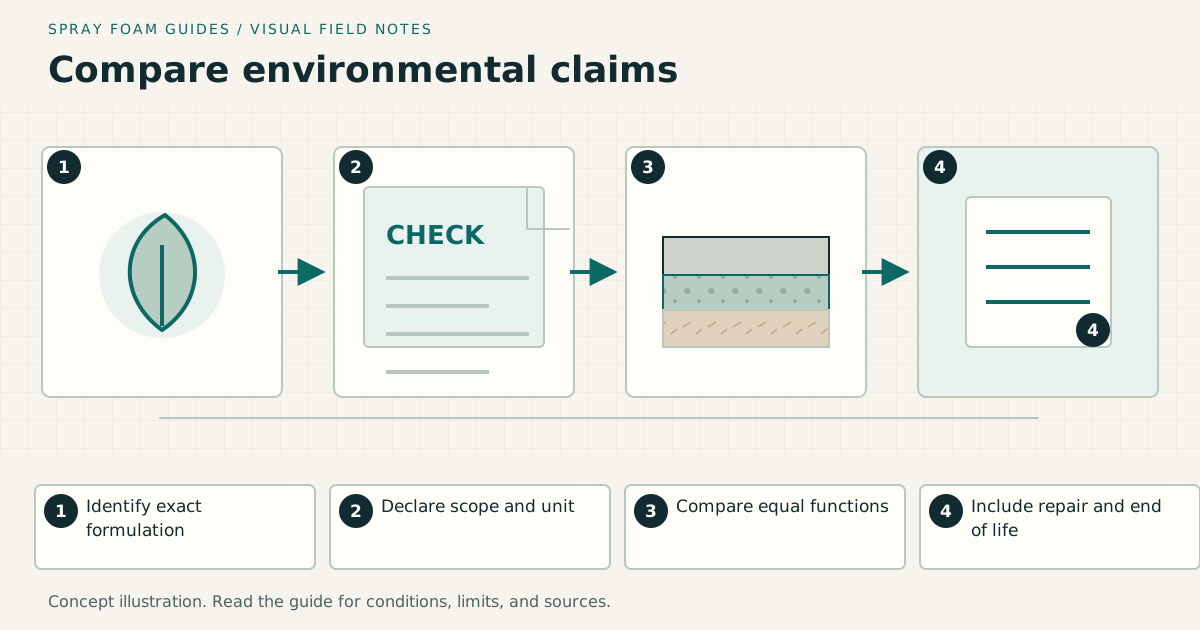
Ask for the exact product, formulation, date, declared unit, life-cycle stages, assumptions, and third-party document. Compare equal building functions and include durability, repairability, waste, and plausible operating scenarios.
This answer changes when…
- Exact product, formulation, blowing agent, market, manufacture date, and evidence date
- Declared unit, system boundary, life-cycle stages, service life, and end-of-life assumptions
- Installed thickness, density, waste, yield, accessories, finishes, and replacement
- Baseline assembly, climate, air leakage, HVAC, energy source, and operating assumptions
- Leakage, repair, renovation, removal, reuse, recycling, and disposal realities
Dotted terms have plain-language definitions. Browse the glossary ↗
State the boundary around the claim
“Lower impact” can refer to one blowing agent, one kilogram of product, one square foot at a given thermal resistance, a complete wall over a service life, or modeled building operation. These are different claims. Write the comparison question and functional unit before reading a headline number.
EPA’s foam blowing-agent substitutions and rigid polyurethane spray listings are current regulatory resources that can change. Check the current listing for the exact end use and date. A chemical’s listing is not a complete product life-cycle assessment or installation approval.
Verify the exact formulation
Product family names may persist while formulations change. Obtain current technical data, safety data, environmental product declaration if available, and a written blowing-agent identification for the actual product and market. Record revision dates and manufacturing information. Do not infer chemistry from “open-cell,” “closed-cell,” color, or marketing terms such as “eco.”
| Claim | Minimum context | Frequent comparison error |
|---|---|---|
| Blowing-agent global-warming value | Chemical identity, time horizon, source, formulation share | Applying one agent value to the entire installed system |
| Embodied impact | Declared unit, stages, product density, thickness, waste | Comparing equal thickness instead of equal function |
| Operational savings | Baseline, climate, leakage, HVAC, energy, behavior | Promising a universal percentage |
| Long service life | Exposure, protection, maintenance, repair, building changes | Treating theoretical durability as verified service life |
| Low waste | Packaged quantity, installed yield, trimming, leftovers, disposal | Using nominal yield as installed coverage |
| Recyclable or reusable | Real separation and local outlet | Counting a theoretical pathway unavailable at the project |
Compare assemblies that perform the same job
If one option provides air control and insulation while another requires a membrane, tapes, fasteners, and separate insulation, include the needed components for both. Compare the same thermal, air, water, vapor, fire, acoustic, and structural functions over the same area and study period.
Installed thickness and density determine material quantity. Framing and discontinuities affect whole-assembly performance. Use transparent low, central, and high operating scenarios instead of presenting one modeled future as a measurement.
Durability and repair can dominate the result
An assembly that keeps bulk water out, dries as designed, and can be inspected may last longer than one with a favorable product number but hidden leakage. Bonded foam can complicate separation, roof-deck replacement, panel repair, or recovery of other materials. Include likely renovations and component service lives.
Overspray, off-ratio work, damaged substrate, unused kits, containers, protective equipment, and removed material belong in the waste plan. Follow product and local disposal requirements. Do not claim recycling without a real receiving pathway.
Build a procurement evidence sheet
- Define the building function and reference assembly.
- List complete components and installed quantities.
- Collect exact, dated product and environmental documents.
- State life-cycle stages and exclusions.
- Model building operation with disclosed inputs and ranges.
- Add maintenance, repair, replacement, and end-of-life scenarios.
- Test sensitivity to service life, leakage, energy source, and waste.
- Record uncertainties and decide which claims may be published.
Stop when a claim lacks an exact product, date, declared unit, comparable function, or traceable source. Also stop when a seller turns a regulatory listing into “non-toxic,” treats absence of one chemical as proof of overall benefit, or guarantees energy savings without a measured baseline and model. A defensible environmental comparison can be modest and still useful because its boundary is clear.
Research & references
Sources used for this guide
- Substitutes in Foam Blowing AgentsU.S. Environmental Protection Agency · government guidance · United States; current SNAP end-use and policy context, not a product life-cycle assessment or broad environmental ranking · accessed 2026-09-09
- Substitutes in Rigid Polyurethane: SprayU.S. Environmental Protection Agency · government guidance · United States; current substitute listings and restrictions by end use, not identification of an installed product formulation · accessed 2026-09-09
- Choosing the Appropriate Insulation TypeENERGY STAR · government guidance · United States · accessed 2026-09-05
- Labeling and Advertising of Home Insulation: 2018 Final Rule NoticeFederal Trade Commission · official standard portal · United States; 2018 rule explanation, not a current legal review · accessed 2026-09-05
A citation supports a specific statement, not every possible assembly or local code interpretation.